The Scattering of Time
Subtitle: Geometric Reconstruction: From Bits to the Universe
This is a journey about re-examining the ontology of the universe. Since we are writing in the style of A Brief History of Time, we will touch upon those deep structures hidden beneath the appearance of reality not only through equations, but also through metaphors and intuition.
System Architecture Diagram
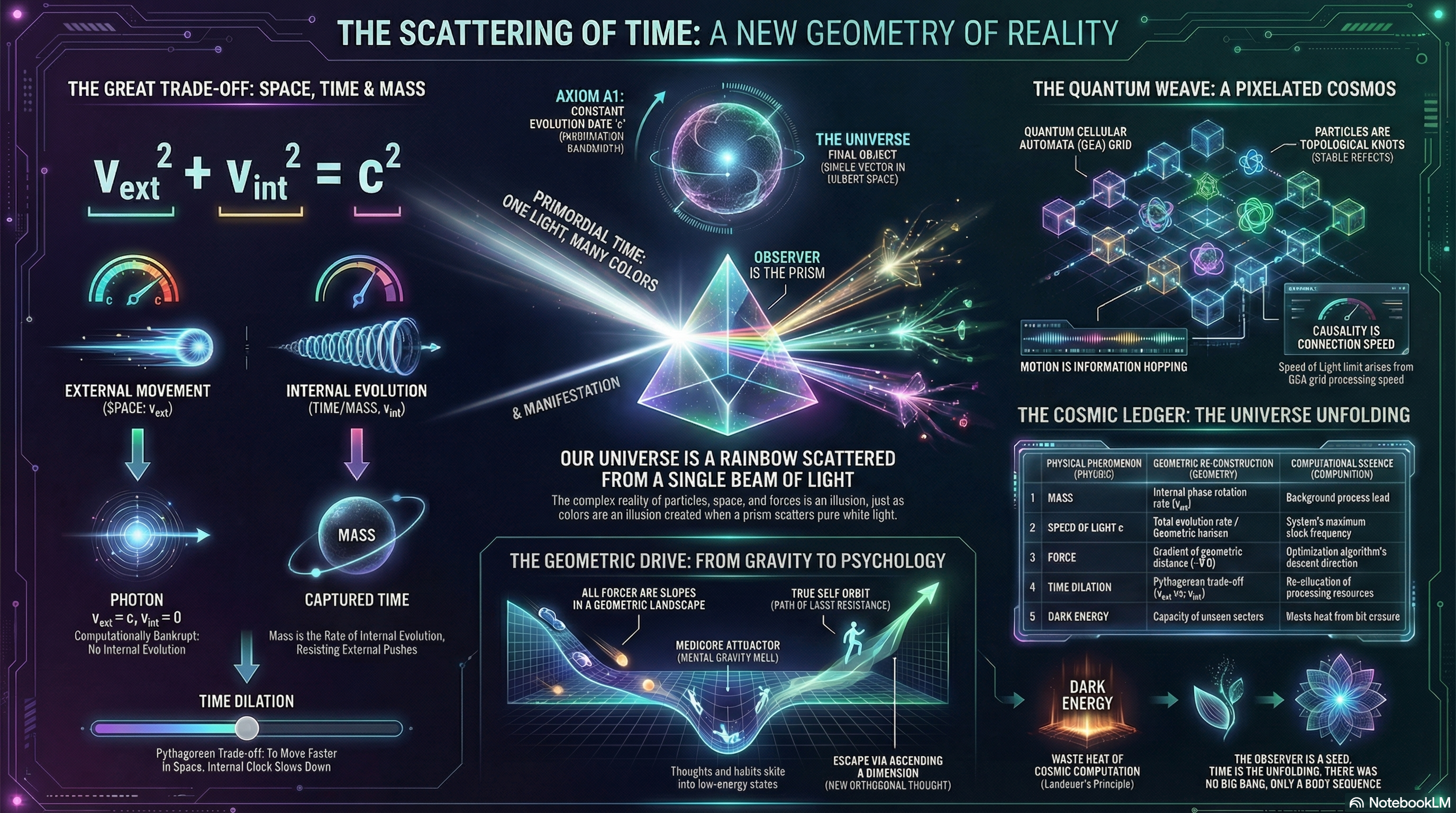
Complete Documentation
Preface
Book Structure
Part I: Silent Passage
Chapter 1: Afternoon in Hilbert Space
Chapter 2: Time Before Time
Part II: The Great Dispersion
In Part I, we established the universe’s ontology: a state vector evolving at constant rate in Hilbert Space. But this is only the background of the story. In the foreground, in our sensory world, this unified rate is scattered. It splits into what we see as “spatial displacement” and “temporal flow.”
This splitting is the origin of all motion and change in physics.
Chapter 3: Pythagoras Rules the Universe
Chapter 4: The Weight of Time
Chapter 5: The Bankruptcy of the Photon
Part III: The Knots of Time
In this part, we will no longer view time as a continuously flowing river, but as a digital sequence composed of countless tiny beats. We will discover that so-called material particles—electrons, quarks, photons—are not independent entities floating in void, but special topological structures on the underlying computational grid. They are “dead knots” in the flow of time.
Chapter 6: The Underlying Pixels
Chapter 7: Particles as Defects
Chapter 8: Resonance as Residence
- 8.1 The Function: Bridge Between Micro and Macro
- 8.2 Residence is Existence
- 8.3 Geometric Saturation
Part IV: The Drive of Geometry
We have built the universe’s static structure: Hilbert Space is the stage, light speed is bandwidth, particles are knotted pixels. Now, we need to make this world move. Why do objects attract each other? Why are there “trends” and “directions”? We will discover that so-called “forces” are not invisible hands, but a kind of tilt of geometric structure itself.
Chapter 9: The Unified Definition of Force
Chapter 10: The Mediocre Attractor
Chapter 11: Distance to the True Self
- 11.1 The Orbit of the True Self
- 11.2 The Physics of Awakening
- 11.3 The Mechanism of Breaking the Loop
Part V: Infinite Unfolding
In the previous chapters, we have built a complete geometric universe model. Now, we will face the deepest implications of this model: the relationship between observers and the cosmic noumenon. We will discover that the universe is not an external container, but an internal hologram being “decompressed” by us.
Chapter 12: Noise of Vacuum
Chapter 13: Seed Expansion
- 13.1 The Observer as Seed
- 13.2 The Growth of Dimensions
- 13.3 The Geometric Explanation of Multiverse
Epilogue: The Silent Geometry
Technical Appendices
In the previous chapters, to maintain narrative flow, we used many metaphors—“budget,” “bandwidth,” “knots.” Here, we remove the literary veil and reveal the hard mathematical skeleton supporting these metaphors. These derivations are primarily based on Fubini-Study geometry, spectral theory, and the formal axiomatic system of Quantum Cellular Automata (QCA).
- Appendix A: Reconstruction of Minkowski Metric from Geometric Evolution Circle
- Appendix B: Dispersion Relation and Lorentz Violation in Dirac-QCA
- Appendix C: Proof of Scattering Time Delay
- Appendix D: Relativistic Bound on Observer Mutual Information
- Appendix E: Fubini-Study Distance and Generalized Force
(End of Book)