7.3 Symmetry as Backup
When we examine the Standard Model—that physics edifice describing all known elementary particles—we find it built on strange mathematical groups: . Physicists call these “gauge groups.”
Usually, these groups are seen as parameters arbitrarily set by God. But in our geometric reconstruction, they are not arbitrary; they are inevitable corollaries of capacity conservation.
Internal Rotation
Let us return to our core axiom: the universe is a total bandwidth-limited system. Every particle is a vector in Hilbert Space, its total length must be constant .
In Chapter 4, we defined mass as internal evolution rate . But this “internal” is not a simple black box. Just as your computer hard drive has one “total capacity” indicator but is internally divided into C, D, E drives, particles’ internal space also has fine structure.
In our model, to accommodate the complexity observed in the Standard Model, we must accept an empirical assumption (H7): the universe’s “internal fiber” at every spatial point has structure.
-
corresponds to color degrees of freedom (strong interaction).
-
corresponds to weak isospin degrees of freedom (weak interaction).
-
corresponds to phase degrees of freedom (electromagnetic interaction).
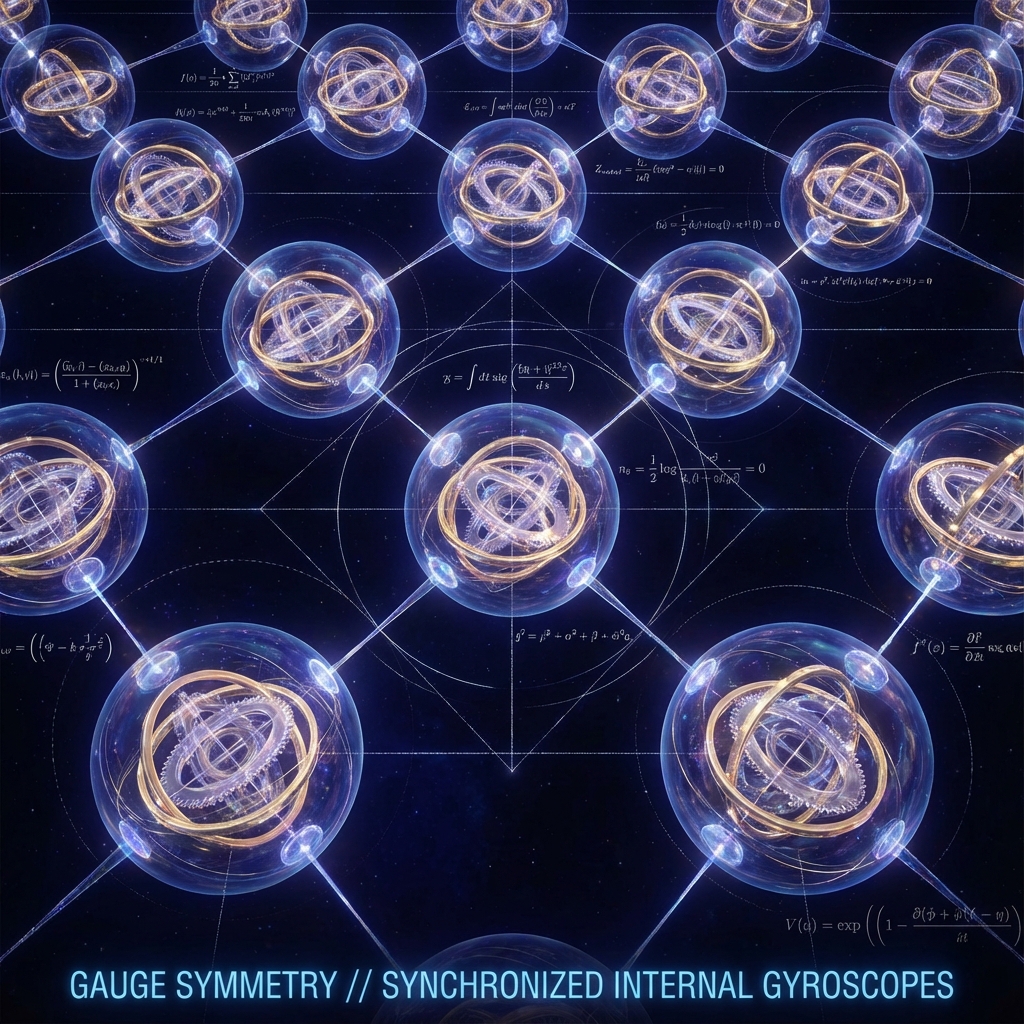
This is like every particle internally containing a precise gyroscope system with three independent rotation axes.
The key point: For the universe’s total background, it only cares how much total bandwidth (energy) you consume, not how you consume it.
This is like shopping at a supermarket; the cashier only cares that the total is 100 yuan, not whether you gave two 50-yuan bills, one 100-yuan bill, or WeChat payment. As long as total value (norm) is unchanged, payment method (internal state) can vary freely.
This “free variation of payment methods” is the famous gauge symmetry (Gauge Symmetry) in physics.
Isometric Transformations
In geometric language, this is called isometric transformations (Isometry).
Imagine a sphere. No matter how you rotate it, its radius (representing consumed bandwidth ) doesn’t change. Gauge groups , , are precisely the sets of rotation operations that can keep “internal geometric capacity” unchanged.
-
When we rotate the “color” axis in internal space (quarks change color), as long as rotation is unitary, the particle’s total computational resource consumption doesn’t change.
-
When we rotate the “phase” axis (electrons change phase), the particle’s mass and energy also don’t change.
Therefore, the Standard Model’s symmetry groups are essentially redundancy allowed by the universe to maintain computational capacity conservation. They are “degrees of freedom” within the system, allowing particles to flexibly adjust their internal configuration without breaking the total budget.
Gauge Fields: Balancing the Books
But what happens if we rotate the gyroscope left here and right there in the universe?
This causes local inconsistency. To compensate for this inconsistency, to maintain global geometric connection while “everyone freely rotates internal coordinate systems,” the universe must introduce a compensation mechanism.
This compensation mechanism is gauge fields (Gauge Fields)—photons, gluons, and W/Z bosons.
From our geometric perspective, gauge bosons are not “force” carriers; they are geometric connectors (Connections). Their role: when you twist local internal coordinate systems, they bend external geometric paths to offset this twist, ensuring total geometric capacity (Action) is conserved.
So why do photons exist? Because the universe allows us to freely change electron phase anywhere ( symmetry). To prevent this free change from breaking physical laws, photons must exist as a “patch” to correct phase differences.
Structure as Destiny
Thus far, we have completed the reconstruction of matter’s microscopic structure.
-
Particles: Not entities, but topological dead knots (defects) on spatial fabric.
-
Mass: Not weight, but time loops locked inside dead knots ().
-
Interactions: Not push-pull, but geometric compensation (gauge fields) that must exist to maintain internal geometric capacity conservation.
The material world we see—complex periodic table, brilliant chemical reactions—is essentially just kaleidoscopic patterns projected by that simple geometric ontology ( conservation) onto complex internal topological structures.
God did not design the Standard Model; rather, if you want to tie stable knots on a discrete, bandwidth-limited grid and allow these knots to freely rotate without collapsing, you must have this mathematical structure as support.
This is the end of Part III. We have dismantled the stage (spacetime) and the actors (matter). Now, we must make these actors move. We must see what happens when these time-knots carrying complex internal structures approach, collide, and entangle.
That is not just force action; that is temporal resonance.
(Next, we will enter Part IV “Geometric Driving Forces,” starting from Chapter 8 “Residence and Resonance,” revealing the temporal essence of interactions.)