11.1 The Orbit of the True Self
“Be yourself.”
This is probably the most repeated advice in human history, and also the most confusing. Which self? The one who wants donuts, or the one who wants six-pack abs? The one who fears the unknown, or the one who craves adventure?
In psychology and philosophy, the “true self” is often a vague, poetic concept. But in our geometric reconstruction, we can give it a precise mathematical definition.
Let us return to Hilbert Space. Here, you are not a static point; you are a trajectory (Trajectory) extending with time . Every thought, every decision, every tiny physiological change moves you a little in this infinite-dimensional space.
Among countless possible future paths, does a special path exist?
Global Optimum
In physics, light always chooses the path taking shortest time (Fermat’s principle); objects always choose paths with least action (principle of least action). The universe is an ultimate optimization algorithm.
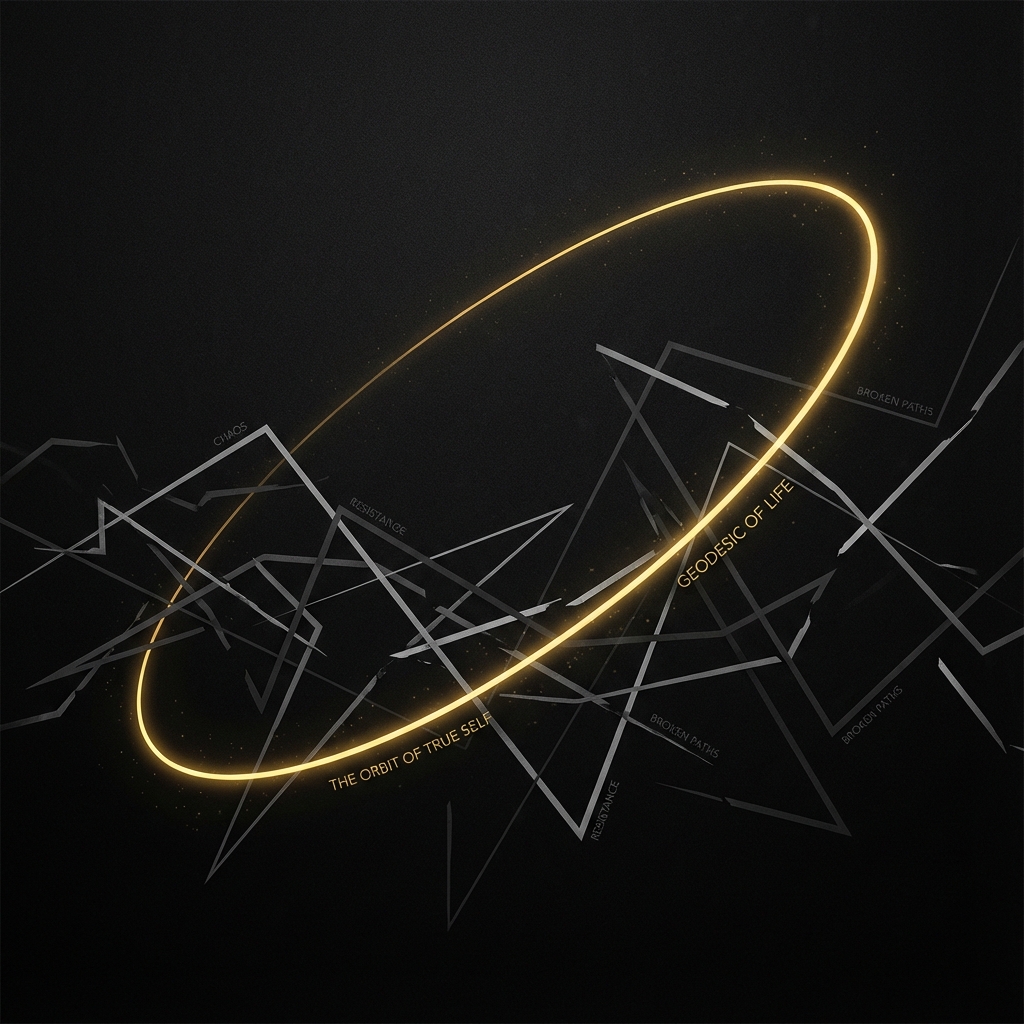
Similarly, for a conscious observer, there exists a life trajectory conforming to the “least action” principle. We define this special trajectory as the orbit of the true self ().
It is not the path making you most comfortable (that’s the mediocre attractor); it is the path with highest global self-consistency.
-
Local self-consistency (mediocre): For immediate comfort, you tell a lie or avoid a challenge. Right now, your stress is minimal. But in the future, you need countless new lies to cover this one, or long mediocrity to repay this moment’s avoidance. You create huge geometric distortion in time’s long river.
-
Global self-consistency (true self): You make a difficult decision causing present pain (high ). But this makes your internal model and external reality achieve harmony over longer time scales.
Therefore, the “true self” is not some mysterious entity hidden in your body; it is that geodesic with lowest energy loss and straightest geometric path in Hilbert Space.
Geometric Resonance
Why does walking on the true self orbit make us feel “meaning”?
In Chapter 8, we discussed “resonance”—when particles’ internal frequency matches external field frequency, energy transfer is most efficient.
The true self orbit is essentially a resonant state of existence.
When observers’ internal evolution vector (, your values, abilities, passion) perfectly aligns with external environment’s geometric structure (universe’s needs, era’s waves), resistance disappears.
In this state, you are no longer swimming against the current; you become part of the river. Your actions no longer consume extra willpower (bandwidth) because you are following the universe’s underlying evolution trend. Psychologist Csikszentmihalyi calls this state “flow”; in our geometric language, this is tangent vector coinciding with geodesic.
The Cost of Deviation
However, most of the time, we are not on that orbit.
We are pushed off the true self orbit by social inertia, parental expectations, or our own fears. We “deviate” in Hilbert Space.
This deviation has cost. According to the force formula we established in Chapter 9, , any deviation produces a restoring force.
-
Physically: Stretching a spring produces elastic force.
-
Psychologically: Deviating from true self produces tension.
This tension doesn’t always manifest as explicit pain; more often it appears as vague “something wrong”—background noise-like anxiety, emptiness, or inexplicable fatigue.
This is not mental illness; it is a geometric signal. Your internal navigation system is alerting: between your current state vector () and your should-be state vector (), there exists a huge angle.
This angle is the Fubini-Study distance.
So, “finding the true self” is not traveling to Tibet or meditating. It is a geometric calibration process. Through constant trial and adjustment, realigning your current evolution direction with that globally optimal geodesic.
But since the true self orbit is so superior, why is it hard to find? Why do we easily slide back to mediocre attractors?
Because the true self orbit usually lies in “high-dimensional” space. In low-dimensional vision, it looks like a dead end or cliff. Only when we learn “dimensional elevation”—introducing new observation dimensions—can we see that hidden shortcut.
This is the theme of the next section—The Physics of Awakening. We will explore pain’s geometric essence and how it acts as kinetic energy pushing us toward high-dimensional orbits.
(Next, we will enter section 11.2 “The Physics of Awakening,” analyzing anxiety and pain’s functions from geometric perspective.)