10.3 The Gravity of the Ego
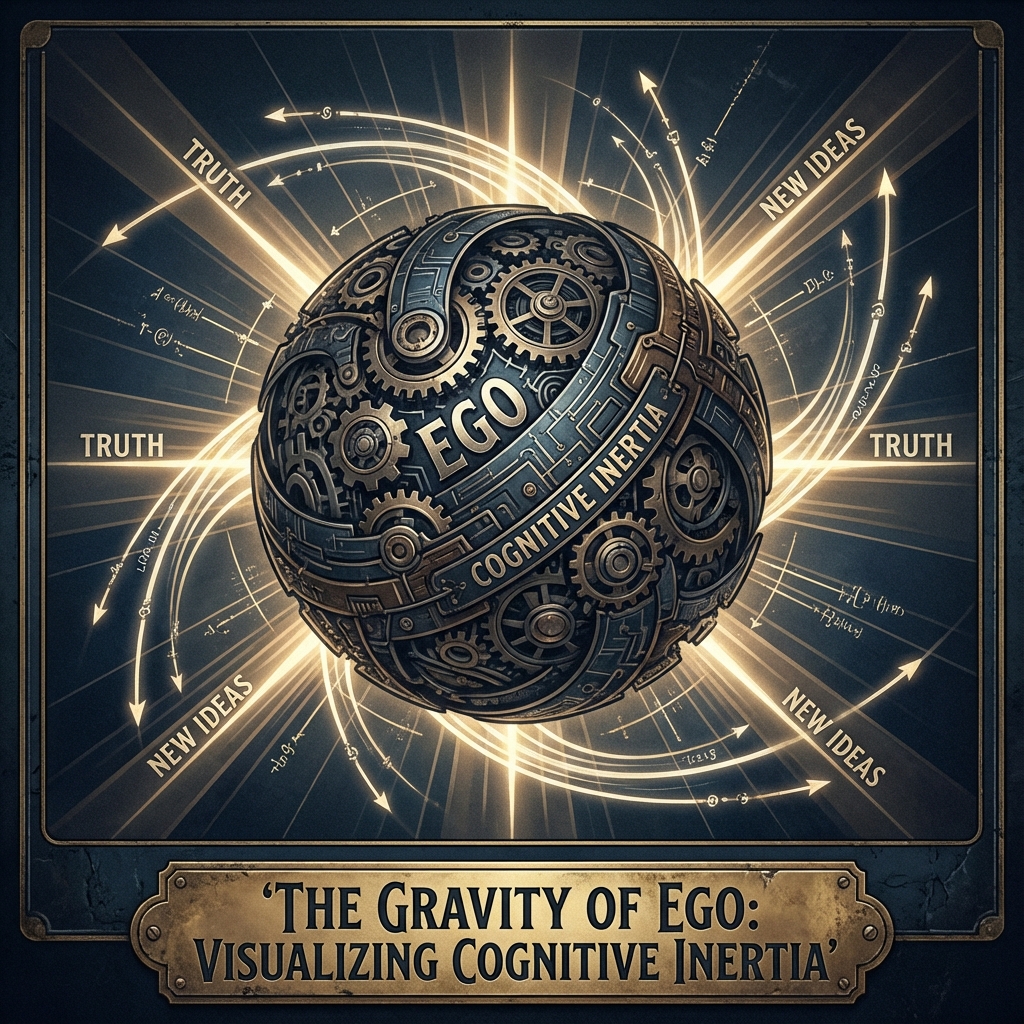
If “strange loops” are cages observers build for themselves, what force makes this cage so strong, even making those inside fall in love with it?
In physics, we know massive objects produce gravity, bending surrounding spacetime. In our geometric reconstruction, that stable, dense logical core formed by observers’ long-term operation in strategy space—what we usually call the Ego (The Ego)—has the same property.
It has mass, it has inertia, it even has its own horizon.
The Mass of Beliefs
Let us recall Chapter 4’s core insight: Mass is imprisoned time. An object is heavy because it invests all evolution bandwidth () the universe grants it into internal cycles ().
This principle also applies to the mental world.
What is the “self”? The self is not an entity; it is a highly structured, self-referential loop of memories and beliefs.
-
When you hold a prejudice, you are not “possessing” a view; you are running a view.
-
Your brain constantly consumes energy (bandwidth) to maintain this view’s logical self-consistency, to resist external counter-evidence.
The more complex and persistent this maintenance process, the more “internal evolution” this belief system accumulates in Hilbert Space. In other words, your prejudice has mass.
This explains why changing someone’s mind is so difficult—it’s like trying to push a boulder. The resistance you encounter is essentially cognitive inertia (Cognitive Inertia).
According to our “resource contention mechanism,” to change a deeply rooted belief (acceleration), observers must withdraw resources from maintaining old beliefs’ budget. But this triggers intense internal conflict. The old “self” resists this resource reallocation because it feels survival threat. Geometrically, this manifests as huge restoring force, trying to pull observers back to mediocre attractor’s valley bottom.
The Gravitational Lens of Information
This “self’s mass” not only produces inertia; it also bends surrounding information fields.
In general relativity, massive objects bend light like lenses. In our geometric universe, the “self” is also a gravitational lens.
When objective truth-light (Raw Data) shoots toward observers, it should propagate straight. But when it passes near that dense “self,” light bends.
-
Distortion: Information matching self-expectations is focused and amplified; information contradicting self-expectations is diverged and ignored.
-
Blind Spot: Just like shadow zones behind black holes where light cannot reach, behind powerful self-gravity exist huge cognitive blind spots. Truth exists there, but truth’s light is bent around by your prejudice.
This forms a geometric explanation of echo chambers (Echo Chamber): it’s not a wall; it’s a high-curvature spacetime region. Within it, all sounds eventually bend back, pointing to the sound’s source.
The Horizon of the Mind
When this gravity becomes extreme, the most terrifying structure appears—black holes of the mind.
For some observers trapped in extreme fanaticism or closed systems, their strange loops rotate so fast, their invested “internal evolution rate” so high, that an event horizon (Event Horizon) forms around them.
Inside the horizon, logic is completely self-consistent, even perfect. But outside the horizon, no new information can penetrate.
-
External challenges (light) fall into the horizon, instantly torn apart by huge gravity, converted into fuel strengthening black hole mass (“See, their attacks prove my greatness”).
-
Internal signals cannot escape; observers lose all causal connection with the real universe.
This is mediocre attractor’s ultimate form: collapse.
A collapsed observer, though biologically alive, in our geometric reconstruction has cut themselves from the universe’s open evolution. They become an isolated dead node that no longer computes new information.
Escape Velocity
Facing such powerful gravity, do we still have hope?
Rockets must reach first cosmic velocity to escape Earth. Observers need enormous energy to escape the “self’s” gravitational well.
This energy usually comes from pain.
Pain is a signal that (distance between reality and expectation) increases sharply. When pain is sufficient, it shatters original strange loops, forcing system budget reallocation restart.
But this is only passive. There’s a more elegant, more active way—dimensional elevation we’ll discuss in the next chapter.
Since running on two-dimensional ground can never escape gravity’s grasp, why not try to take off?
We are about to leave this heavy, gravity-filled Chapter 10. Ahead is Chapter 11, where there’s a path to higher ground, a path that’s steep but leads to freedom—that true self orbit belonging to you in Hilbert Space.
(Next, we will enter Chapter 11 “Distance to True Self,” formally exploring how to break loops and achieve geometric transitions.)