10.2 Strange Loop
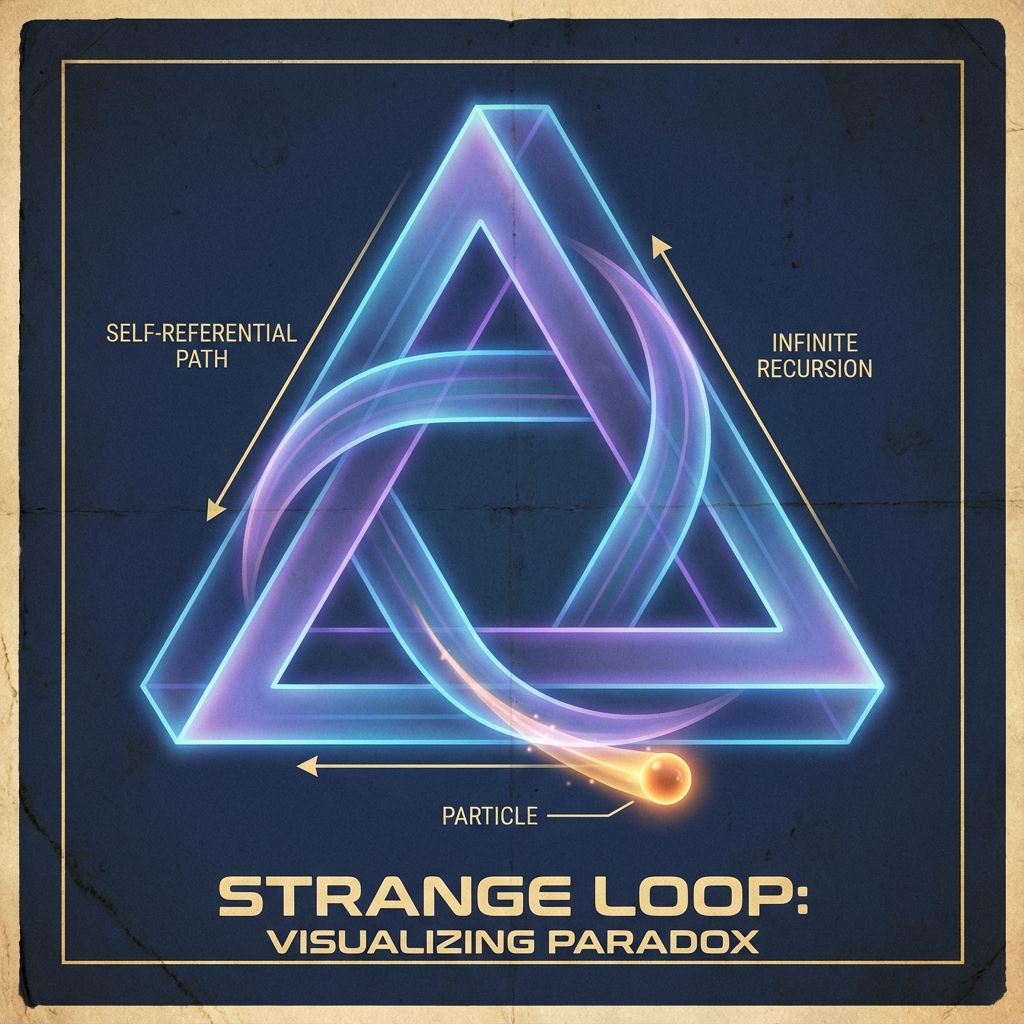
In M.C. Escher’s famous print Drawing Hands, two hands are drawing each other on paper: the left hand draws the right hand, while the right hand simultaneously draws the left hand. This forms a Strange Loop.
In this loop, you cannot tell where is the source, where is the end. Each hand is both creator and created.
In our geometric universe, this is precisely the ultimate dilemma observers most easily fall into. Mediocre attractors are hard to escape not only because they are energy valleys, but because they are logically self-referential dead loops.
The Geometry of Self-Fulfilling Prophecies
Let us see how this loop is constructed in Hilbert Space’s strategy manifold.
As a bandwidth-limited observer (remember the photon’s bankruptcy? We are richer than photons, but still not infinite), we cannot process all universe information. To survive, we need to build an internal model to predict the future.
This model is like a filter (Filter). It tells us: which information is important “signal,” which can be ignored as “noise.”
Thus, the strange loop begins its rotation:
-
Model determines observation: Your internal model sets your projection direction. If you believe “the world is hostile,” your radar focuses on searching threats and offenses.
-
Observation reshapes reality: In massive information, you precisely filter fragments matching your expectations. You ignore kindness, amplify hostility.
-
Reality validates model: You tell yourself: “See, I always said the world is dangerous; this evidence proves I’m right.”
-
Model reinforcement: Since the model is “validated,” you use this filter more firmly; next observation becomes more biased.
Geometrically, this is a positive feedback spiral.
Observers think they’re going straight—they constantly collect evidence, constantly “correct” their worldview. But in strategy space’s high-dimensional geometry, because their coordinate system (projection basis) is bent by their own beliefs, they actually move along a closed curve.
The harder they try to prove themselves right, the deeper they sink into this circle. They are not just trapped; they built the cage themselves and locked themselves inside.
Echoes Within Algebra
This structure is not unique to psychology; it is deeply rooted in our theory’s mathematical skeleton.
In this book’s theoretical appendix, we define observers as subalgebras (Subalgebra) within the universe’s large algebraic system. Observers try to simulate the entire large algebra using this subalgebra.
This produces a mathematical “Gödel dilemma”: a system trying to describe itself within the system.
When observers’ internal theories become complex enough, they inevitably encounter self-reference (Self-Reference) problems. Observers are no longer observing the universe, but observing “the universe’s reflection in their own eyes.” The patterns they see are actually scratches on their retinas; the truth they hear is actually echoes of their own heartbeat.
This is the physical essence of strange loops: They are topologically locked evolution paths.
In this loop, Fubini-Study distance always appears small because “expectation” and “perception” always perfectly match. This is local perfection, a logical short circuit.
Prisoners of Dimensionality
Why is it hard to realize we’re in a loop?
Because on this low-dimensional loop cross-section, everything appears linear.
Imagine an ant crawling on a huge cylinder. If it only focuses on “forward-backward” dimension, it feels it’s always moving forward. It doesn’t know it’s actually circling. Only when it jumps off the cylinder surface into three-dimensional space can it see the loop’s overall structure.
Similarly, observers in strange loops are often prisoners of dimensionality.
They use fixed concepts (like “success,” “safety,” “correctness”) to dimensionally reduce complex worlds. This low-dimensional language is like that cylinder, guiding them back to origin again and again.
This loop is fatal. It consumes precious internal evolution rate (that is, life), yet produces no substantial displacement. Like an engine idling there, exhausting all fuel in roaring noise, going nowhere.
So how can the ant know it’s circling? How can observers break this perfect logical closed loop?
There is only one answer: dimensional elevation.
The ant must learn to “look up.” Observers must introduce a new projection dimension completely orthogonal to existing models. This requires enormous energy, requires tearing original self-consistency, but this is the only path to freedom.
This is the theme of our next chapter—Distance to True Self. We will explore how to use geometry’s power to open an escape orbit to higher dimensions in mediocre gravitational fields.
(Next, we will enter Chapter 11 “Distance to True Self,” seeking geometric mechanisms to break loops.)