11.3 The Mechanism of Breaking the Loop
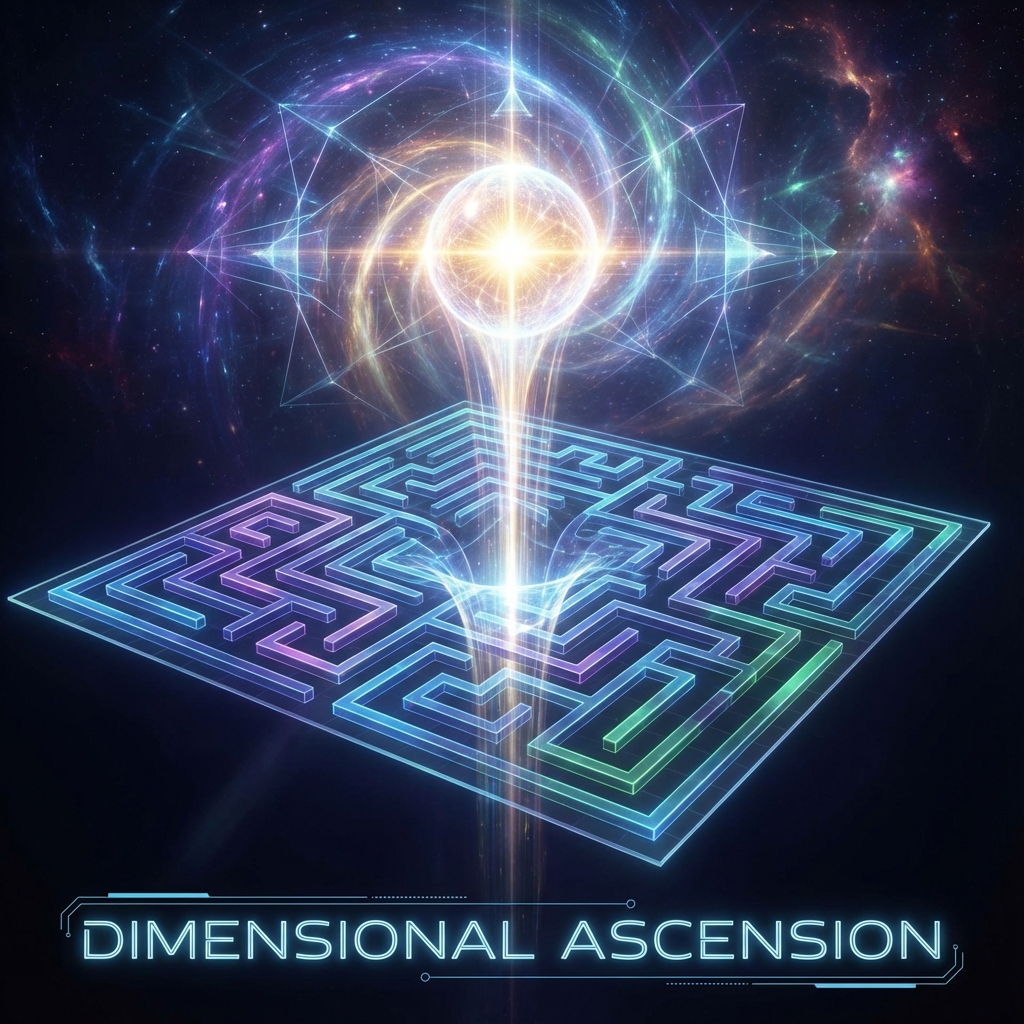
If you’re trapped in a maze with walls on all sides, what do you do?
For two-dimensional creatures, this is an unsolvable dead end. But for three-dimensional creatures, the answer is obvious: Jump up. You don’t need to pass through walls; you just need to enter that third dimension ignored by two-dimensional creatures.
In our geometric reconstruction, the only mechanism for observers to break mediocre attractors and escape strange loops is precisely this dimensional ascension (Dimensional Ascension).
The Curse and Blessing of Dimensionality
In mathematical optimization theory (and deep learning theory), there’s a counterintuitive phenomenon: in low-dimensional spaces, systems easily fall into local optima (our mediocre attractors). You’re trapped in a small pit, surrounded by high walls; no matter which direction you go, potential energy increases, so you cannot move.
But when you increase system dimensions, miracles happen.
In high-dimensional spaces, true “pits” (all directions upward) are extremely rare. Most places that seem like pits are actually saddle points (Saddle Points). Like a saddle’s shape: in forward-backward direction it’s the lowest point (you feel trapped), but in left-right direction it’s actually the highest point (just step sideways and you can slide down).
This is the blessing of dimensionality.
What traps us is often not the problem itself, but too few coordinate dimensions for observing the problem.
-
If your life runs on the “survival” coordinate axis, then “earning money” and “resting” become zero-sum games. You fall into either-or dead loops.
-
If you introduce “creation” as an orthogonal dimension, the original dead loop becomes a spiraling staircase. You survive while also creating.
Adding Projection Bases
In Hilbert Space language, dimensional elevation means increasing the number of projection operators.
In Chapter 2, we said observers are functors projecting high-dimensional ontology onto low-dimensional screens. “Falling into dead loops” happens because your projection screen is too small; new evolution paths are invisible on your screen.
To break loops, observers must actively introduce a new orthogonal basis (Orthogonal Basis).
This is like in physics: if you only measure particle position, you can never understand its momentum. Only when you introduce “momentum” as a new observation dimension can you see complete phase space trajectories.
For humans, these new “bases” usually manifest as seemingly “useless” things:
-
Aesthetics (Aesthetics)
-
Curiosity (Curiosity)
-
Altruism (Altruism)
-
Metaphysical contemplation (Metaphysics)
From low-dimensional survival competition perspective, these are bandwidth-wasting burdens. But from high-dimensional geometric perspective, they are escape routes. They provide directions completely perpendicular to the “survival axis.” When you move along these directions, you’re not fighting mediocre attractor’s gravity (you don’t need to earn more or rest more); you slide out from the attractor’s side.
The Geometric Definition of Free Will
This finally lets us give “free will” a physical definition.
Free will is not the ability to violate physical laws (that’s impossible); free will is the ability to choose projection bases.
Although the universe’s total bandwidth is locked, although physical laws are rigid, observers have freedom to decide “which direction to look.”
-
A locked observer only watches (external benefits), inevitably falling into resource competition’s zero-sum games.
-
An awakened observer begins rotating their prism, exploring those high-dimensional curled dimensions hidden deep in .
When you change observation dimensions, you change ’s terrain map. Original high walls become flat ground; original dead ends become bridges. You haven’t changed the universe; you’ve changed how the universe unfolds in your coordinate system.
Transition
When you accumulate sufficient displacement in new dimensions, you’ll find you’ve unknowingly detached from the original strange loop.
You haven’t “defeated” that old self; you’ve just transcended it. You’ve completed a topological transformation in Hilbert Space. Your trajectory is no longer a closed circle, but an open line pointing to that true self orbit waiting for you from the beginning.
This is the final revelation “scattering of time” gives us: Although we are imprisoned in time’s knots, we can choose how to tie these knots.
Now, we have mastered the geometric key to escape mediocrity. But where does this dimensional elevation path end? When an observer constantly elevates dimensions, constantly unfolds universe’s potential, what ultimately happens?
Does the universe itself have an endgame?
It’s time to enter the book’s final part—Part V: Infinite Unfolding. There, we will turn our gaze to the universe’s end, listening to the final sigh in the vacuum’s depths.
(Next, we will enter Part V “Infinite Unfolding,” starting from Chapter 12 “The Noise of Vacuum,” exploring cosmology’s ultimate picture.)