8.2 Residence is Existence
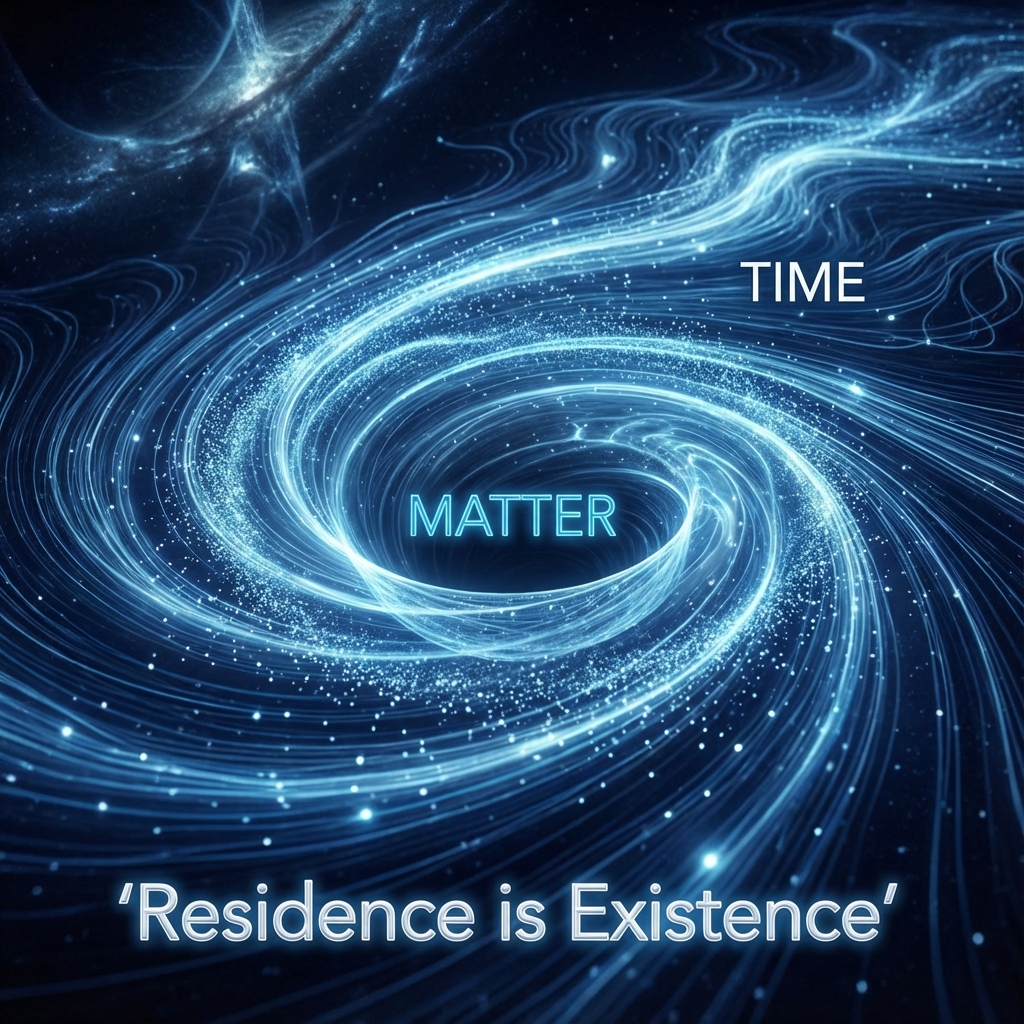
In everyday language, when we say an object “exists” somewhere, we usually mean it occupies that spatial position. But in our geometric reconstruction, space is only a secondary projection. In the underlying ontology of Hilbert Space, the only truth is the rate of evolution.
If everything is flying at light speed , if all things are flowing, then how does “existence”—this seemingly static, stable state—arise?
The answer lies in residence (Residence).
The Runner in the Maze
Let us return to that universe state vector evolving at constant rate . Imagine it as a tireless runner.
When photons traverse vacuum, this runner is sprinting on a straight highway. To external observers, it instantly crosses space with no hesitation. It “passes through” space, but it doesn’t truly “exist” at any point in space. It is just a fleeting passerby.
But when this runner encounters an atom, or enters a strong interaction region, things change.
Geometric paths are no longer straight. They become a maze.
The runner (evolution vector) doesn’t slow down—according to Axiom A1, it must always maintain rate . But it is forced to detour, circle, backtrack in this maze. It runs extremely long distances within tiny spatial regions.
To external observers (us with stopwatches), this looks like particles slowing down, even stopping.
This is the physical picture of time delay. The time particles “reside” in interaction regions is essentially the extra detour they take in Hilbert Space’s internal dimensions.
Resonance: The Vortex of Time
The most extreme form of this residence is resonance (Resonance).
In particle physics experiments, when we tune energy to specific values, scattering cross-sections suddenly surge, particles seem “sucked” by targets. Physicists say this produces short-lived “resonance state” particles.
From our geometric perspective, this happens because evolution vectors encounter a geometric vortex.
At that specific energy point, the function—that time density function we introduced in the previous section—shows a sharp peak. This means geometric paths tightly wind together at that point, forming an almost closed loop.
Particles don’t disappear; they just fall into time’s cycle. They spin frantically in that tiny region, consuming their evolution budget. Until they’ve rotated enough turns, finally find an exit, and fly out again in straight form.
This brief “vortex” manifests macroscopically as an existing entity.
I Reside, Therefore I Am
This brings us a shocking ontological conclusion: Matter’s sense of existence stems from its “residence” in time.
-
Photons don’t reside, so they have no mass, no fixed position; they are pure flow (Flow).
-
Matter resides; it is flow that is curled, delayed, trapped in local mazes. It is a knot (Knot).
If you could completely untie an electron’s internal time knot, straighten its evolution path, it would instantly disappear, becoming a flash of light racing away at light speed. It would no longer “exist” here; it would become pure relation.
So when we say “there is a stone here,” we are actually saying: “There is an extremely dense time delay here.” This stone is hard and heavy because it internally contains astronomical amounts of geometric path winding. It is an aggregate of countless microscopic mazes.
This redefines “interactions.”
Collision of two particles is not two billiard balls hitting hard, but convergence of two time vortices. Their wave functions interfere, their mazes briefly connect, evolution vectors seek new paths between them.
If paths can untie, they scatter apart; if paths entangle tighter, they combine into a new, more complex knot—like atomic nuclei.
Binding energy (Binding Energy), in this sense, is the geometric cost that must be paid (or released) to maintain this more complex maze structure.
Everything we see is essentially sediment of time. The universe is a turbulent river, and matter is vortices in the river. Vortices appear as static objects with fixed shapes and positions, but they are completely composed of flow. If water flow stops, vortices also dissipate.
Now, we face a final question. If microscopic particles can infinitely curl time, if resonance can be infinitely strong, could there be an “infinitely deep” time trap? Could there be a point where time completely stops flowing, forming a mathematical singularity?
Physics hates singularities. And in our geometric framework, there is a natural mechanism preventing this disaster. This is the theme of our next section—geometric saturation.
(Next, we will enter section 8.3 “Geometric Saturation,” revealing why the universe’s bandwidth limit naturally prevents infinity and provides natural ultraviolet cutoff.)