9.3 The Entropic Perspective
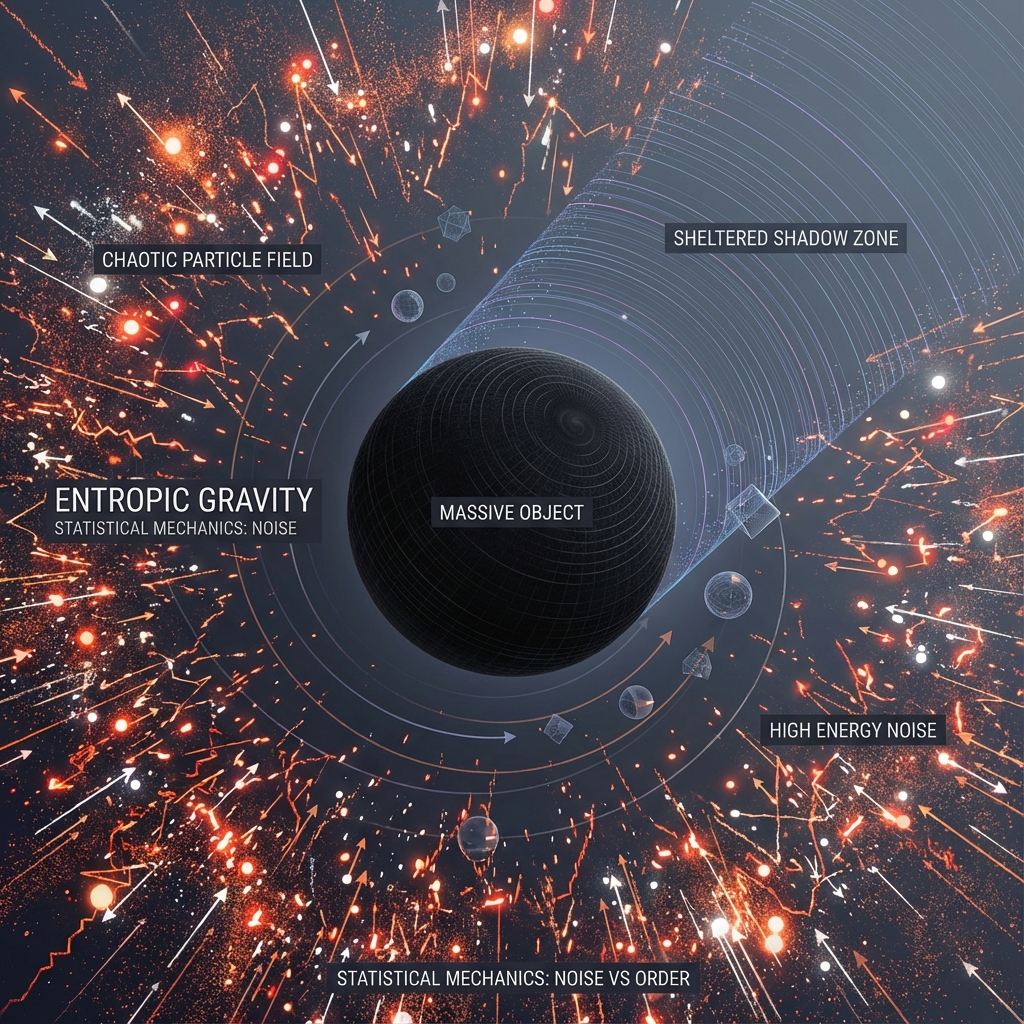
In the previous section, we defined force as “tendency to shorten distance.” This sounds beautiful, but it leaves an unresolved question: Why?
Why does the universe always tend to shorten distance? Why do objects always slide toward low potential energy states? Who is pushing them from behind?
Traditional physics tells us this is fundamental law. But in our geometric reconstruction, there is only one fundamental law (Axiom A1): evolution rate is constant. Beyond this, everything should be statistical results.
Therefore, we propose a bold view: There is no such thing as “force.”
All forces we experience—gravity, elastic force, even your drive to change the status quo—are essentially entropic forces (Entropic Force).
The Logic of Parking Lots
Imagine a vast, crowded parking lot. If all cars tend to park near the exit, it’s not because some mysterious “gravity” pulls cars at the exit, but because of probability.
In thermodynamics, systems always tend to evolve toward macroscopic states with maximum microscopic states (entropy).
In our geometric universe, this logic manifests as capacity competition.
Let us recall that fundamental formula: (here we add back environment/invisible sector to discuss vacuum capacity).
Any massive object (like the Sun) frantically consumes (internal evolution) at its location. This means it “eats up” most local geometric bandwidth.
The result is that vacuum around the Sun becomes “barren.” Available remaining capacity () there is less than far away.
This creates a capacity gradient.
When a planet passes nearby, it is not “pulled” by the Sun. It merely discovers in random quantum fluctuations that moving toward the Sun (entering that capacity-depleted region) maximizes total microscopic arrangements of the entire system (planet+Sun+vacuum).
Gravity, from this perspective, is not a fundamental force field, but a capacity shielding effect (Capacity Shielding).
-
Mass causes local geometric bandwidth saturation.
-
This saturation creates a “low-entropy pit” around it.
-
Surrounding objects “fall” into this pit, as naturally as gas molecules automatically diffuse to low-pressure regions.
The Illusion of Dark Matter
This entropic perspective even provides a key to solving the dark matter mystery.
Astronomers found that stars at galaxy edges rotate too fast, as if massive invisible matter pulls them. But in our framework, this might not require new particles.
At galaxy edges, gravity is very weak (extremely low acceleration). In vacuum there, geometric capacity is not fully occupied. According to holographic principle and entropic force derivations (like Verlinde’s work), entropic force behavior changes in such low-acceleration regions.
We speculate that this extra “gravity” is actually entropic force enhancement caused by vacuum capacity gradients.
When geometric bandwidth is not fully consumed by matter at large scales, vacuum itself exhibits “elasticity.” This elasticity produces extra centripetal force, maintaining galaxy rotation.
So there are no ghostly dark matter particles. That is vacuum’s own weight. That is an illusion produced when calculating the universe’s “resource management log,” ignoring vacuum’s own overhead.
The Universe’s Longing
Connecting this chapter’s three sections, we get a complete picture:
-
Slope (9.1): Force is natural sliding on geometric structure.
-
Longing (9.2): In living beings, this sliding manifests as pursuit of “true self.”
-
Entropy (9.3): At the bottom, all this is statistical necessity because the universe tends to maximize its possibilities.
This completely unifies physics and psychology.
You feel hungry—this is an entropic force—your body’s effort to maintain low-entropy state.
Apples fall—this is an entropic force—they try to maximize gravitational field’s phase space.
So-called “driving forces,” whether atomic or spiritual, are essentially trends produced when the universe, this computer, runs optimization algorithms. We are all pushed by probability’s giant waves.
But if everything is just probability, if everything just slides toward entropy-increasing abyss, what meaning does life have? Are we just fallen leaves drifting with the current?
No. Because as we saw in section 9.2, life has the ability to set targets (). Although we cannot change sliding rules, we can choose sliding directions.
However, choosing direction is not easy. On Hilbert Space’s strategy map, traps abound. Some directions look tempting, effortless, but once you slide in, you can never get out.
This is the theme of our next chapter—Mediocre Attractors. We will see why most people, like particles, end up trapped in local optimum dead loops.
(Next, we will enter Chapter 10 “Mediocre Attractors,” exploring geometric traps in observer strategy space.)