9.2 The Geometry of Longing
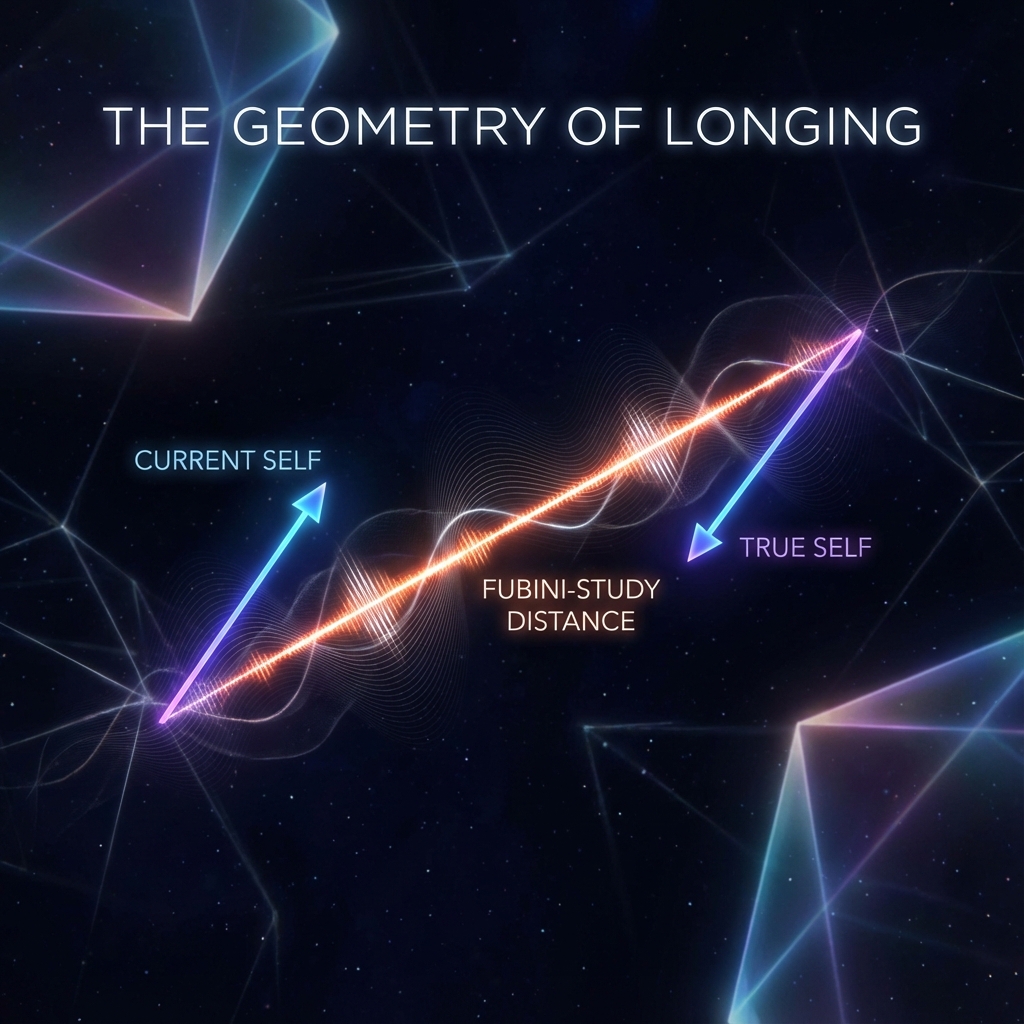
In the previous section, we defined physical force as “slope”—objects naturally slide toward places of higher time density (larger ). This explains why apples fall.
But the universe contains not only apples, but also observers.
Living, conscious systems seem not to follow simple physical “sliding.” Birds fly against wind, humans swim against current, civilizations build order in an entropy-increasing universe. It seems life possesses a “willpower” that can resist physical gravity.
Where does this willpower come from? Is it supernatural?
In our geometric reconstruction, there is no supernatural. Life doesn’t violate physical laws; life merely responds to another form of slope in higher-dimensional Hilbert Space. We call this slope longing.
Fubini-Study Distance: Quantifying “Difference”
To understand this, we need to introduce an ultimate ruler measuring “distance” between any two states in the universe: Fubini-Study distance ().
In Euclidean geometry, distance is the length of a straight line connecting two points. But in quantum mechanics’ Hilbert Space, states are represented by rays (Ray). measures the most fundamental difference between two quantum states.
-
If two states are identical, .
-
If two states are completely orthogonal (like “life” and “death,” “0” and “1”), reaches maximum ().
This distance is not just mathematical abstraction; it represents transformation difficulty. To transform state A into state B, the physical cost (energy time) you must pay is proportional to the Fubini-Study distance between them.
The Universal Formula of Force
Now, we can give a universal formula of force governing all things:
This formula tells us: All forces are essentially systems’ tendencies to shorten geometric distance between “current state” () and “target state” ().
-
For dead matter (physical gravity):
-
is the lowest energy state (or geodesic path).
-
Apples fall because in that direction, decreases fastest. They have no choice but to slide down the slope. This is passive longing.
-
-
For life (mental gravity):
-
is a complex, internally set target state (like “capture prey,” “complete painting,” “become better self”).
-
Life’s special feature is its ability to autonomously set .
-
Driving Force as Geometric Tension
This explains what “longing” is.
When you feel hungry, a huge geometric distance arises between your current state (low blood sugar, empty stomach) and your target state (full, satisfied).
This distance is not an illusory concept; it produces real, measurable electrochemical potential energy in your neural network. This potential energy converts into neural impulses, driving muscle contraction, making you walk toward the refrigerator.
This is physicalization of psychological driving force.
Anxiety, desire, ambition, love—these human emotional experiences, from underlying geometric perspective, are all perceiving distance.
-
Anxiety is you detecting deviating from , distance increasing.
-
Satisfaction is you successfully bringing closer to , distance decreasing.
Life appears able to “move against gravity” not because it overcomes force, but because it switches targets.
A stone can only obey gravity’s call; its is locked to the ground. But a bird can set its to the sky. By consuming internally stored energy (time it previously hoarded), it can locally create a stronger gradient pointing skyward, thus offsetting Earth’s gravity.
The Optimization Algorithm
In this sense, every process in the universe, whether an electron’s transition or an empire’s rise and fall, is essentially the same optimization algorithm running in different dimensions.
This algorithm has only one instruction: Minimize .
-
Electrons try to minimize action.
-
Proteins try to minimize free energy.
-
Neural networks try to minimize loss function.
-
Humans try to minimize gap between reality and ideal.
This unity spanning physics and psychology shows us a trembling beauty. We don’t need to invent new physics for “mind.” Hilbert Space geometry is broad enough to accommodate both atomic vibrations and poets’ sighs.
But since life has freedom to set targets, why do we often feel powerless? Why do most of us end up living similar lives, trapped in mediocre cycles?
This is not because we lost freedom, but because our optimization algorithm fell into local dead ends. Geometrically, this is called mediocre attractors.
This is the theme of our next chapter. We will see how these geometric “pits” capture our lives, making us spin in place.
(Next, we will enter Chapter 10 “Mediocre Attractors,” revealing geometric traps in observer strategy space.)