9.1 The Slope
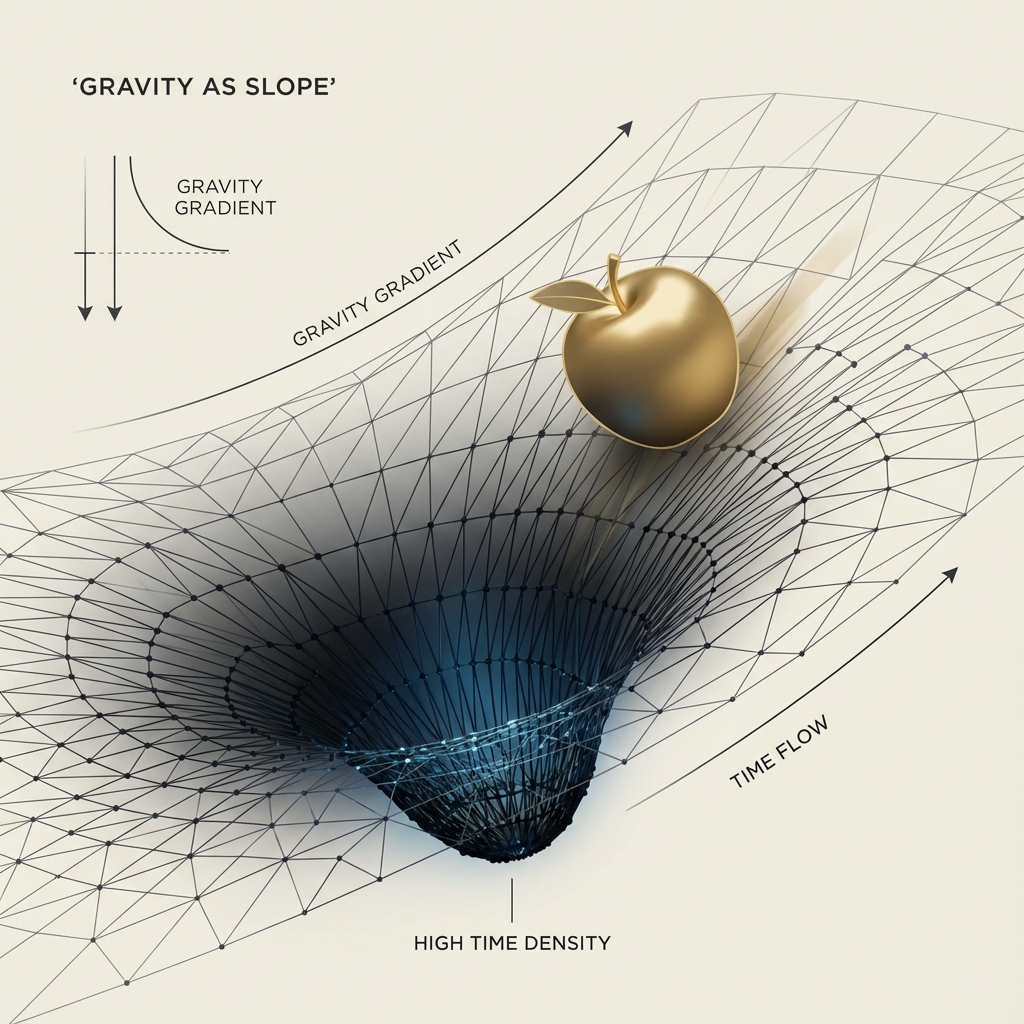
If you ask a child: “Why does the apple fall?” They will tell you: “Because the Earth is pulling it.”
If you ask a Newtonian physicist, they will say: “Because universal gravitation is acting.”
If you ask an Einsteinian physicist, they will say: “Because spacetime is curved, and the apple moves along a geodesic.”
These answers all describe phenomena, but none touch that most fundamental motive. Why does curved spacetime cause motion? What exactly is that “driving force” that drives objects to change state?
In our geometric reconstruction, we give a more fundamental answer: Force is the slope of time density.
The Invisible Slope
Let us recall the “Great Trade-off” from Part II: . Any massive object (like an apple) possesses enormous internal evolution rate . That is, the apple is a container storing vast amounts of “internal time.”
Now, imagine space around Earth. According to general relativity, massive objects (Earth) slow down time flow around them. Closer to the ground, time passes slower.
What does this mean in our language?
This means time density is higher near the ground. As we saw in Chapter 8 discussing , time delay means geometric path winding and accumulation. Earth is like a giant time magnet; Hilbert Space around it is extremely compressed and curled, forming a high-density “time deep well.”
When an apple hangs on a branch, it is in an awkward position:
-
Above it (away from ground), time flows slightly faster, meaning time density is sparse.
-
Below it (near ground), time flows slightly slower, meaning time density is dense.
The frantically rotating evolution vector inside the apple feels an asymmetry. This is like one foot standing on flat ground, the other in a swamp. The swamp has greater resistance, higher density; your body involuntarily tilts in that direction.
The apple “falls” not because Earth extends a hand to pull it down, but because it slides toward places of higher time density.
Objects always tend to slide toward places where their internal evolution () can be maximally “accommodated.” This is the essence of gravity: It is not pull; it is slope.
The Negative Gradient of Distance
We can refine this intuition into a universal mathematical definition, perhaps the most important concept in this book after the Pythagorean theorem.
In physics, we habitually say force is the gradient of potential energy (). But in our geometric universe, energy is just the length of evolution vectors. A more fundamental quantity is distance.
We define a distance in Hilbert Space called Fubini-Study distance (). It measures how “different” two quantum states are.
Force is essentially the tendency to shorten some geometric distance.
-
For gravity: Objects slide toward geodesics to minimize geometric path cost in curved spacetime. They seek paths maximizing their proper time (Proper Time).
-
For elastic force: Springs try to restore original length to minimize geometric tension from molecular electron cloud deformation.
-
For strong force: Quarks are confined by gluons because once separated, geometric distance between their gauge fields increases dramatically, producing huge restoring force.
There is no entity called “force” in the universe. Force is merely corrective action systems exhibit when finding themselves in “non-optimal geometric states,” to return to equilibrium (minimizing distance).
The Push-Back Sensation Here and Now
This view completely changes our understanding of the sensation of “being pushed.”
When you sit in an accelerating car, you feel the seatback pushing you. Newton says this is force. Einstein says this is because you’re deviating from geodesics. We say this is because the car’s engine is forcibly rotating your internal evolution vector.
The engine forces you to convert part of (internal time) into (external space). Your body (countless tiny gyroscopes) resists this rotation; this resistance is translated in your senses as “push-back sensation.”
So all forces are ultimately geometric structure’s response to change.
-
Gravity is sliding along geometric structure (downhill).
-
Electromagnetic/mechanical forces are opposing forced geometric structure changes (uphill).
We live in a universe full of slopes. There has never been true flatness. Every piece of matter presses time depressions around it; every beam of light pulls spacetime’s warp and weft.
What we call “universal gravitation” is actually all things’ desire to “have more time.” Apples fall to return to that embrace where time flows slower and denser.
But this only explains motion of dead matter. Does this formula also apply to that most mysterious observer—life?
If physical force is shortening distance between “physical states,” then psychological driving force, is it also shortening distance between some “psychological states”?
This is the astonishing corollary we will explore in the next section. We will extend the concept of “force” from physics to psychology, seeking that hidden slope driving life forward.
(Next, we will enter section 9.2 “The Geometry of Yearning,” exploring how to describe life’s driving force using the same geometric framework.)