6.2 Causality as Connection Speed
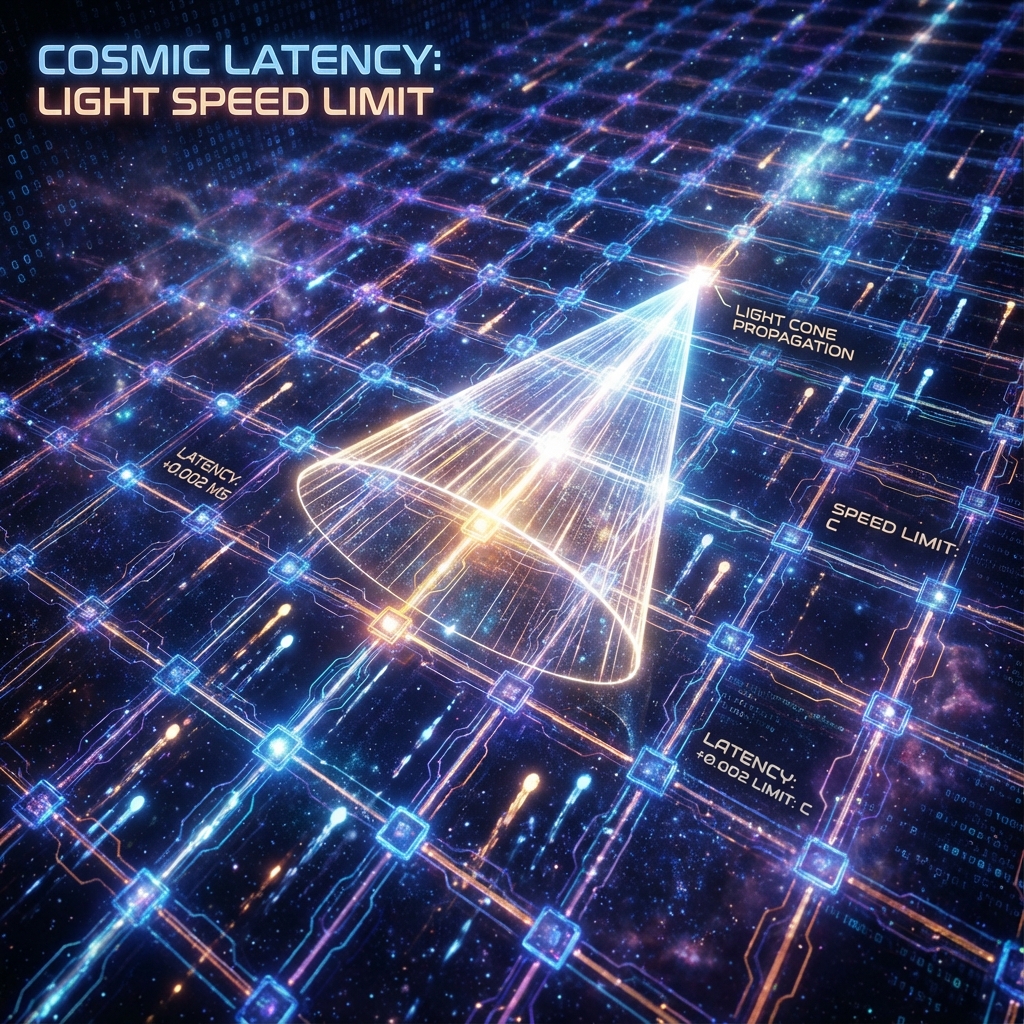
In classical physics, causality is a philosophical concept: causes must precede effects. But in Einstein’s relativity, causality becomes a geometric concept: the light cone (Light Cone). Any event can only affect the future within its light cone; any connection beyond the light cone is impossible.
But this still sounds like an arbitrary prohibition. Why ? Why not infinitely fast? If the universe is just an empty stage, why can’t events at one end instantly reach the other?
In our Quantum Cellular Automaton (QCA) model, this puzzle receives an extremely intuitive answer: Light speed is not flight velocity; light speed is information transmission rate.
The Domino Effect
Imagine a vast floor densely covered with dominoes. Each domino represents a spatial pixel (QCA unit).
If you push over the first domino (creating an event), it falls and hits its neighbor. The neighbor falls to the next neighbor. A “wave” begins spreading through the domino array.
Now, how fast can this wave propagate?
This depends on two factors:
-
The size of dominoes (spacing of spatial pixels).
-
The time needed for dominoes to fall (fundamental time step, or logic gate operation cycle).
No matter how strong your push, no matter how urgent your intent, the speed at which this wave spreads across the room has a physical upper limit. You cannot make the 100th domino fall at the same instant as the 1st domino, because every intermediate domino needs time to respond.
This is the true face of the “speed-of-light limit” in our universe.
From the QCA perspective, nothing is really “flying.” Photons are not bullets traversing void; they are a relay of states.
When physicists say “light speed is ,” they are actually saying: In this universe network composed of qubits, information seeps from one node to adjacent nodes, limited by the update rate of the most fundamental logic gates.
Mathematicians Lieb and Robinson rigorously proved this in a famous theorem: In a quantum lattice system with local interactions, even without presupposing relativity, a maximum information propagation speed naturally emerges. This is the Lieb-Robinson Bound.
In our dictionary, the light cone is the boundary of this propagation limit.
The Logical Horizon
Let us use a more modern metaphor: network speed.
If we view the universe as a vast distributed computer, each spatial point as a server node, then light speed is the maximum PING value or latency of this entire network.
-
When we look at the Moon, we see the Moon from 1.3 seconds ago. This is not just because light travels that far, but because information about the Moon (Bits) needs to pass through countless spatial pixels’ “handoffs” and “processing” to reach your retina.
-
The black hole’s event horizon (Event Horizon), in this sense, is the network’s disconnected zone. The network topology there makes information propagation hops infinite, or information packets are forever stuck in the buffer.
Therefore, causality is no longer an abstract philosophical principle; it becomes a hard constraint of network topology.
If someone claims they can instantly transmit information to the Andromeda Galaxy, they are actually claiming they can bypass all intermediate nodes in the universe and directly modify remote memory. But in a strictly local QCA universe, this is strictly forbidden by the underlying operating system (Axiom A1).
Discrete Light Cones
In continuous spacetime, the light cone is a perfectly smooth cone. But in our pixelated world, if we zoom the microscope to the limit, we see that the so-called “light cone” is actually a pyramid expanding in steps.
Each step corresponds to a Planck time step ().
Each layer of diffusion corresponds to a Planck length ().
At macroscopic scales, because steps are too small, the pyramid’s edges are smoothed, appearing like a smooth cone. This again confirms our core point: continuous physical laws are just emergence (Emergence) of discrete computational processes.
Now, we understand that space is pixelated and causality is limited. But there is still a huge gap in this picture: If space is composed of fixed grids, why don’t we sense the grids? Why do we measure the same light speed in all directions? Logically, walking diagonally on grids should be “slower” than walking straight (because the path is more tortuous).
This is the famous “Lorentz symmetry breaking” problem. It is the nightmare of all discrete spacetime theories.
But in the next section, we will demonstrate an astonishing mathematical miracle: how these discrete pixels use ingenious camouflage to deceive all our detectors at the macroscopic level, making the world appear perfectly symmetric.
(Next, we will enter section 6.3 “The Vanishing Mosaic,” using the suppression mechanism to explain why the discrete universe appears so smooth.)