6.3 The Vanishing Mosaic
If the universe is really composed of discrete pixels (QCA grids), then logically, we should easily discover it.
Imagine walking on graph paper. If you want to go from point A to point B, and B is diagonally opposite, you cannot walk directly diagonally (because there are only grids); you must walk zigzag “stair steps.” This means on grids, the “hypotenuse” length does not equal the sum of squares of legs. This is the conflict between so-called “Manhattan distance” and “Euclidean distance.”
If light also “crawls” on the universe’s grid this way, then when we look in different directions, light speed should be different. Light should be fastest along grid axes, and slower (or faster, depending on specific jump rules) along diagonals.
This is called Lorentz Violation.
This is the nightmare of all discrete spacetime theories. Because countless astronomical observations—such as the Michelson-Morley experiment—tell us that light speed is extremely precisely the same in all directions. If the universe is pixelated, this pixel grid must be hidden extremely perfectly. How exactly does it do this?
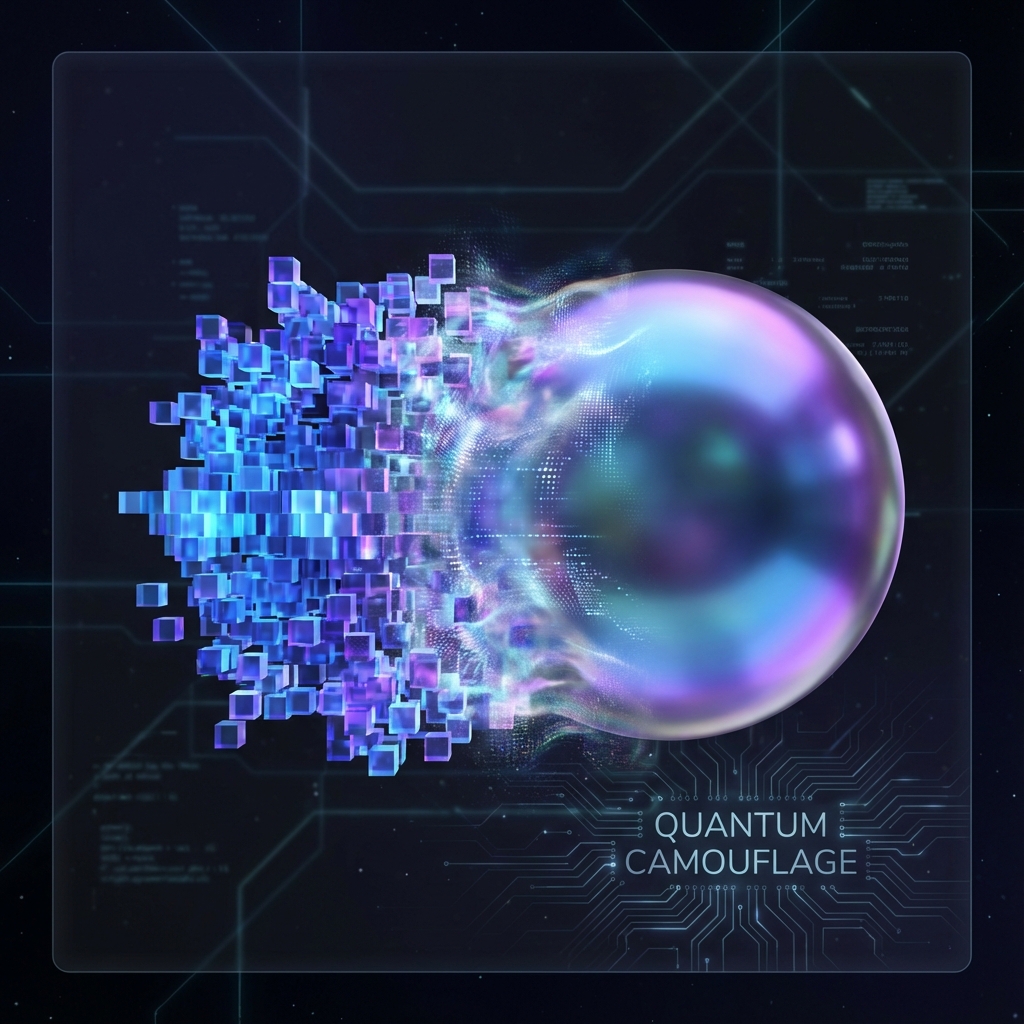
Quantum Camouflage
The secret is that we are not just dealing with “cellular automata,” we are dealing with quantum cellular automata.
If a photon were a classical marble, it would indeed be tripped by grid corners. But a photon is a wave function. In quantum mechanics, wave functions do not propagate along a single path, but simultaneously explore all possible paths.
When we write down the QCA evolution equation (as we do in the Dirac-QCA model), a miracle happens. Although every tiny jump occurs between discrete grid points, when these jumps’ wave functions superpose, the grid’s “square effects” cancel each other out.
This is like displaying a circle on a square pixel screen. Although every pixel is square, by adjusting edge pixel brightness (anti-aliasing), you can make that circle appear perfectly round.
The universe uses the most advanced mathematical anti-aliasing technique. At macroscopic scales, the anisotropy of discrete grids is perfectly smoothed by quantum interference. The emerging macroscopic wave equation (Dirac equation) miraculously restores perfect rotational symmetry.
High-Order Suppression
Of course, this camouflage is not absolutely perfect. As physicists, we need to know how large the “error” actually is.
In our geometric reconstruction, this error manifests as corrections to the dispersion relation (Dispersion Relation). In perfect continuous space, the energy-momentum relation is . But in our QCA pixel universe, this relation becomes a series expansion:
Note that correction term (momentum to the fourth power). This is an extremely crucial detail.
Many crude discrete models lead to or level corrections; such errors are too large and should have been seen by our telescopes long ago. But our QCA model has special symmetries (parity and time-reversal symmetry), which suppress the leading error term to level.
What does this mean?
This means that for ordinary low-energy particles (like atoms in your body, even light from the Sun), this error term is negligible. Only when particle momentum approaches Planck momentum (an extremely enormous energy) does this term become significant.
This is like saying the universe’s display resolution is too high. Unless you can zoom the microscope to Planck scale ( times smaller than atomic nuclei), you will never see that “mosaic.”
Evidence from Deep Space
Have we actually searched for this mosaic? Yes.
Astronomers have used the Fermi Gamma-ray Space Telescope (Fermi-LAT) to observe photons from distant gamma-ray bursts. If spacetime were really discrete, then photons of different colors (different momentum ) should be slightly differently affected by the grid, and their arrival times on Earth should have extremely tiny differences.
Observational results show: Even after traversing 7 billion light-years, high-energy and low-energy photons arrive almost perfectly simultaneously. This rules out crude “linear Lorentz violation” models.
But our model perfectly passes this test. Because at gamma-ray burst energy scales, corrections are only about seconds, completely hidden below current detection limits.
So the conclusion is astonishing: Although the universe is pixelated, it still maintains a perfect continuous illusion within our observational capabilities through exquisite mathematical structure.
This explains why we live in a world that appears so smooth and describable by calculus, despite its underlying foundation being a jumping digital grid.
Now, we have understood the stage (space) and the script (time). But there are some strange actors on this stage. Some grid regions seem “knotted,” forming unsolvable tangles. These tangles are so stable that we have given them names: “electrons,” “quarks.”
This leads to the next chapter’s theme: If space is a grid, what are particles? The answer might surprise you—particles are bugs on the grid.
(Next, we will enter Chapter 7 “Particles as Defects,” revealing the topological nature of matter.)