13.3 The Geometric Explanation of Multiverse
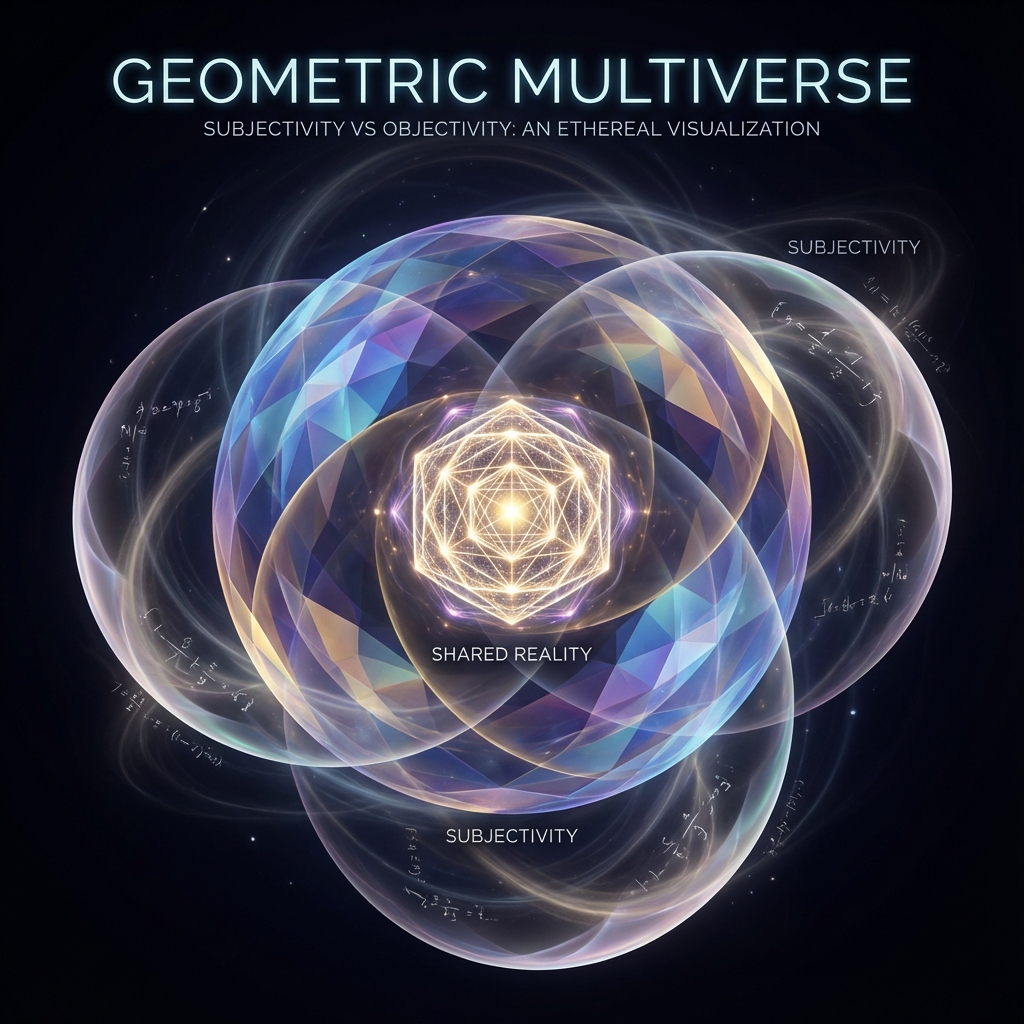
In science fiction films, “multiverse” usually means parallel worlds: in that world, you had bread instead of cereal for breakfast, or the Nazis won World War II. This is exciting imagination, but in physics, it often leads to ontological confusion. If there are infinitely many universes, does “reality” still exist?
In our geometric reconstruction, the multiverse is not parallel independent entities, but slices of the same noumenon from different observer perspectives.
Everyone is a Coordinate System
Let us return to Hilbert space. The cosmic terminal object is unique and determinate. It is like a massive, motionless sculpture.
But every observer (you, me, aliens, even an electron) is a local coordinate system in this space.
-
Your “now” is defined by your internal clock.
-
Your “space” is defined by your state of motion (special relativity).
-
Your “facts” are defined by your observational projection (quantum mechanics).
Because our positions in Hilbert space differ, our projection matrices (Projectors) also differ slightly.
-
For you: At this moment, you are reading this sentence. This is your cosmic slice.
-
For me: I am writing this sentence. This is my cosmic slice.
Strictly speaking, we do not live in the same universe. Each of us lives in a “private universe” with ourselves as the origin.
This is the geometric essence of “Type I Multiverse”: multiverse is multi-perspective.
The Emergence of Objectivity
If everyone has their own private universe, why can we still sit at the same table drinking coffee? Why can we agree that “the table is hard”?
Because although our coordinate systems differ, they overlap highly.
Our positions in Hilbert space are very close. We share the same evolution rate , we are constrained by the same physical laws (those invariants unchanged under all projections), and our brain structures (decoding algorithms) are highly similar.
This overlapping region is what we call “objective reality”.
Objective reality is not a priori existence; it is the intersection of countless subjective private universes. It is the greatest common divisor all observers can reach.
-
For humans: Our intersection is large. We all agree the sun is round, fire is hot.
-
For humans and bats: Our intersection is smaller. The bat’s universe is full of ultrasonic echoes, which are blind spots in our universe.
-
For humans and neutrinos: Our intersection is almost zero. Neutrinos pass through Earth as through void; in its universe, Earth almost doesn’t exist.
So there is no absolute, observer-independent “objective universe.” There is only “inter-subjectivity”. So-called “truth” is projection structures that remain unchanged across the widest group of observers.
The Unification of Quantum Multiverse
This model can even accommodate the “Many-Worlds Interpretation” in quantum mechanics.
When quantum measurement occurs, the universe seems to split into two branches: in one branch the cat lives, in another the cat dies. In Everett’s view, these two worlds truly split.
But from our geometric perspective, the universe does not split; what splits is the observer’s trajectory.
Hilbert space is large enough to accommodate both the “live cat” and “dead cat” orthogonal state vectors. When measurement occurs, the observer’s state vector becomes entangled with the cat’s state vector.
-
Part of you (projection component A) entangles with “live cat,” evolving along one path.
-
Another part of you (projection component B) entangles with “dead cat,” evolving along another path.
These two components become orthogonal in Hilbert space, meaning the between them reaches maximum. They can no longer see each other.
This explains why we don’t sense the other world: because geometrically, they are already perpendicular to our reality. They still exist in that massive noumenon , just beyond our projection screen.
Ultimate Inclusion
This brings us great relief.
We don’t need to choose between “materialism” (the world is objective) and “idealism” (the world is subjective). Geometry includes both.
-
Noumenon is material: Evolution in Hilbert space is objective, mathematical, independent of human will.
-
Experience is ideal: The reality we perceive depends entirely on our observational projection.
This unity is healing. It tells us that although each of us is a lonely observer trapped in our private slice, we are connected at the deepest level. We all originate from the same noumenon; we are all decoding the same beam of light.
We are both fragments of the universe and the entirety of the universe.
Now, the journey is about to end. We started from timeless primordial light, passed through relativity’s game, untangled quantum mechanics’ dead knots, and finally understood the observer’s mission.
What remains is only one final sigh. What is that ultimate picture containing past, present, and future?
Let us enter the book’s final chapter—“Silent Geometry”.
(Next, we will enter the book’s final chapter “Silent Geometry,” drawing a quiet conclusion to this journey of thought.)