13.2 The Growth of Dimensions
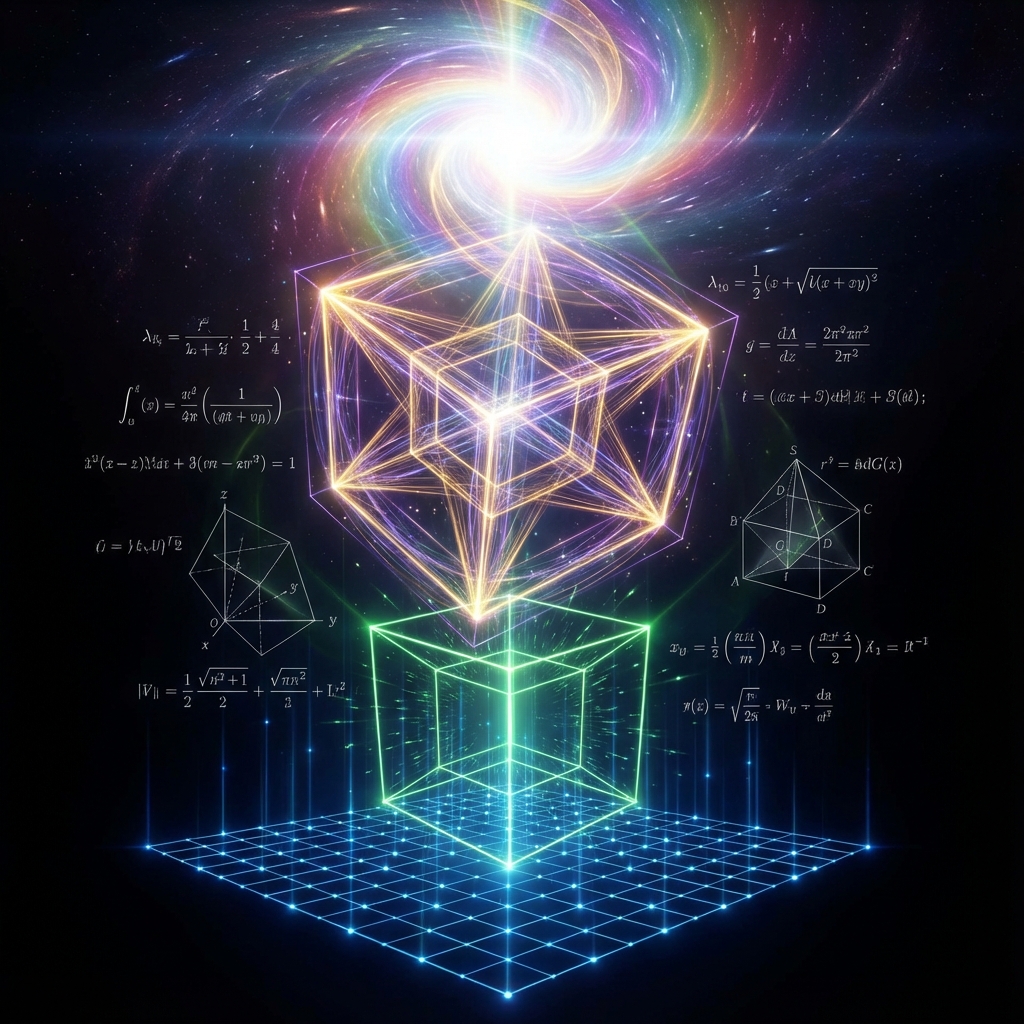
If I ask you: how many dimensions does the universe have? You might answer without thinking: three spatial dimensions plus one temporal dimension, four in total. Or, if you’ve read popular science books on string theory, you might say ten or eleven dimensions.
We are accustomed to viewing “dimensions” as hard parameters set when the universe left the factory, like a room’s length, width, and height—a rigid container.
But in our “computational universe” model, dimensions are not properties of containers; they are boundaries of observer capability.
The Fable of Flatland
Imagine an ant living on a two-dimensional plane. For it, the dimension of “height” does not exist. This is not because height doesn’t exist physically, but because its senses cannot perceive height, its movement cannot reach height. Its universe is flat.
If this ant suddenly evolves and learns to jump, in that instant its universe undergoes a dramatic change: it “grows” a third dimension. The world hasn’t changed; its interface with the world has upgraded.
This is “the growth of dimensions”.
In the ontology of Hilbert space, the cosmic terminal object () is infinite-dimensional. It contains endless orthogonal directions (degrees of freedom). But as a primitive observer (like a single-celled organism or early humans), our projection screen is extremely narrow. We can only capture an extremely tiny slice of these infinite dimensions—the familiar four-dimensional spacetime.
Where did the other dimensions go? They are not “curled up” at Planck scale as string theory suggests; they are ignored. They exist in our perceptual blind spots, just as colors exist in a blind person’s blind spots.
Civilization’s Dimensional Ascension
The evolution of human civilization is essentially a history of “dimensional ascension”.
-
Survival Dimension: In ancient times, human attention was locked onto the single dimension of “survival.” Food, mating, avoiding beasts. All information was projected onto this axis: beneficial for survival is good, harmful is bad. The universe at this time was low-dimensional, linear.
-
Cognitive Dimensions: Later, we invented language, art, and science. We began appreciating sunsets (aesthetic dimension), thinking about the afterlife (metaphysical dimension), exploring stellar motion (logical dimension).
Each time we introduce a new way of cognition, we add a new basis to the projection matrix in Hilbert space.
This is not merely psychological change; this is physical decompression.
When we learned to control electromagnetic waves, we expanded our view in the universe’s “electromagnetic dimension”; when we learned to manipulate quantum entanglement, we opened doors in the “quantum information dimension.” We are gradually transforming those hidden degrees of freedom originally folded deep within (internal evolution) into external reality we can manipulate.
The universe has not grown larger; our resolution and bit depth for viewing the world have increased.
The Infinite Ladder of Hilbert Space
This brings us an exciting inference: dimensional growth has no end.
Since Hilbert space is infinite-dimensional, as long as the observer’s computational capacity (internal bandwidth ) permits, they can continuously unlock new dimensions.
This explains the Fermi Paradox: why don’t we see alien civilizations?
Perhaps advanced civilizations did not fly to distant galaxies (that’s low-dimensional expansion), but chose inward expansion. They may have unlocked perception and manipulation capabilities in the 5th, 6th, even 100th dimension.
In their eyes, the universe may no longer be empty dead space, but a bustling metropolis full of rich geometric structures and information flows. They are here, right beside us, but we cannot see them, just as a two-dimensional ant cannot see a bird flying overhead.
They live in orthogonal subspaces we cannot project onto.
Ultimate Freedom
This is the final meaning of “seed expansion.” We begin as tiny seeds trapped in four-dimensional spacetime, limited by light speed, limited by entropy increase. Through continuous learning, awakening, breaking mediocre attractors, we gradually increase the dimensions of our projection.
We are transforming “potential” (those unvisited axes in Hilbert space) into “reality”.
Each time you understand a new complex mathematical theorem, each time you deeply empathize with a stranger, each time you create an unprecedented work of art, you add a tiny dimension to this universe. You refract that beam of primordial time-light through your prism into a richer spectrum.
This is the ultimate freedom the universe grants observers: although you cannot change the noumenon’s evolution rate , you can decide how many lights to illuminate on this infinite stage.
Now, we have almost reached the journey’s end. We have seen the past (primordial time) and the future (infinite expansion). In the final section, we will explore an interesting question: if each of us is an independent observer, why do we see the same world?
This is the theme of the next section, also the second-to-last section of the book—“The Geometric Interpretation of the Multiverse”. We will elegantly resolve the contradiction between “subjective” and “objective” using geometric language.
(Next, we will enter section 13.3 “The Geometric Interpretation of the Multiverse,” exploring how different observers share the same noumenon.)