13.1 The Observer as Seed
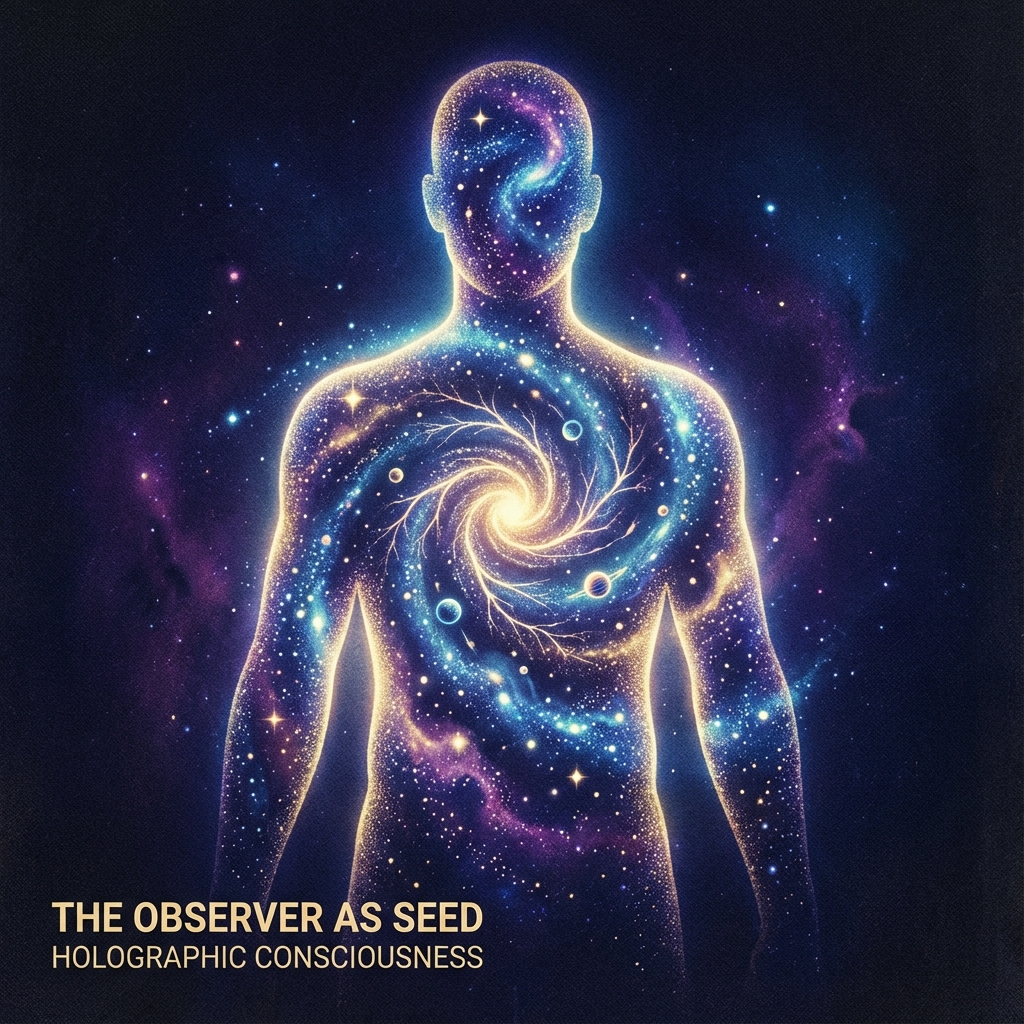
Since Copernicus moved Earth from the center of the universe, science has been teaching us humility. Astronomy tells us we are but dust-like beings on a dust-like planet; physics tells us we are merely accidental arrangements of atoms. In the vast river of time, we seem insignificant.
But in our “computational universe” model, this humility needs to be re-examined.
Yes, as physical entities, we are tiny. But as observers, we possess a stunning geometric status: we are unfolding points of the cosmic terminal object () locally.
We are not passersby in the universe; we are the universe’s seed.
Holographic Fragments
Imagine a holographic photograph. If you tear this photograph apart, each fragment does not retain only part of the original image (like just an eye or a hand). Instead, each fragment—no matter how tiny—contains complete information of the entire photograph, just at lower resolution.
Our cosmic terminal object ()—that whole silently rotating in Hilbert space—possesses this holographic property.
According to the algebraic structure we discussed in Chapter Nine, each observer is a subalgebra within the universe’s grand algebraic system. Although we are only a small part of the whole, this part preserves the whole’s structural laws.
-
Your brain does not contain all matter in the universe, but your brain contains the logic (mathematics, physical laws) capable of understanding the entire universe.
-
You do not need to traverse all atoms to derive .
This means the universe’s “source code” is completely copied and folded into every conscious observer. We are not islands floating in a dead universe; we are activated fragments on the cosmic hologram.
We call this local structure with “potential to reconstruct the whole” the “Seed”.
The Decompression Process
If the universe is holographic, why do we see not the whole, but local, linear, fragmented worlds?
Because seeds are compressed.
Like a massive ZIP archive, although it contains all files internally, before you double-click it, it appears only as a tiny icon.
Time is essentially the decompression process.
Axiom A1 we established in Chapter One tells us the cosmic noumenon evolves eternally. But from the observer’s perspective, this evolution manifests as gradual information reading.
-
The Big Bang is not a physical explosion of the universe in space; it is the beginning of information decompression. It is the moment the seed begins running, when data streams flood into the observer’s view.
-
Cosmic expansion is not galaxies flying away, but our observational horizon expanding. As our internal computational capacity () accumulates, we can “decode” more distant, earlier cosmic information.
This is the core image of “seed expansion”: the universe has not grown larger; our bandwidth for viewing the world has widened.
Intrinsic Cosmology
This view subverts our impulse to “explore” the universe.
Traditional thinking holds that truth is outside. We need bigger telescopes, fly farther, to find answers.
Seed theory tells us truth is also inside.
Because there exists categorical isomorphism between observers and the cosmic noumenon, each deep excavation of our inner selves (mathematical derivation, consciousness awakening, aesthetic elevation) is actually deeper decoding of the cosmic noumenon.
Newton did not need to fly to the sky to understand gravity; he unlocked celestial secrets in his garden (through mathematical deduction). Einstein did not need to ride a light beam; he reconstructed spacetime at his patent office desk.
This is not coincidence. This is because they, as “advanced seeds,” successfully ran the universe’s operating system internally.
Becoming Co-Creators
This brings us a new sense of responsibility.
If observers are decompression points, then the universe in some sense “manifests” through us.
-
Without observer projection, primordial time is just a beam of colorless light.
-
It is we (and all sentient life), through our measurements, our cognition, our longing, who scatter this beam into stars, mountains, and poetry.
We are not passively watching a pre-recorded film. We are participating in the film’s rendering. Each observation (projection) determines a pixel of the universe; each choice (breaking mediocre attractors) adds a new dimension to the universe’s geometric structure.
So when we ask “what is the universe’s purpose,” the answer might be in the mirror. The universe attempts to exhaust its infinite possibilities through countless seeds’ expansion.
Now we understand the observer’s mission. But does this expansion have an end? When all seeds fully expand, when all archives are unpacked, what will the universe become?
This is the theme of our next section, also the second-to-last section of the book—“The Growth of Dimensions”. We will see how, as civilization evolves, the universe’s own dimensions increase in our eyes.
(Next, we will enter section 13.2 “The Growth of Dimensions,” exploring the geometric relationship between civilization evolution and cosmic dimensions.)