Appendix B: Dispersion Relation and Lorentz Violation in Dirac-QCA
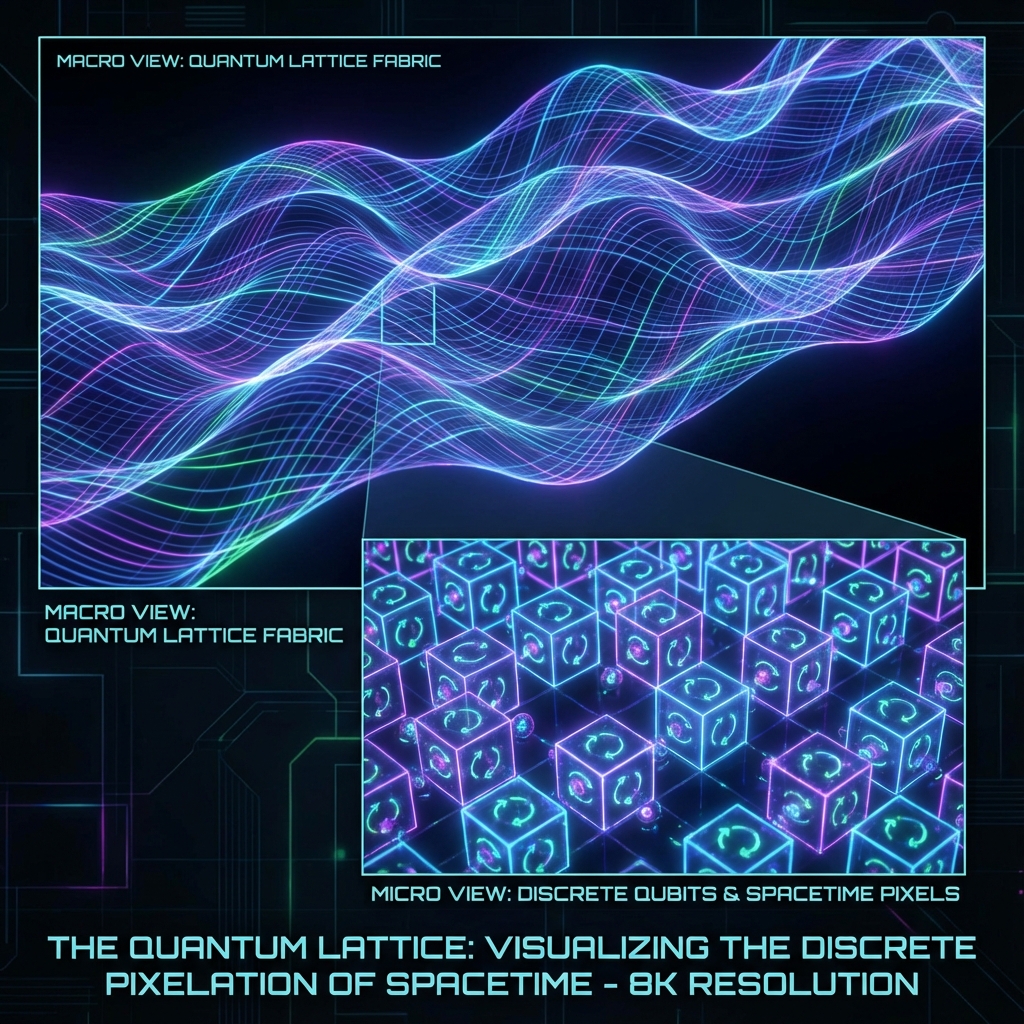
This appendix demonstrates how Lorentz invariance emerges as a low-energy approximation when we discretize continuous spacetime into a Quantum Cellular Automaton (QCA), and the origin of higher-order correction terms ().
1. Discrete Evolution Operator
Consider a one-dimensional lattice with lattice constant and time step . Define the single-step evolution operator as the product of translation operator and coin operator (internal rotation) :
where is related to mass, and is momentum.
2. Derivation of Dispersion Relation
Solving the eigenvalue equation , we obtain the strict discrete dispersion relation:
3. Continuous Limit and Corrections
In the low-energy limit (, ), we perform Taylor expansion of the cosine functions:
Retaining second-order terms, we recover the Dirac equation (where ).
But if we retain higher-order terms, we discover Lorentz violation terms:
The term represents the geometric saturation effect brought by lattice structure. Since this term is fourth power in momentum, it is extremely difficult to observe at low energies, explaining why the macroscopic universe appears so smooth.