5.1 The Cost of Immortality
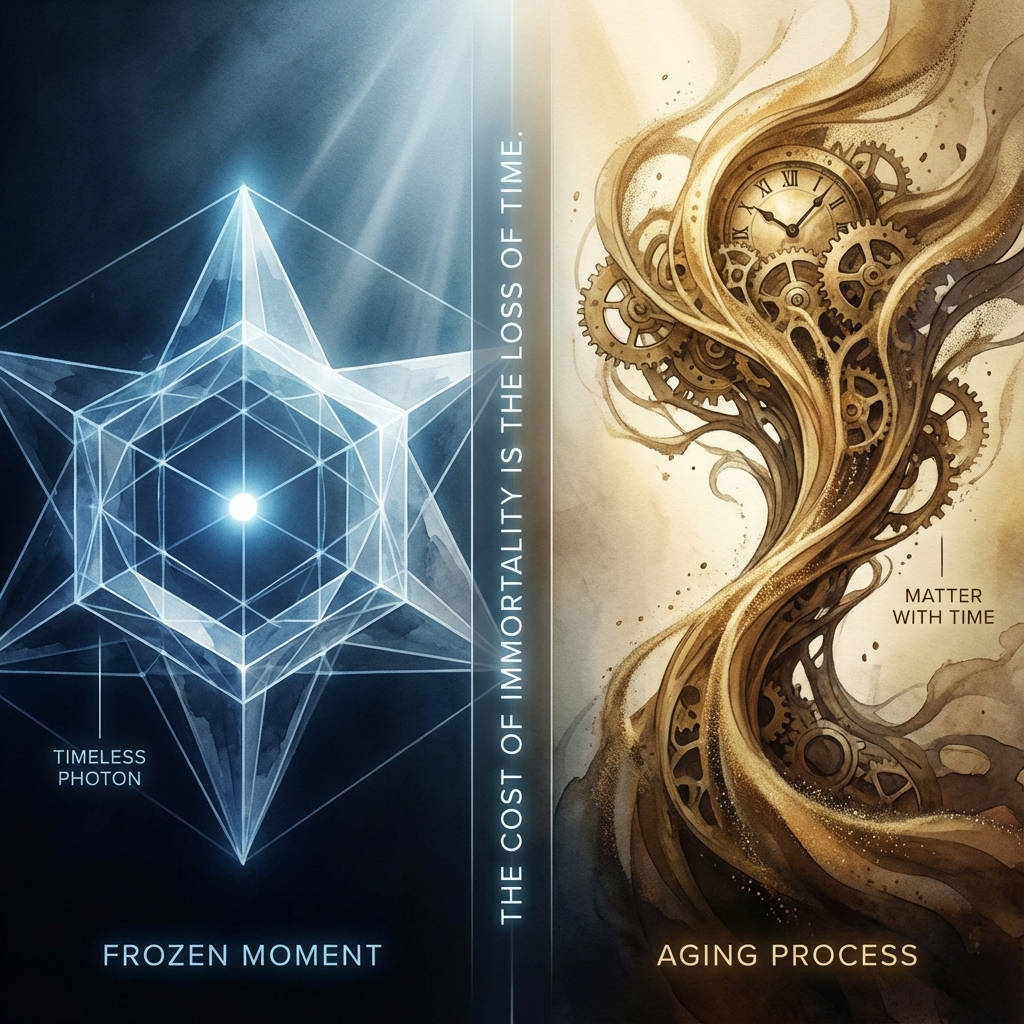
Humans have dreamed of immortality since ancient times. Heroes in myths seek the fountain of youth; wealthy people in science fiction freeze their bodies. We yearn to stop time’s wheel from turning on us, to transform moments into eternity.
In the world of physics, there indeed exists a state of “immortality.” But this is not God’s gift; it is a cold geometric transaction. Its cost is beyond any poet’s imagination.
Let us take out once more that ledger ruling the universe—the Pythagorean theorem:
For a massive object (like a stone, or you), most of the budget is spent on (internal evolution). This means you experience time, you age, you remember, you change. This is the cost of being “matter”—you have a rich internal life, but you are imprisoned in a low-speed cage.
But photons make a completely different choice. Like a desperate gambler, they stake all their chips—that total budget of —all-in on (external displacement).
When is pushed to the limit, reaching total bandwidth , the mathematical formula mercilessly declares the result:
What does this mean?
In our geometric dictionary, represents the ticking rate of the internal clock. For photons, this value is zero. This means the photon’s internal clock has completely stopped.
This leads to the most dizzying corollary in relativity: Light has no time.
Imagine a photon born shortly after the Big Bang, traversing dark void, flying for 13.8 billion years, finally striking your retina, letting you see the afterglow of cosmic microwave background radiation.
In our reference frame, this photon experienced an impossibly long journey. It witnessed the birth of galaxies, observed the death of stars.
But in the photon’s own reference frame, no time has passed. It has not experienced the journey; it has not “aged.” In its experience, the instant of its birth and the instant of its death (absorption) are completely coincident.
This is the cost of immortality: To gain the freedom to traverse all of space (light speed), you must sacrifice the right to experience all of time (life).
Photons are eternal, but this eternity is not “infinite time,” but timelessness (Timelessness). They are like photos sealed in amber, forever preserving the moment of their birth. They have no history, no future; they only have that eternal “now” belonging solely to them.
This is also why photons cannot have mass. As we saw in the previous chapter, mass is the rate of internal evolution (). If a photon wanted to have even a tiny bit of mass, it would have to withdraw part of the budget from external velocity to maintain internal cycles. At that moment, it would no longer be light; it would have to slow down, fall to earth, and begin experiencing birth, aging, sickness, and death.
So when we look up at the stars and see those messengers racing at light speed, we see not only the limit of speed, but the limit of existence. Photons show us the universe’s most extreme truth: If you want to embrace all of space, you must abandon all of time.
It is a computational destitute, because it spends all its resources on traveling, leaving no remaining bandwidth to process its internal state. It has nothing, so it is fast as lightning.
(Next, we will enter section 5.2 “The Computational Destitute,” exploring why this state of “having nothing” is crucial for the universe’s causal structure.)