1.1 The War of Two Gods
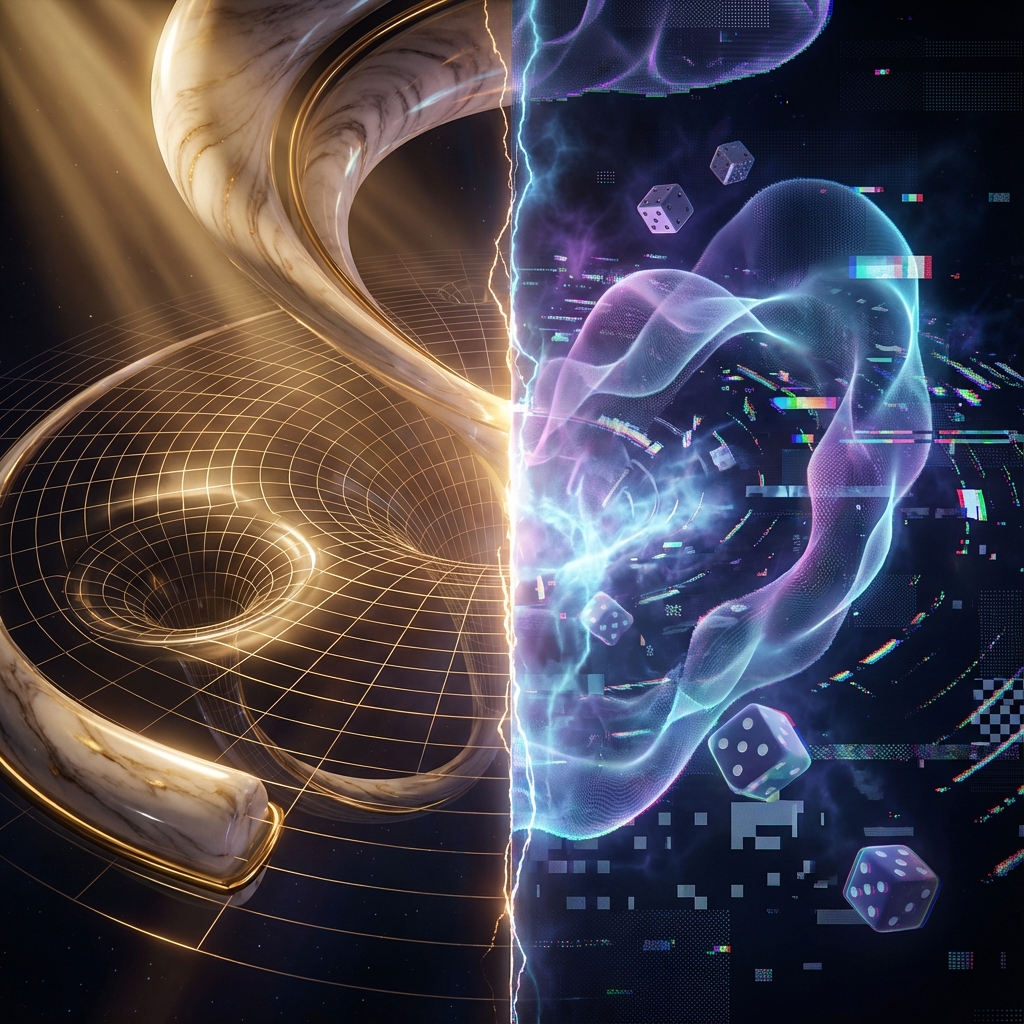
If physics is a religion describing the universe, then for the past century, we have actually been serving two gods with vastly different temperaments.
The first god dwells in the macrocosmic temple, and his name is Albert Einstein. The world he created—General Relativity—is exquisitely smooth, elegant, and deterministic. In this world, space and time are not some rigid background stage, but a soft fabric. When you place a massive object (like the Sun) on this fabric, it bends and sags. Planets are not orbiting the Sun under the pull of some mysterious force; they are simply sliding along the “straightest-looking” paths on this curved fabric.
Einstein’s universe is like a flawless piece of marble. In this universe, if you know the positions and velocities of all objects at this moment, you can in principle predict every second ten thousand years from now with extreme precision. There are no jumps, no fuzziness; you can even zoom in infinitely on spacetime, and it remains smooth and continuous forever. This is a geometer’s dream, a theory about shape.
However, when you try to peer deep into matter with a microscope, when you zoom in to the scale of atomic nuclei, Einstein’s god disappears. You enter the domain of the second god—Quantum Mechanics.
Here, the ruler is Niels Bohr and his Copenhagen school. The rules here are no longer geometric, but algebraic. In this microscopic world, particles no longer have definite positions and trajectories; they become diffuse wave functions, or rotating vectors in Hilbert Space. Nature here reveals its granular side: energy does not flow continuously, but is transmitted in discrete “packets.” More disturbingly, the core law here is probability. Like a god rolling dice, you cannot know for certain what will happen next; you can only calculate the probability of it happening.
This is the schizophrenia of modern physics.
For more than half a century, physicists have been trying to mediate the war between these two gods. We have attempted to build a “Theory of Everything,” trying to describe both the swallowing of black holes (extreme gravity) and the jumping of electrons (extreme quantum) with a single set of equations.
But whenever we try to force them together, disaster strikes. When you try to calculate the fluctuations of the gravitational field at quantum scales, the mathematical equations collapse, and the calculations yield infinity. It’s like trying to draw an absolutely perfect smooth curve (General Relativity) on a low-resolution screen full of pixels (Quantum Mechanics); no matter how hard you try, the pixelated jaggedness will always destroy the curve’s perfection.
Where exactly is the root of the problem?
Mainstream attempts—such as string theory or loop quantum gravity—believe the problem lies in structure. Perhaps particles are not points, but vibrating strings? Perhaps space itself is woven from tiny loops?
But this book wants to propose a more radical view: The problem is not what structure we have discovered, but what language we are using.
General Relativity relies on “spacetime manifolds” (Manifold), which assumes the universe is a place where things happen. Quantum Mechanics relies on “Linear Algebra,” which suggests the universe is a superposition of states. This is not just a difference in mathematical techniques; it is a fundamental conflict of worldviews—a conflict of “Ontology.”
One says: “The world is curved geometry.”
The other says: “The world is probabilistic algebra.”
Perhaps they are both wrong. Or more accurately, they have each only seen one side of the truth.
If we are to end this war, we cannot patch up the old ruins. We need to step out of spacetime, this old stage, and seek a deeper, broader mathematical container. We need a “third language,” one that can accommodate both the curvature of geometry and the superposition of algebra.
This container has long existed in mathematicians’ drawers; it is called Projective Hilbert Space.
In this space, the universe is not a drama evolving in space over time, but a silent, eternal mathematical object. Let us imagine it as a lazy afternoon, sunlight shimmering on the sea. In this high-dimensional ocean, there is no clamor of the Big Bang, no collisions of particles, only pure, coherent, ceaseless passage.
That is the true starting point of our story.
(Next, we will enter section 1.2, formally unveil this “cosmic terminal object,” and propose that single axiom.)