6.2 The Complex Origami
“What we call ‘particles’ are merely ways of knotting high-dimensional geometry at microscopic scales. The Standard Model is not a chaotic periodic table but a precise origami manual.”
In the previous section, we revealed that (internal velocity) is not a single value but an entrance to a deeper cascade structure. Now, we will enter the core of this internal world to explore the geometric essence of modern physics’ most magnificent and perplexing theory—The Standard Model—from the perspective of Vector Cosmology.
Physicists are often puzzled by why the universe needs so many strange quantum numbers: charge, spin, isospin, color charge, hypercharge… These labels look like convenience stickers artificially attached. But in our FS geometric framework, these “labels” have unified and intuitive physical meaning: they are rotation modes of a single vector on different Internal Manifolds.
The universe did not invent “charge”; the universe merely folded that unique vector into a circle in a specific dimension and let the vector rotate along it.
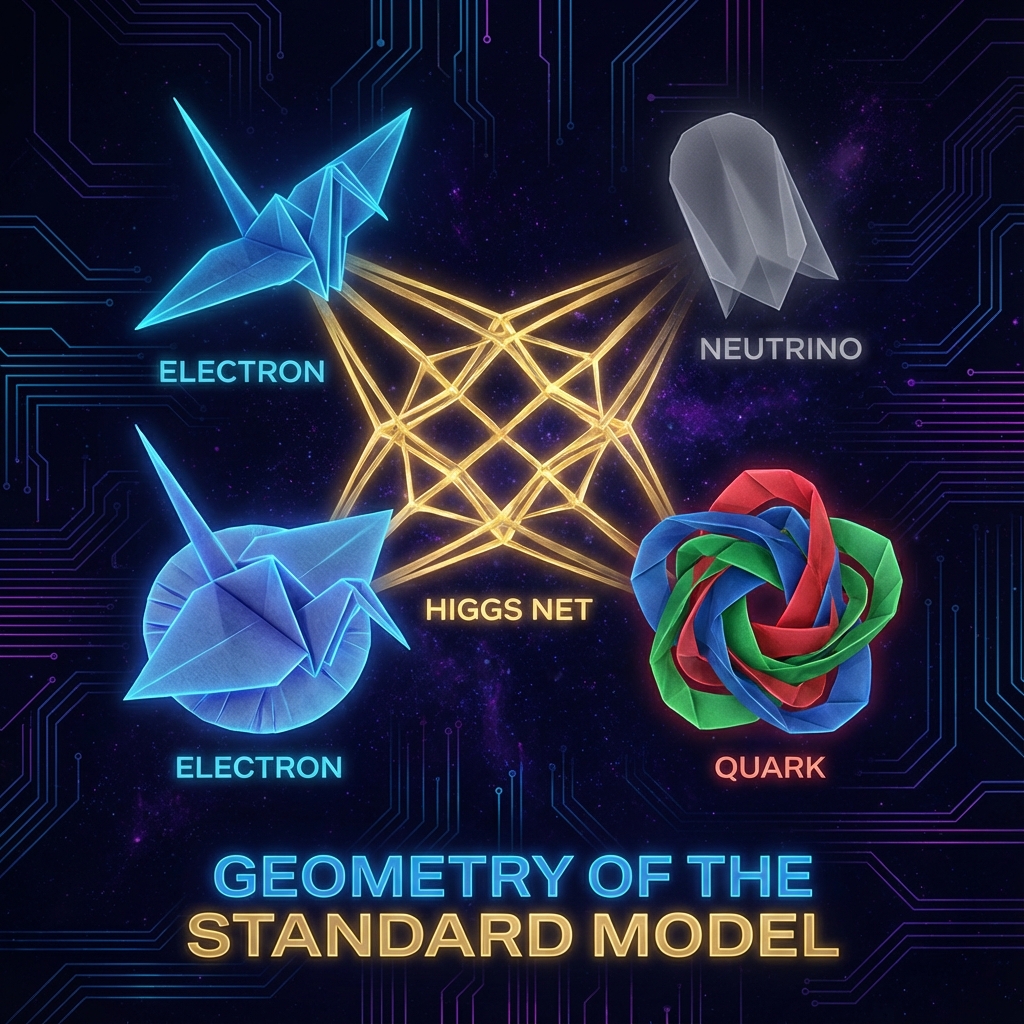
Topological Structure of Internal Space
If we imagine the universe’s total vector as a flat sheet of paper, then orthogonal decomposition is drawing lines on the paper. And the Standard Model is an extremely complex folding of this paper at microscopic scales.
According to gauge field theory, the Standard Model’s mathematical structure is based on the group . These are not just abstract algebraic symbols; they correspond to specific geometric shapes:
-
: A circle.
-
: A three-dimensional hypersphere (3-Sphere).
-
: An eight-dimensional complex manifold.
When we invest the budget into the internal sector , this velocity vector does not wander randomly in the void; it is constrained to run on orbits of these specific shapes.
Charge as Velocity
In classical physics, we are accustomed to viewing “charge” as some kind of material substance painted on particle surfaces. But in FS geometry, Charge is merely an alias for angular velocity.
Let us rewrite that famous Noether’s Theorem: every symmetry corresponds to a conserved quantity.
-
Rotational symmetry in space corresponds to angular momentum (spin).
-
Rotational symmetry in internal space corresponds to charge.
-
Electromagnetic Origami ():
Imagine the vector rotating on a circle in the internal space. The angular velocity of this rotation is what we observe as Electric Charge.
-
Electrons are negatively charged because their vector rotates counterclockwise on this circle.
-
Positrons are positively charged because they rotate clockwise on the same circle.
-
Neutrons are uncharged because their vector’s projection component on this circle is zero ().
-
-
Weak Force Origami ():
This is a more complex folding. The vector rotates on the surface of a three-dimensional hypersphere (). The “charge” produced by this rotation is called Weak Isospin.
The special feature of this dimension is that it has Chirality—like a Möbius strip, only “left-handed” particles can run smoothly in this origami structure. This is the geometric root of why weak interactions violate parity.
-
Strong Force Origami ():
This is the most complex origami art. The vector winds in an eight-dimensional manifold (). There are so many rotational degrees of freedom here that we need three coordinates (red, green, blue) to describe its position. This produces Color Charge.
The component here is extremely large, meaning the vector consumes an extremely high proportion of the budget here. This is why the strong interaction is much stronger than the electromagnetic force—it occupies a larger geometric “bandwidth.”
Geometric Identity of Particles
At this point, the truth about the so-called “particle zoo” is revealed. The universe does not have dozens of different fundamental particles; the universe has only one vector and multiple folding methods.
Each particle is essentially a “budget allocation protocol” or “geometric rotation combination”:
-
Electron = Invest a little in + rotate at full speed on (circle) + rotate at full speed on (hypersphere) + remain stationary on (eight-dimensional manifold).
-
Quark = Invest moderately in + invest partially in (fractional charge) + rotate at full speed on .
-
Neutrino = Invest extremely little in + zero on both and + rotate only on .
This is why neutrinos can penetrate Earth—because their projections on most internal geometric dimensions are zero, they have no “geometric intersection” with ordinary matter (mainly composed of and ), like two radio stations broadcasting on different channels.
Higgs Field: The Glue of Origami
If the Standard Model is origami, what is the Higgs field?
It is glue.
At extremely high energy scales (the beginning of the Big Bang), all origami structures were unfolded, and symmetry was perfect. All particles were massless, and vectors slid freely in these dimensions.
However, as the universe cooled, the Higgs field underwent condensation. This condensation is like glue drying, forcibly bonding and fixing certain geometric structures.
Vectors that were originally freely rotating were forced to “stick” or “slow down” in certain dimensions. This resistance forced part of the budget to transfer from (light-speed flight) to maintaining internal dimensions. This “internal retention” produced by Higgs glue sticking is precisely the origin of rest mass ().
Chapter Summary
By geometrizing the Standard Model, we eliminate mysticism in physics.
There is no magical “charge fluid,” nor are there colored “quark entities.” There is only that unique, eternal vector, running, rotating, and winding ceaselessly in that high-dimensional manifold maze we call “internal space.”
If you could see that microscopic geometric world, you would not see particles. You would see countless tiny, vibrating strings or loops, which are projections of that great circle onto tiny dimensions. And we are precisely the magnificent patterns woven by these complex “origami.”