5.2 The Information-Velocity Circle Experiment
“We do not need to build a microscope that only God can use. On our laboratory tables, we can simulate the pixel texture of the universe’s deepest layer.”
In the previous section, we proposed a shocking theoretical prediction: that perfect “information-velocity circle” symbolizing special relativistic symmetry will undergo “Droop” under extreme conditions approaching the Planck scale. This means relativity is merely a macroscopic illusion; discreteness is the truth of the universe.
But this immediately raises a sharp question: How do we verify it?
The Planck length is meters. To probe effects at this scale, we would need a particle accelerator larger than the Milky Way. In the foreseeable future, humanity has absolutely no possibility of directly touching spacetime’s lattice.
However, Vector Cosmology provides a shortcut. Since our theory is based on the mathematical structure of Quantum Cellular Automata (QCA), we only need to construct an artificial, macroscopic QCA system in the laboratory to reproduce the universe’s underlying logic at a controllable scale.
We call this—The Information-Velocity Circle Experiment.
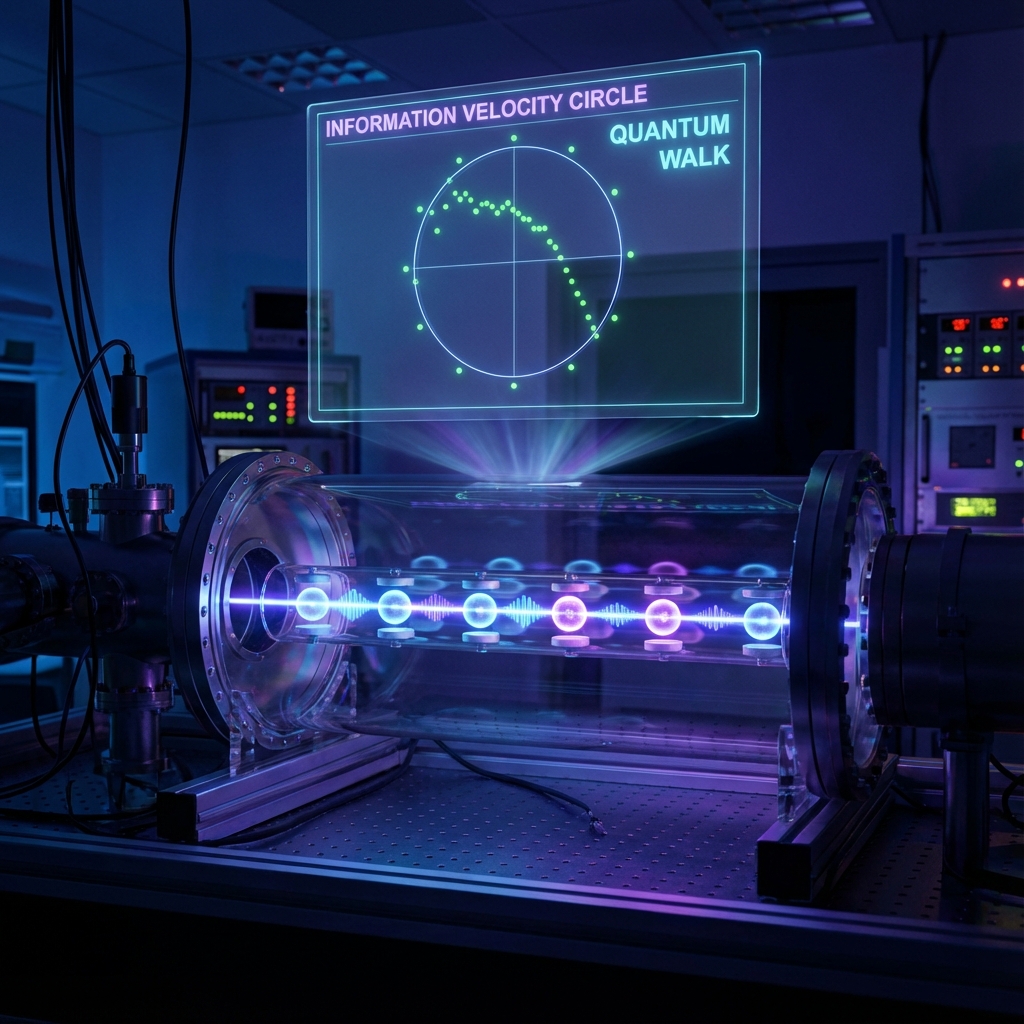
Building Blocks of Simulated Universe: Quantum Walk
We don’t need to actually disassemble spacetime; we can “run” spacetime.
In modern quantum optics and cold atom laboratories, physicists have mastered a technique called Quantum Walk. This is not just a mathematical toy; it is an exact simulator of the Dirac equation on a discrete lattice.
Imagine a photon or an ion (the “walker”) jumping on a one-dimensional chain formed by laser potential traps.
-
Lattice: The spacing of laser potential traps plays the role of “Planck length .” Although it may be several micrometers long, mathematically, it is the smallest pixel of this miniature universe.
-
Coin: The particle’s internal spin state (such as ) plays the role of the “internal sector.”
-
Each Step: The laser pulse operation plays the role of “Planck time .”
In this artificial universe, we are God. We can arbitrarily adjust “light speed” (lattice update rate) and arbitrarily assign particles “mass” (by rotating internal coin states).
Experimental Protocol: Redrawing Pythagoras’ Circle
The goal of the experiment is very clear: measure the external velocity () and internal velocity () in this miniature universe, and see if they satisfy .
-
Measuring (group velocity):
We prepare a wave packet with a specific quasi-momentum on the lattice and let it evolve freely. By tracking the displacement of the wave packet center over time , we can directly measure its drift velocity. This corresponds to the particle’s macroscopic flight velocity.
-
Measuring (internal precession rate):
This is a more delicate operation. We need to measure how fast the particle’s internal “clock” ticks. In quantum walks, this corresponds to the rotation speed of the coin state (spin) in parameter space. Through Ramsey interference techniques or Rabi oscillation measurements, we can extract this internal frequency. This corresponds to the particle’s rest energy or mass term.
We will repeat the above measurements for different momenta (from long waves near 0 to short waves near ), and plot each set of data points on coordinate paper.
Witnessing “Droop”: Resistance from Pixels
What will the results be?
-
In the low-momentum region ():
Data points will perfectly fall on a circle of radius (normalized units).
This simulates the situation in our real world: particle wavelengths are far greater than lattice spacing, Lorentz symmetry perfectly emerges, and relativity holds.
-
In the high-momentum region ():
As momentum increases, the wave packet begins to “sense” that the lattice beneath its feet is no longer smooth ground but discontinuous steps. Data points will begin to detach from the circle and collapse toward the center.
On the experimental chart, this manifests as a clearly inward-curving arc, which is the “Lattice Droop” we predicted.
The Philosophical Significance of the Experiment
This is not just a verification of a formula; it is humanity’s first direct visualization of how “discreteness” destroys “symmetry”.
The gap (deviation) on the chart is the pixel texture of the universe’s underlying structure.
-
It tells us: Relativity’s perfect circle is just a visual illusion caused by standing too far to see details.
-
It proves: In a universe constrained by finite information budget (), when you try to update information at extremely high frequencies (high ), the geometric structure of the lattice itself becomes a resistance, consuming part of the budget originally applied to conservation.
This experiment is the decisive evidence for Vector Cosmology. It shows us that if we could build a powerful enough microscope to observe the vacuum, we would no longer see Einstein’s smooth spacetime curvature; we would see the exposed, jagged digital skeleton of quantum cellular automata.
And now, through quantum walks, we have actually seen the shadow of this skeleton.