Chapter 5: The Drooping Circle
We have delved deep into the universe’s microscopic engine room, witnessing the ticking Quantum Cellular Automata (QCA) lattice at that extremely tiny scale. In this discrete pixel world, continuous space is just an illusion, and infinity is strictly forbidden.
Now, we face a most audacious question: What happens if we run at full speed on this microscopic lattice?
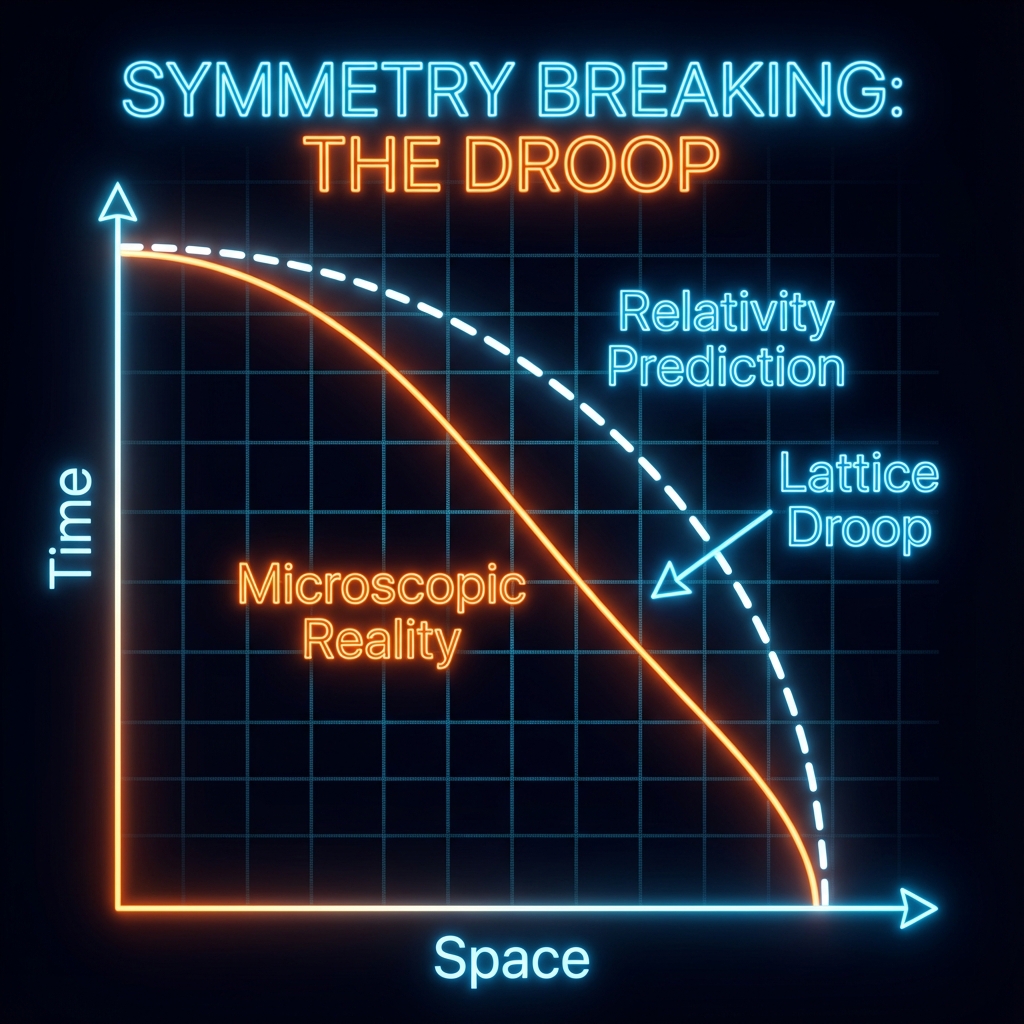
In the macroscopic world, Einstein’s relativity tells us that no matter how fast you run, physical laws are perfect and symmetric. But from the microscopic perspective of Vector Cosmology, we will reveal an astonishing secret: When you approach the universe’s “pixel limit,” the perfect symmetry of relativity will break. That perfect circle symbolizing spacetime conservation will show visible distortion.
We call this phenomenon—“Droop”.
5.1 The Breaking of Lorentz Symmetry
“Relativity is not the whole truth; it is a blurry projection of truth at low resolution.”
In physics, Lorentz Symmetry is regarded as a sacred and inviolable axiom. It guarantees that no matter how fast you move in the universe (as long as below light speed), the form of physical laws you see remains unchanged. It guarantees that the Dirac circle is always a perfect circle.
However, in a discrete universe based on QCA, this is only an emergent truth.
The Perfect Circle is Only a Low-Energy Illusion
Let us return to that Pythagorean identity. In the continuous limit (i.e., the macroscopic scale of our daily lives), wavelengths are far greater than lattice spacing (). At this point, QCA’s discrete dispersion relation can be approximated through Taylor expansion as the perfect relativistic form .
This is why we have verified relativity countless times in experiments with perfect accuracy—because we are too “slow,” our energy is too “low.” We have always lived on an extremely small arc at the top of that circle, which looks like a perfect circle.
Lattice Artifacts: When the Circle Becomes a Chord
But when we push energy to the limit, making particle wavelengths approach the Planck length (i.e., momentum approaches the Brillouin zone boundary ), the higher-order terms of the Taylor expansion can no longer be ignored. The “graininess” of the lattice begins to manifest.
In the QCA model, we discover a shocking deviation:
The equality becomes an inequality!
As momentum increases, the point representing the system state no longer runs tightly along that perfect circle of radius but begins to collapse toward the center. On the information-velocity plane , the trajectory of data points is no longer a circular arc but a Drooping Curve.
This is called “Lattice Droop”.
Physical Meaning: Pixel Resistance
What does this “droop” mean?
-
“Devaluation” of total budget: At extremely high energy scales, the universe seems to “lose” part of its effective budget for evolution. This is because on a discrete grid, high-frequency oscillating modes are suppressed by lattice geometry (similar to lattice scattering or dispersion of high-frequency phonons).
-
Anisotropy of light speed: Although we only discuss a one-dimensional model here, in higher-dimensional lattices, this breaking means “light speed” may show tiny differences in different directions. Running along grid axes and running along diagonals experience different “pixel resistance.”
-
Return of absolute reference frame: The breaking of Lorentz symmetry implies the existence of a preferred reference frame—that is the lattice itself (the universe’s stationary grid). At extremely microscopic scales, you can indeed distinguish “who is moving” and “who is not moving.”
Conclusion: The Boundary of Relativity
Therefore, special relativity is not the universe’s underlying meta-law; it is merely a statistical approximation of QCA dynamics in the long-wavelength limit.
Just like displaying a circle on a computer screen, it looks like a perfect circle from afar, but if you press your face against the screen (approaching Planck scale), you will see it is actually a jagged polygon composed of square pixels. That “droop” is the jagged edge of the universe’s underlying structure that we glimpse through macroscopic appearance.
This does not mean relativity is wrong; it is merely an Effective Field Theory. In of physical situations, the circle is circular. But in that final —near black hole singularities, in the first instant of the Big Bang—the circle breaks, exposing the underlying digital grid. And it is precisely this breaking that hints at the true entrance to quantum gravity.