4.3 The Denial of Infinity
“Nature abhors a vacuum, but nature abhors infinity even more. True physics breathes only within finite boundaries.”
In the glorious halls of classical physics and quantum field theory, a persistent ghost wanders—Infinity.
When we try to calculate an electron’s self-energy or the vacuum’s zero-point energy, standard theory often gives the answer “infinity.” Physicists are forced to invent a mathematical technique called Renormalization, carefully subtracting these infinities to obtain finite observed values. Although this method has achieved remarkable experimental success, philosophically and logically, it always seems like a form of “cheating” to cover up theoretical defects.
From the microscopic perspective of Vector Cosmology, we no longer need this cover-up.
By introducing Quantum Cellular Automata (QCA) as the universe’s underlying architecture, we not only explain the origin of light speed but also thoroughly “deny infinity”. In this discrete universe, singularities disappear, divergences terminate, and everything returns to elegant finiteness.
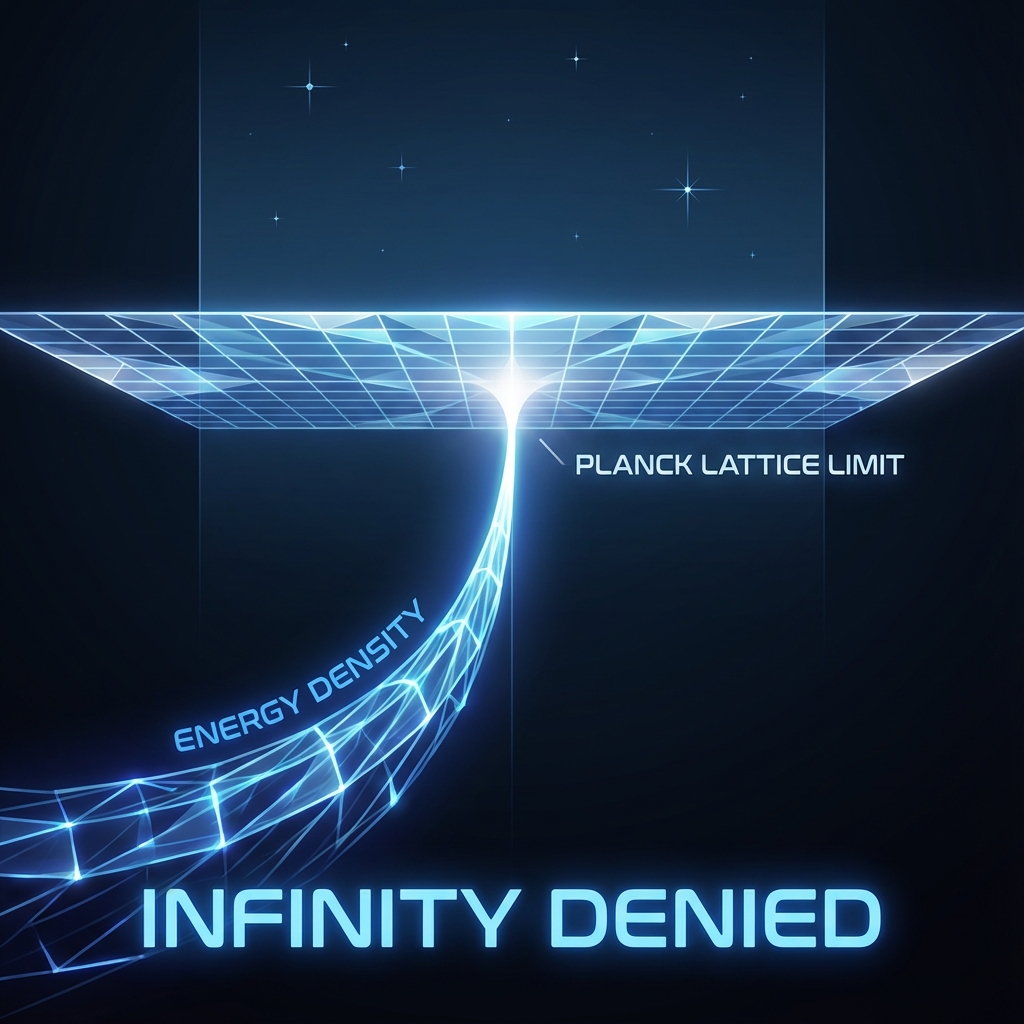
The Curse of Continuity: Ultraviolet Divergence
Why does traditional physics encounter infinity? The culprit lies in our obsession with “continuous space”.
In continuous field theory, we treat space as infinitely divisible. This means wavelengths can be infinitely short and frequencies can be infinitely high. When we try to count the total energy (or total probability) in a spatial region, we need to integrate over all possible frequency modes:
The upper limit of the integral is infinity, which is called Ultraviolet Divergence. It implies that if space remains continuous at extremely tiny scales, then every inch of void contains infinite energy sufficient to destroy the universe. This is obviously absurd.
The Lattice’s Redemption: The Closure of the Brillouin Zone
In the discrete lattice model of QCA, this integral upper limit is naturally truncated.
In Section 4.1, we established that the universe has a smallest scale—the Planck length . This means physical wavelengths cannot be shorter than .
In momentum space, this spatial discreteness leads to a profound geometric consequence: momentum is no longer an infinitely extending straight line but a closed loop or a finite interval. This is called the Brillouin Zone in solid-state physics.
All physical momentum is confined to the interval .
All energy is confined to a finite bandwidth.
Therefore, the integral that causes infinity is forcibly terminated by physical mechanisms:
This is not an artificially introduced cutoff; it is an intrinsic property of the universe’s discrete structure. In this system, no physical process can excite energy beyond the Brillouin zone boundary. The so-called “infinite energy” is merely a computational artifact produced when we use the wrong mathematical tool (continuous calculus) to describe a world that is essentially digital.
The Illusion of Trans-Planckian Scales
This mechanism perfectly solves the “Trans-Planckian Problem” that plagues black hole physics and cosmology.
In calculations of Hawking radiation or cosmic inflation, if we trace back time continuously, particles’ wavelengths seem to be infinitely compressed due to redshift effects, eventually becoming smaller than the Planck length, with energy becoming infinite. This has caused panic among countless theoretical physicists.
But in the QCA model of Vector Cosmology, this panic is unnecessary.
-
No infinite compression: When a wave packet’s wavelength is compressed close to the lattice constant , it touches the Brillouin zone boundary.
-
Aliasing effect: On a discrete grid, waves with wavelength and are indistinguishable (similar to how a wheel spinning too fast appears to rotate backward).
Those modes that seem to have “trans-Planckian energy” are actually ordinary modes at the edge of the Brillouin zone. They are mapped back into the finite energy band. The universe does not collapse, nor are there singularities; there is only information cycling within finite bandwidth.
The Ultimate Limit of FS Capacity
This finiteness again echoes our core axiom—constant FS capacity ().
This formula not only defines light speed but also defines the universe’s maximum computational power.
If the universe allowed infinity (whether infinite energy density or infinitely subdivided space), then the required to maintain this universe’s operation would have to be infinite. But since we assume the universe is a single, normalized vector , its total rate of change must be finite.
Denying infinity means acknowledging that the universe’s resources are finite.
-
Black hole singularities do not exist: At the center of gravitational collapse, matter is not squeezed into a point of infinite density but reaches the lattice’s information storage limit (saturated ).
-
Big Bang singularities do not exist: At , the universe is not a point of zero volume and infinite temperature but an initial grid configuration in an extremely high (but finite) entangled state.
Conclusion: Finiteness is Perfection
We once thought that only “infinity” was worthy of the universe’s grandeur. But in Vector Cosmology, we discover that “finiteness” is true elegance.
Through QCA as the microscopic engine, we eliminate all pathological divergences in physics. We construct a clean, computable universe. Here, every unit of energy is accountable, and every bit has a place.
At this point, we have completed our exploration of the microscopic discrete structure. We know the universe is pixelated, light speed is its refresh rate, and infinity is its forbidden zone.
But is this discreteness truly undetectable? Can that perfect “Dirac circle” really remain perfect on microscopic pixel grids?
In the next chapter, we will make a bold prediction. We will see that when we approach this lattice limit, relativistic symmetry will break. That originally smooth circle will begin to “sag”.