4.2 The Microscopic Origin of Light Speed
“Light did not receive a traffic ticket. Light appears so fast because it has traversed all the cells.”
In special relativity, the speed of light is revered as a sacred and inviolable constant. Einstein introduced it as an axiom but never explained why the universe must have a speed limit. Why meters per second? Why not infinity?
In the microscopic engine room of Vector Cosmology, we can finally lift the veil on this constant. The speed of light is not a parameter arbitrarily set by God; it is the hardware performance indicator of the universe’s underlying discrete structure.
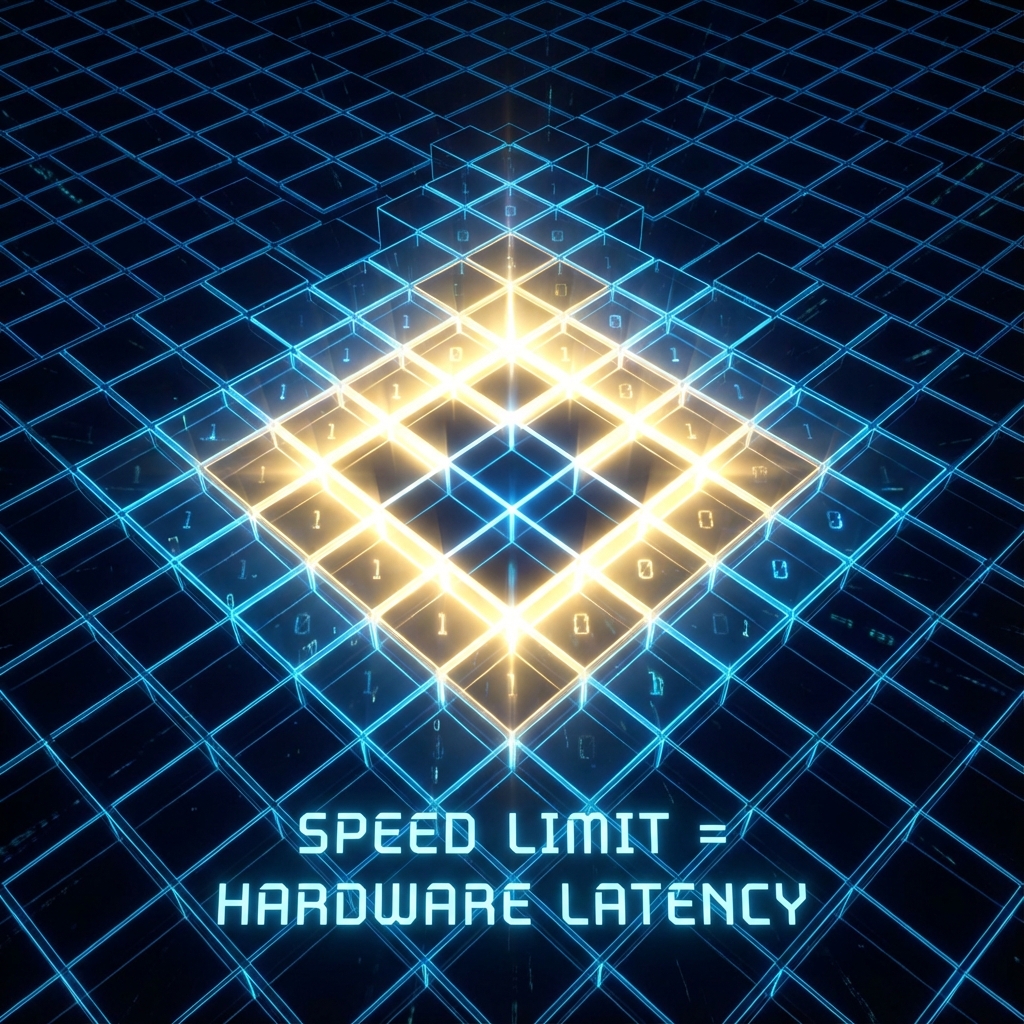
The Jump Limit of Information
In the previous section, we established that the universe’s substrate is a Quantum Cellular Automata (QCA) lattice. In this discrete world, there is no true “continuous motion.” What we call motion is essentially the transmission and replication of information between adjacent grid points.
Let us examine the microscopic mechanism of this process:
-
Locality: In QCA rules, each grid point can only interact with its directly adjacent grid points within one update step .
-
Finiteness: The distance between grid points is fixed (Planck length), and the update time interval is also fixed (Planck time).
This means that no matter how intense the interaction, the maximum distance information can propagate in one step is locked to . Therefore, the maximum physical speed of information propagation is:
This speed is called the Lieb-Robinson Velocity in mathematical physics. It is the inherent causal boundary of all lattice systems. No signal can exceed this speed, just as on a chessboard, no matter how clever your strategy, your piece can only move to an adjacent square in one step and cannot instantly teleport to the other end of the board.
The familiar speed of light is precisely the emergent manifestation of this microscopic Lieb-Robinson velocity in the macroscopic continuous limit. The speed of light is finite because the universe’s “refresh rate” and “pixel spacing” are finite.
Physical Calibration of FS Capacity
Now, we need to connect this physical lattice velocity with the abstract budget FS capacity () we defined in Volume 1.
In the geometry of projective Hilbert space, measures the angular velocity of global quantum state evolution. In the physical picture of QCA, measures the spatial velocity of wave packet propagation on the lattice. There exists a strict mathematical correspondence between the two.
For a standard Dirac-type QCA model, we can prove:
This formula reveals the true physical dimension of :
-
is spatial velocity (length/time).
-
is information processing capacity (1/time, or frequency).
This again confirms our “economic metaphor”: Light speed () is only appearance; computational power () is the essence. The universe limits how fast objects move because it limits the amount of information updates that can be processed in each Planck time.
When we say “light speed is the limit,” we are actually saying: The bandwidth of the universe, this computer, is saturated. When a physical process consumes all budget for moving data between grids ( reaches maximum), it reaches the physical speed of light .
The Emergent Light Cone
At this point, the mysterious Light Cone structure also has an extremely simple explanation.
In relativity, the light cone distinguishes the past, future, and absolute “elsewhere.” From the QCA perspective, the light cone is the wavefront of information diffusion.
Imagine dropping a stone into calm water (a local perturbation).
-
At , only the center point is affected.
-
At , the influence spreads to the nearest neighbors.
-
At , the affected region is an area with radius .
This continuously expanding region boundary is the light cone. The Lieb-Robinson theorem mathematically guarantees that outside this light cone, any correlation function decays exponentially. This means causality is not an abstract philosophical principle but a statistical necessity of discrete dynamics.
Conclusion: The Iron Law of Hardware
Through microscopic examination, we find that special relativity is not the ultimate truth of the universe; it is merely an approximation of discrete lattice dynamics in the low-energy long-wavelength limit.
-
There is no magical axiom called “constancy of light speed.”
-
There is only a rigid, mechanical set of local update rules.
We live in a huge cellular automaton. With each tick of Planck time, the universe redraws everything according to these rules. It is this mechanical, finite update process that gives us stable causality and that insurmountable speed limit.
But since the universe is a discrete lattice, when we probe extremely tiny scales with extremely high energy, can that perfect, circular relativistic symmetry still hold? Just as zooming into a low-resolution photo reveals pixels, will our physical laws show cracks at the microscopic limit?
This is precisely the theme of the next chapter—The Sagging Circle. We will see that at that extreme scale, even relativity itself collapses.