Chapter 3: Gravity: Market Distortion
“Matter tells spacetime how to allocate budget; spacetime tells matter how to move according to the remaining budget.”
In the previous two chapters, we established a universe model based on a single-particle perspective: a particle is like a lone trader, engaging in a zero-sum game between its own (motion) and (existence).
However, the universe is not alone. When countless particles gather together—forming rocks, planets, stars, and even galaxies—quantitative change triggers qualitative change. These massive aggregates are no longer merely participants in the market; they become rule-makers.
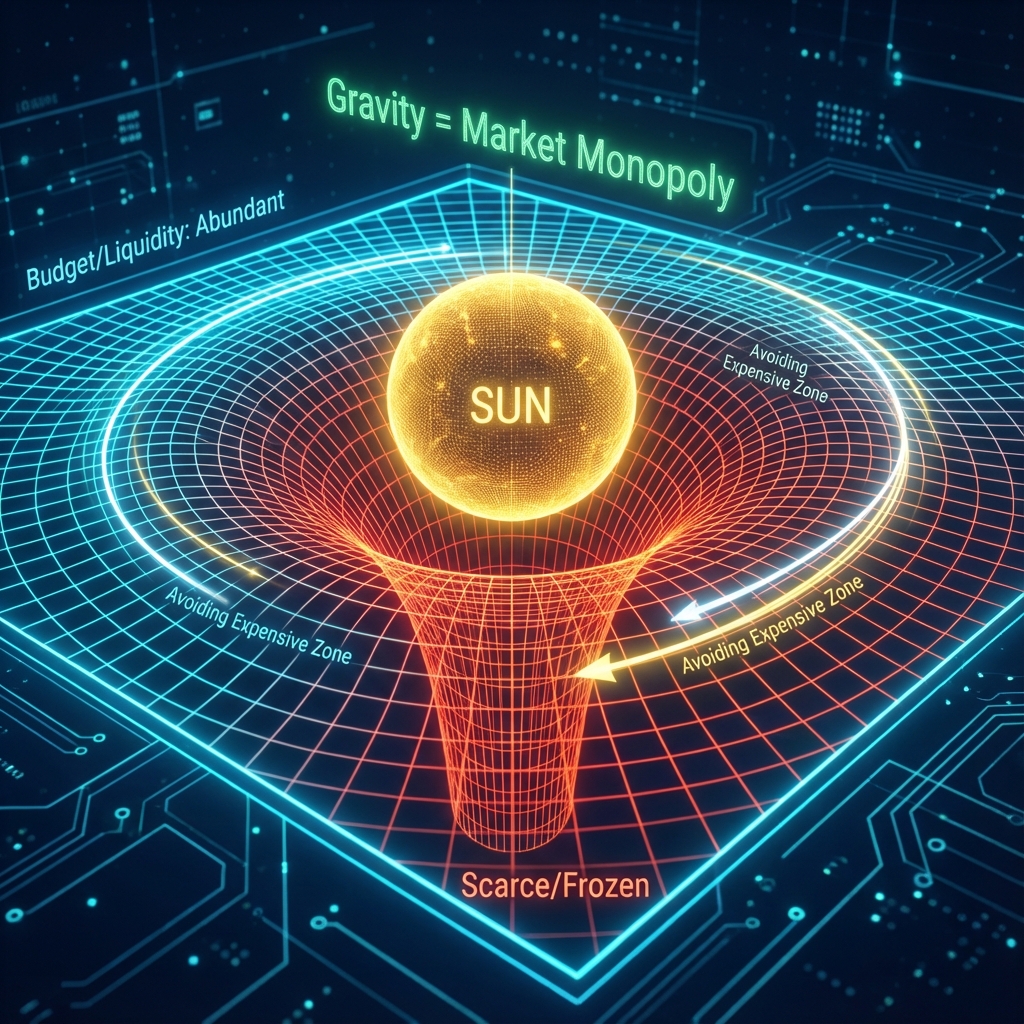
In general relativity, this is called “spacetime curvature.” But from the economic perspective of Vector Cosmology, this should be more precisely described as a “Market Monopoly”.
3.1 The Monopolist
If photons are free wanderers, then massive celestial bodies like Earth or the Sun are the universe’s top oligopolistic monopolists.
High-Density Asset Accumulation
Let us recall the essence of mass: mass is frozen budget. A proton with enormous means it consumes an extremely high information update rate in the microscopic dimension.
Now, imagine compressing protons (the mass of the Sun) into a relatively small spatial region. This creates a terrible consequence: regional computational power depletion.
In this vast Quantum Cellular Automata (QCA) network that is the universe, each spatial node (or Planck volume) has an upper limit on the FS capacity density it can carry. When a massive object occupies this region, it is essentially declaring: “All bandwidth in this region is used by me to maintain my internal existence ().”
This is high-density asset accumulation. The location of the Sun is no longer a flat stage but a massive budget black hole (here “black hole” is a metaphor, referring to resource consumption). It monopolizes local , causing severe distortion of the “background capacity” in that region.
The Crowding-Out Effect
What does this monopoly mean for surrounding space? It creates a crowding-out effect.
In the deep vacuum far from mass, spatial nodes are idle, and any passing photon or particle can freely apply for budget for (displacement). The “transaction cost” there is low, and the geometric structure is flat.
But when you approach a massive object (monopolist), the situation changes. Since the monopolist has already requisitioned most of the underlying degrees of freedom to encode its own mass information, the effective budget available to “passers-by” becomes scarce.
This scarcity manifests geometrically as changes in the metric.
In general relativity, we say that time flows slower in gravitational potential wells (gravitational redshift). In our vector language, this is because the monopolist has seized the refresh rate.
-
On Earth’s surface, the underlying network of space is busy processing Earth’s own massive data stream.
-
When you stand on the ground, the local environment you are in has its “background refresh rate” actually “dragged down” by Earth’s mass. To maintain total budget balance, any observer in this strong gravitational field has their available share shrunk relative to distant observers.
You have not slowed down; it is the “market” you are in that has slowed down.
From Curvature to Gradient
Therefore, gravity is no longer a mysterious force emanating from large objects and pulling small objects. Gravity is a gradient caused by uneven budget distribution.
Imagine a huge spreadsheet representing the space of the universe.
-
In vacuum regions, each cell’s value (available budget) is 100.
-
At the Sun’s location, the cell’s value becomes 1 (because 99 are occupied by the Sun).
-
Between the two, a descending gradient from 100 to 1 is formed.
When a small asteroid (test particle) enters this region, it instinctively follows Fermat’s principle or the principle of least action. It is not “pulled” toward the Sun; it is trying to find an optimal path in a market where liquidity is gradually drying up.
This explains why light bends when passing the Sun. Light does not feel a force; light is merely traversing a region of “computational congestion”. To maintain its constant consumption (light speed), it must adjust its path to adapt to the distortion of local spatial geometry (budget density).
Conclusion: Gravity is the management cost the universe must pay to handle high-density information accumulation. Massive objects, by monopolizing , distort the trading rules around them. So-called “universal gravitation” is merely the path correction that free particles are forced to make when facing market monopoly.