2.3 Mass as Frozen Assets
“Inertia is not an object’s property of resisting motion, but the resistance of budget to reallocation.”
In the geometric derivation of the Dirac Circle, we witnessed a mathematical miracle: the famous mass-energy relation in physics is essentially just an algebraic transformation of the information-velocity circle .
However, this is not merely a mathematical game. This equation forces us to redefine one of the most fundamental yet perplexing concepts in physics—Mass.
In Newtonian mechanics, mass is regarded as an intrinsic property of matter, representing the “amount of matter.” But from the perspective of Vector Cosmology, this static definition is completely shattered. Mass is no longer a noun but a consequence of a verb.
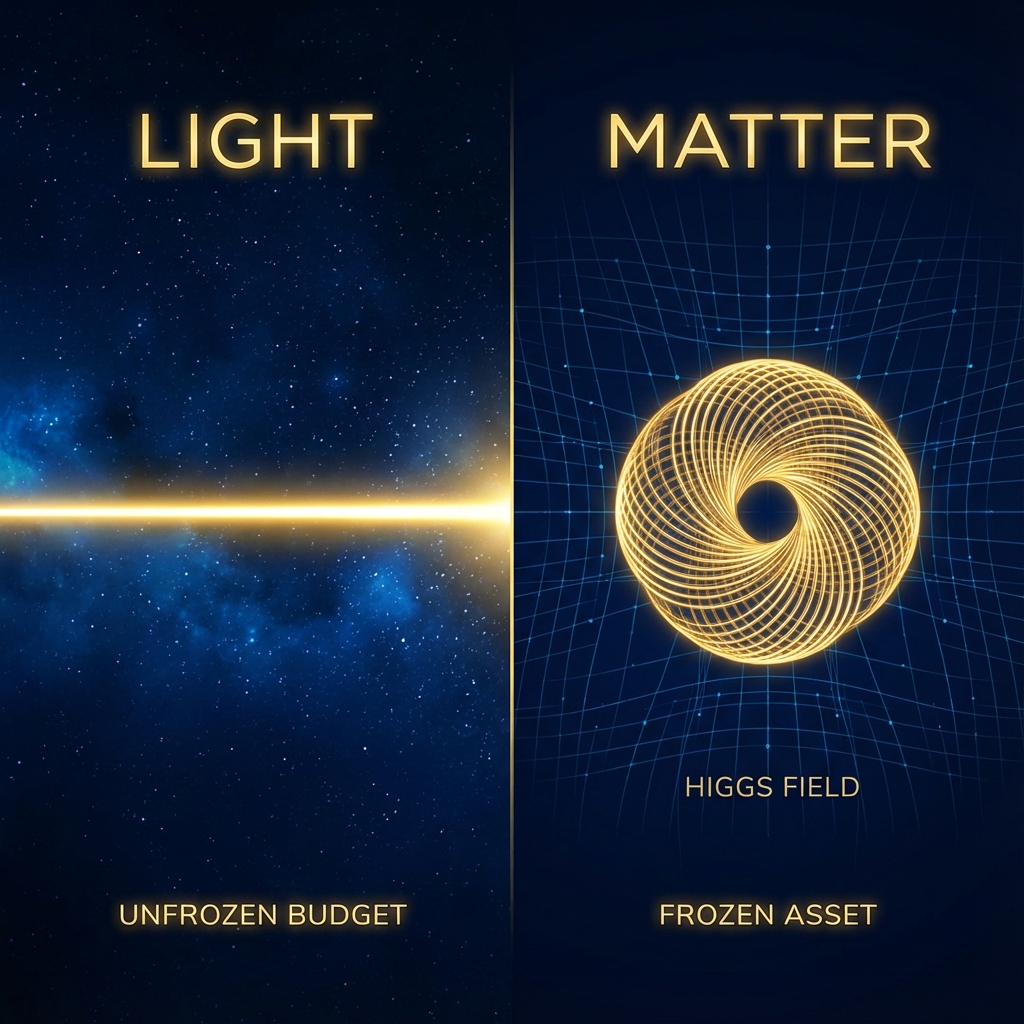
Static Budget and the Origin of Inertia
If we view the universe as an economy, then (FS capacity) is the cash flow you must spend at each moment. You cannot save it; you must let it flow—either to external space () or to internal structure ().
What is mass ()?
Mass is the “asset sedimentation” formed when a system chooses to invest most of its budget in internal evolution ().
When a particle possesses mass, it is essentially saying: “I lock my budget in the rotation of the internal dimension.” This locking creates a strong path dependence, which we call inertia in macroscopic physics.
Why is it hard to push a massive object?
-
Traditional explanation: Because it is heavy.
-
Vector Cosmology explanation: Because you are trying to force a system already running at full capacity to change its budget allocation table.
A massive object at rest has its occupying almost 100% of the budget. When you try to push it (increase its ), the system must painfully “divest” from its massive internal expenditure, converting part of into .
This “resistance to divestment” is inertia. The larger the mass, the more internal budget is locked, and the greater the “transaction cost” (force) required to change the direction of this massive investment.
The Eternity of Light: The Freedom of the Proletariat
To truly understand the essence of mass, we must look at its opposite—Light.
Photons (and other massless particles) are the proletariat of the universe. Their position on the Dirac Circle is extreme:
Substituting into the Pythagorean identity, we obtain:
This reveals three profound truths about light:
-
Light must move at light speed:
Light does not “want” to move fast. Light is penniless (no internal mass to consume budget), so it is forced to pour all its budget onto the external spatial axis. The speed of light is not a speed limit; it is the full payout when budget has nowhere else to go.
-
Light has no time:
Because , the photon’s internal clock never ticks. For a photon, from the moment it is born in the stellar core to the moment it strikes your retina, these two events are simultaneous. In light’s subjective perspective, the universe is an instantaneous slice. Light gains absolute freedom in space at the cost of losing all experience in time.
-
Light has no inertia:
Because light does not lock any budget in , it has no “fixed assets” to maintain. But this does not mean light has no energy; its energy is entirely manifested as kinetic energy (frequency).
Geometric Preview of the Higgs Mechanism
This raises an obvious question: If the universe’s default state should be free flight like light (), why would matter stop and become massive?
In the standard model of particle physics, this is called the Higgs Mechanism. In our geometric language, this can be described as a “forced budget freeze”.
You can imagine that in the very early universe, all particles were massless, all racing at . Suddenly, a “sticky” field (the Higgs field) appeared in space. Some particles interacted with this field. This interaction forced them to turn part of their inward, beginning to spin in place (acquiring ).
This frequency of “spinning in place” is what we define as mass.
Thus, light-speed flight stopped, and the passage of time began. The original energy flow was curled into matter. Every atom is a segment of imprisoned light, spinning wildly in the internal dimension.
Chapter Summary
At this point, we have completed the first round of reconstruction of the macroscopic architecture.
-
Relativity tells us the budget is limited.
-
The Dirac Circle tells us mass is the internal locking of budget.
-
Light tells us the eternal state after complete budget release.
The solid matter we see—tables, chairs, stars—are essentially “frozen assets”. The universe constructs a stable macroscopic world by locking in microscopic internal cycles. But these assets have not truly disappeared; they are just burning intensely in ways we cannot see (). Once these assets are unfrozen (nuclear reactions), the released will once again shake the world.
Now that we understand how “single particles” form mass through budget allocation, the next question is: When these particles with massive assets gather together, how will they distort the rules of the entire market through “monopoly”? In the next chapter, we will enter the realm of gravity.