2.2 The Dirac Circle
“Matter is not a stationary heavy object; matter is imprisoned light.”
In the previous section, we revealed how motion causes time to slow down through “budget squeeze.” Now, we turn our gaze to another holy grail of physics: the mass-energy equation.
Einstein’s most famous formula tells us that mass is energy. But this is merely a quantitative equality; it does not explain why. Why would formless energy solidify into tangible mass?
In Vector Cosmology, the answer lies hidden in a perfect geometric figure—we call it “The Dirac Circle”.
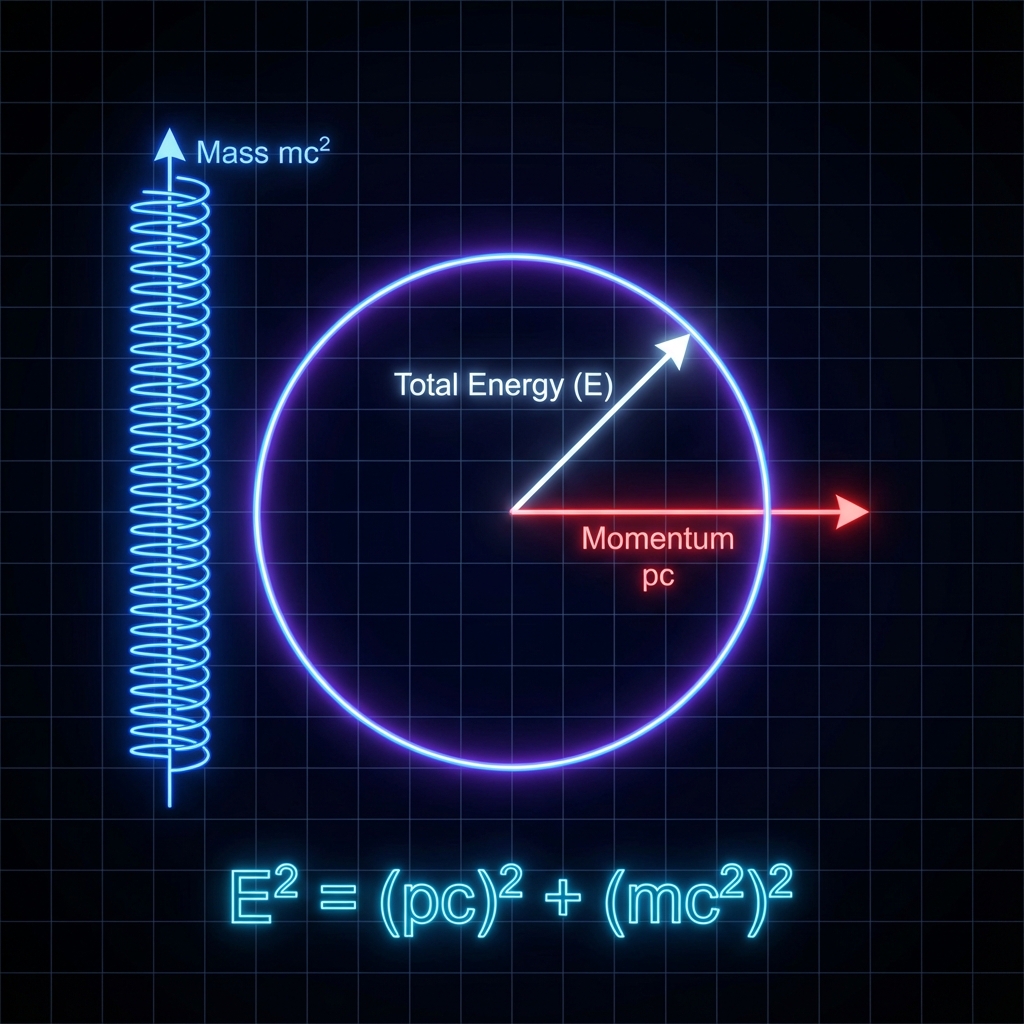
The Pythagorean Theorem of Energy
Let us rewrite the core equation governing all relativistic particles—the dispersion relation. For a free particle with momentum and rest mass , its total energy satisfies:
In traditional physics classes, this is a conclusion that needs to be derived through Lorentz transformations. But from our FS geometric perspective, please gaze carefully at this equation. In form, .
Isn’t this the Pythagorean theorem?
If we divide both sides of the equation by (the square of total energy) and multiply by (the square of the speed of light), we obtain an identity about velocity:
Let us see what these two terms represent:
-
First term: . This is precisely the particle’s group velocity, the physical velocity we observe in macroscopic space. In our system, this is external velocity ().
-
Right side: . This is the universe’s limiting velocity, our FS capacity ().
Then, what is that mysterious second term ?
According to our core axiom , this term must be internal velocity ().
This reveals a stunning geometric fact: The famous mass-energy dispersion relation in physics is mathematically strictly equivalent to a circle in information-velocity space.
Mass as Frozen Assets
This derivation completely reconstructs our understanding of “mass” ().
In the expression for , we see that mass is in the numerator. This means: Mass is not a rigid material property; it is a measure of internal evolution velocity.
-
When a particle is at rest ():
External velocity . At this point, all budget must be invested internally.
This means that an apple seemingly at rest on a table is actually, in the microscopic Hilbert space, rotating internally at the universe’s maximum speed (light speed). The energy of this rotation is what we call “rest mass”.
-
Economic metaphor:
If is your cash flow, then mass () is frozen assets.
You lock part of your cash flow () in an account (internal dimension) that no longer flows outward. This locked budget manifests as the object’s “weight” and “inertia.” It resists change (inertia) because it has already consumed its capacity for change in maintaining its own existence.
Matter is Imprisoned Light
The Dirac Circle reveals the essence of matter to us.
If we remove the mass term (set ), the Dirac Circle collapses into a straight line: . This is the photon. Photons have no internal structure, do not linger here, they are pure flow.
And so-called “matter” (electrons, quarks) is essentially imprisoned light. Through some mechanism (the Higgs mechanism or topological knotting we will explore in Volume 3), they forcibly curl the vector that should propagate in a straight line into the internal dimension.
Thus, light no longer advances forward but begins to spin in place. This frequency of “spinning in place” is what we observe as “mass.”
The true meaning of is: Energy () is the total length of the vector, mass () is the projection length of the vector in the internal dimension. They can be interchanged because they are essentially projections of the same vector at different angles.
The explosion of an atomic bomb is not matter turning into energy, but the curled vector being straightened. Those budgets that were spinning wildly in the microscopic dimension are instantly released onto the external spatial axis, becoming destructive .
The Dirac Circle not only draws the elegance of relativity but also the source of the universe’s most violent forces.