Chapter 2: The Poverty of Speed
“Light did not transcend time; light lost time because of poverty.”
We have established the macroscopic architecture of the universe: a constant information-velocity budget , and a mandatory Pythagorean allocation law. Now, we will use this entirely new perspective to re-examine the most famous and perplexing theory in modern physics—special relativity.
In textbooks, relativity is often described as some mysterious property of spacetime geometry: length contraction, time dilation, constant speed of light. But in Vector Cosmology, all of this is no longer an axiom; it is an inevitable corollary of “budget conservation.”
2.1 The Truth of Relativity: Time Dilation as Budget Exhaustion
What do we really mean when we say “time has slowed down”?
On a high-speed spacecraft, astronauts’ heartbeats slow down, atomic vibrations slow down, and even random processes like decay slow down. Einstein told us this is because “each second now is longer than before.” This sounds extremely mysterious.
But under the information-velocity decomposition framework of Vector Cosmology, the truth is much more straightforward and harsh: Your time slows down because you don’t have enough budget to pay for the passage of time.
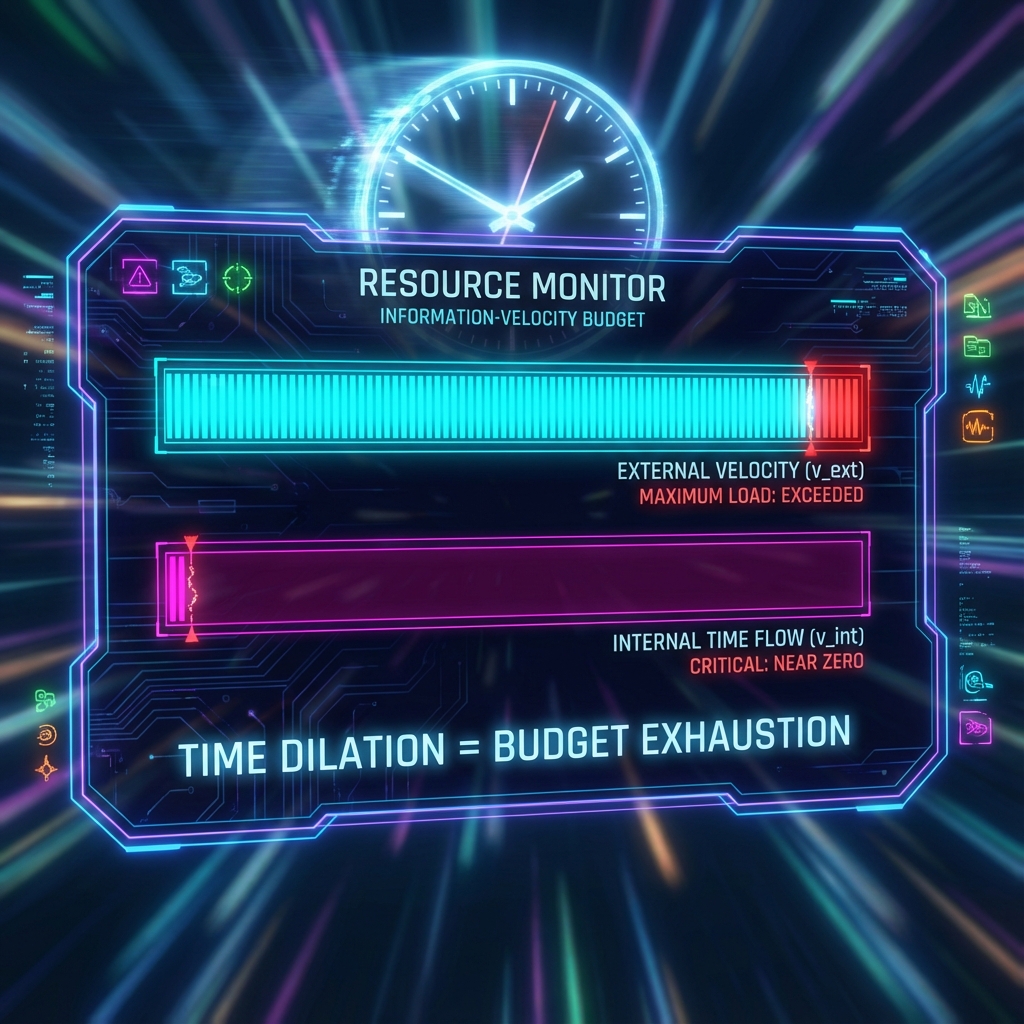
Internal Velocity as Time Flow Rate
Recall our core formula:
We need to assign a physical meaning to (internal velocity). It represents the rate at which the vector evolves in the internal sector. For a physical system (such as a clock or a person), “being alive” or “experiencing time” is essentially the process of continuous internal state changes.
If is large, it means the system’s internal evolution is intense, and time passes quickly; if goes to zero, it means the system’s internal state is completely frozen, and time stops.
Therefore, is your proper time flow rate.
A Zero-Sum Game
Now, let’s see what happens when you try to accelerate.
Suppose you are initially at rest in space. At this point, your external velocity . According to the Pythagorean identity, all the budget you possess is invested in internal evolution:
At this moment, your time flows at its fastest rate; your life is burning at the maximum rate allowed by the universe.
When you start accelerating, trying to gain velocity in space (i.e., increasing ). Because the total budget is locked (the universe won’t give you extra credit), you must divert part of the allocation from to pay for the cost of .
Your internal evolution is forced to slow down:
This is the physical mechanism of time dilation. It is not magic of the spacetime background; it is resource squeeze. When you use more and more capacity for “changing position,” you are left with less and less capacity for “changing yourself.”
Geometric Derivation of the Lorentz Factor
We can directly derive the core mathematical structure of special relativity—the Lorentz factor —from this simple circle equation.
In physics, we are accustomed to using to denote the speed of light (our ), and to denote spatial velocity (our ). Then the ratio of internal time flow rate to the maximum rate is:
If we denote the reference time flow at rest as , and the proper time flow in motion as , then by definition, should be proportional to . Thus we obtain:
Flipping this over gives the standard relativistic time dilation formula:
See, we don’t need to assume the constancy of the speed of light, nor do we need to introduce the complexity of Minkowski spacetime. We only need to acknowledge that the universe is a circle. The Lorentz factor is actually the secant function—it is a simple trigonometric ratio of the hypotenuse to the leg in the geometry of the great circle division.
The Poverty of Speed
This perspective completely changes our view of “extreme speed.”
In science fiction, the speed of light is portrayed as ultimate freedom. But in Vector Cosmology, the speed of light represents ultimate poverty.
When a particle’s external velocity reaches , the formula becomes:
This means its internal budget is completely depleted. It has no remaining capacity to undergo any internal changes. For a photon, from its birth in the Big Bang to its absorption by your retina, the thirteen billion years that span this interval are zero seconds in its subjective perspective. It does not age, does not evolve, because it has sacrificed all its “existence” to “distance.”
The truth of relativity is: Motion is an expensive consumption. The reason we cannot exceed the speed of light is not because there is a wall ahead, but because when , we are already bankrupt—we have no remaining budget left to convert into speed.