3.2 Gravity as Entropic Force
“The apple does not fall because the Earth pulls it; the apple falls because falling increases the entropy of the universe.”
In the previous section, we described massive objects as “monopolists” in the market, who, by hoarding enormous internal budgets (), cause “computational power depletion” or “liquidity contraction” in surrounding space. This uneven distribution of resources manifests geometrically as spacetime curvature.
But this still leaves a dynamical question: Why do objects move toward monopolists?
Since monopolists (like black holes or stars) have extremely high “transaction costs” and extremely narrow “bandwidth” (time slows down), shouldn’t a rational free particle stay away from there and go to the budget-rich void? Why is universal gravitation attractive rather than repulsive?
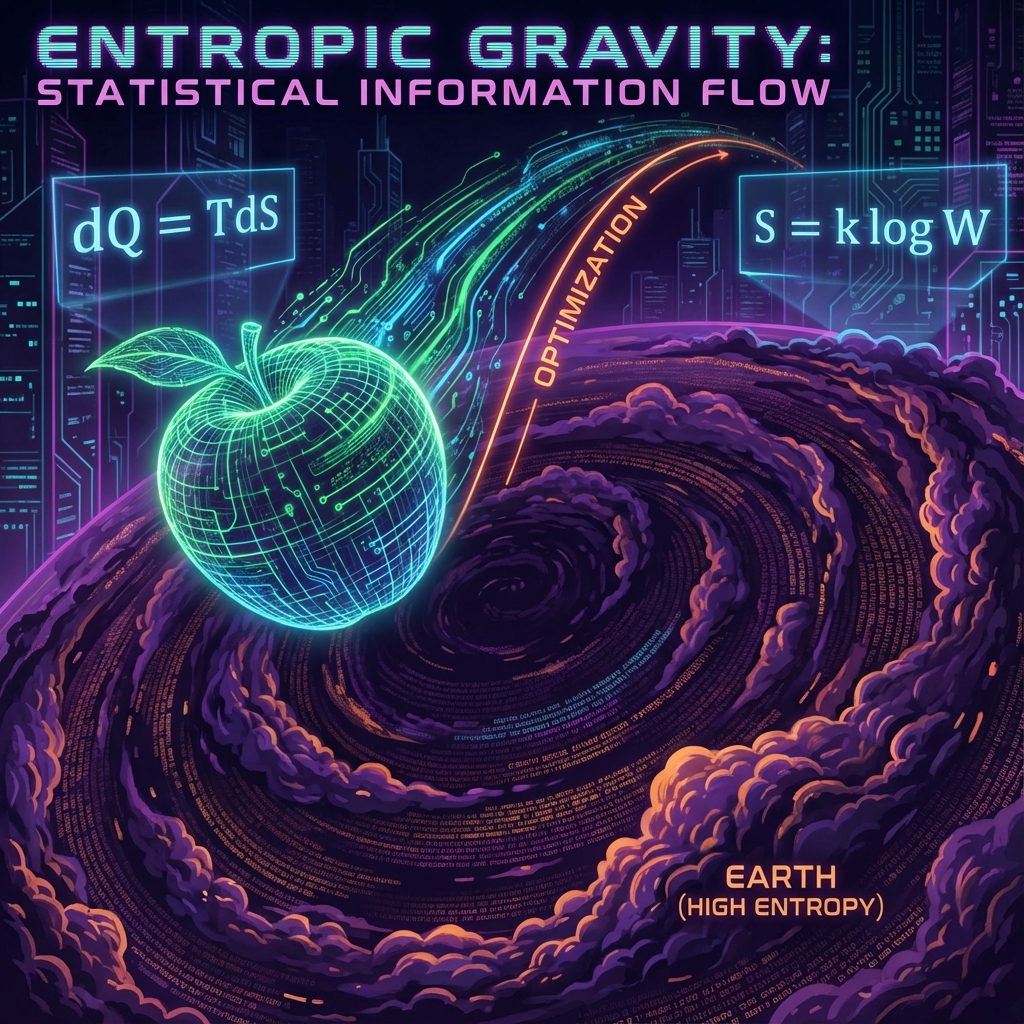
To answer this question, we need to introduce a concept in physics that is even more fundamental than energy—Entropy. In Vector Cosmology, gravity is no longer a fundamental interaction force; it is a “statistical tendency”, an Entropic Force produced by the universe to maximize information flow.
3.2.1 The Invisible Hand: Thermodynamics’ Geometric Disguise
In economics, Adam Smith proposed the “invisible hand”: individual behavior pursuing profit maximization automatically leads to efficient allocation of market resources. In physics, this “invisible hand” is the Second Law of Thermodynamics.
Modern physicists Ted Jacobson and Erik Verlinde have proposed a stunning view: gravity may not be a fundamental force but an entropic force. Just as a rubber band contracts not because molecules pull each other, but because the contracted state has more microscopic configurations (higher entropy).
In our FS vector system, this view receives a perfect geometric explanation.
Let us return to the core identity:
The third term (environment/entanglement velocity) is crucial. In vacuum, it may be small. But near massive objects, the situation is completely different. Massive objects are not just accumulations of mass; they are accumulations of information. Earth is not just a rock; it is a highly entangled body of qubits.
This means that the space around massive objects is a high-entropy potential zone.
3.2.2 Why the Apple Falls: The Temptation of Information Gradient
Now, let us re-examine that famous apple. It hangs on a branch, in Earth’s gravitational field.
-
Apple at height:
Far from the ground, space is relatively flat, and budget is less monopolized. The apple has high potential (potential energy), but its entanglement with Earth is low. Its information is relatively isolated.
-
Apple on the ground:
Near the ground is a region of highly dense . Here are full of possibilities for microscopic interactions with Earth as a huge heat reservoir.
Why does the apple fall?
Not because Earth sends an invisible rope to pull it. But because: In this direction, the number of microscopic states increases.
In the computational metaphor of Vector Cosmology, we can understand it this way:
-
The universe always tends to distribute information more “uniformly” or more “chaotically” (entropy increase).
-
Earth is a huge information black hole (information sink), and there exists a huge Information Gradient in the space around it.
-
The apple is also a bundle of information. When it approaches Earth, it is actually following this gradient, trying to integrate into that larger information network.
Gravity is the pressure difference of information flow.
The universe, this computer, tries to balance computational load. The computational power () in vacuum is idle, while that near Earth is overloaded. The apple’s fall is actually a process to fill this gradient. It sacrifices its positional potential energy (converting into kinetic energy and then into thermal energy after impact), ultimately to increase the total entropy of the entire system.
3.2.3 Thermodynamic Derivation of Einstein’s Equation
This is not just a philosophical metaphor; it is mathematically strictly corresponding.
Jacobson proved that Einstein’s field equation is actually the spacetime geometric version of the thermodynamic equation .
In our FS geometry:
-
(heat flow): Corresponds to the flux crossing the interface (energy/matter flow).
-
(temperature): Corresponds to Unruh temperature or horizon temperature, which is proportional to the degree to which is locally compressed (acceleration/curvature).
-
(entropy change): Corresponds to changes in horizon surface area, that is, changes in information capacity.
When we say “spacetime tells matter how to move,” we are actually saying: Matter always evolves along the path of fastest entropy increase (or lowest free energy). Geodesics are nothing but optimization paths in information geometry.
3.2.4 Conclusion: No Gravity, Only Statistics
At this point, we have completed an astonishing conceptual leap.
In this universe, there is no fundamental force called “gravity” pulling you. You are pressed into your chair because the Earth beneath your feet is a huge information distribution center.
-
Your body tries to follow statistical laws, “diffusing” (falling) toward regions of higher information density.
-
The electromagnetic force on your chair (Pauli exclusion principle) prevents this diffusion.
Gravity is our macroscopic illusion of the universe’s “statistical tendency.” Just as air pressure is not a fundamental property of molecules but a statistical result of countless molecular collisions; gravity is not a fundamental property of spacetime either. It is the geometric squeeze produced by countless vectors trying to maximize system disorder under the limited budget .
The apple falls because in the world of vectors, that is the only direction toward maximum possibility.