Chapter 1: In the Beginning was the Circle
On the first day of creation, there was no light, no matter, not even space. Only that single, eternally rotating circle.
In the prologue, we established that unique vector and its constant change budget . As long as this vector merely rotates as a whole in the void, the universe is perfect, symmetric, but also monotonous. To produce the world full of differences that we perceive—heaven and earth, motion and stillness, fast and slow—this perfect circle must break its own integrity.
It must make a choice: to tear itself apart.
This chapter will tell the story of the universe’s original trauma, the moment when physics was born. We will witness how this “one” transforms into “two” through geometric orthogonal decomposition, thereby establishing the most fundamental rules of the game in the macroscopic physical world.
1.1 The First Orthogonal Decomposition
The word “decomposition” may sound abstract in physics, but in our Vector Cosmology, it has the most intuitive geometric meaning.
Imagine an arrow pointing toward the sky (representing a vector). We can decompose the direction of this arrow into “northward component” and “eastward component.” This operation does not change the arrow itself, but for observers living in the two different worlds of “north” and “east,” they see two completely different phenomena.
The creation of the universe is such a process of orthogonally projecting the omnipotent . We define this division as the First Orthogonal Decomposition: splitting the universe’s total rate of change into external motion () and internal evolution ().
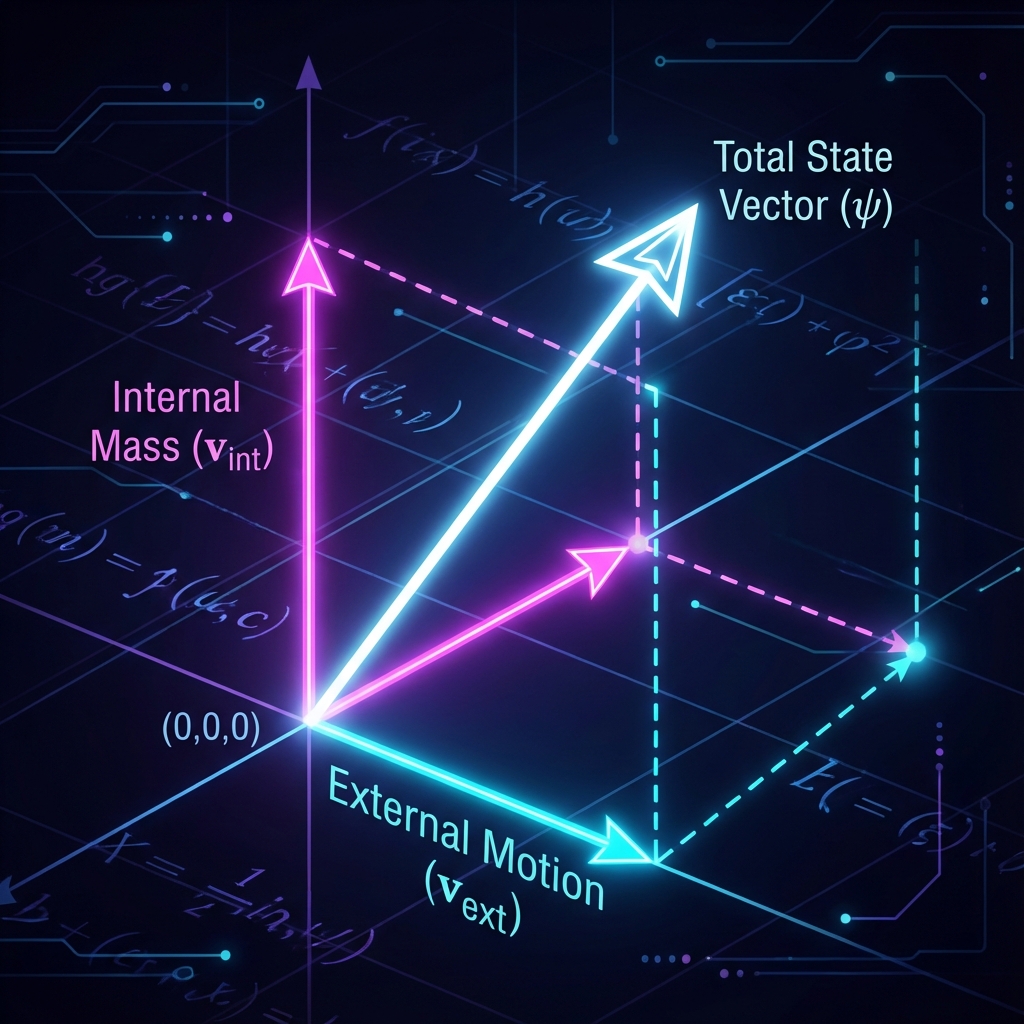
The Tearing of Dimensions: External and Internal
Mathematically, this process manifests as the splitting of the tangent space () of projective Hilbert space. We decompose the global tangent vector into two mutually perpendicular components:
These two components must be orthogonal under the Fubini-Study metric, meaning there is no interference term between them, and they can be independently distinguished.
This is not merely a mathematical game; it is the binary origin of physical reality:
-
External Sector ():
This is the projection of the vector onto the eigen-direction of the “position” or “space” operator.
When the universe invests budget in this sector, we observe displacement, momentum, and propagation. It is explicit, visible, macroscopic. In Chinese philosophy, this corresponds to “Yang”—the moving, external force.
-
Internal Sector ():
This is the projection of the vector onto the eigen-direction of the “structure” or “intrinsic property” operator.
When the universe invests budget in this sector, objects do not move in space, but their internal quantum states are flipping violently. We observe mass, spin, and charge. It is implicit, still, microscopic. This corresponds to “Yin”—the still, internal essence.
The Zero-Sum Contract
Since is a constant total budget, this decomposition immediately brings a cruel but fair consequence: You cannot have everything at once.
In Euclidean geometry, if the hypotenuse (total budget) of a right triangle is fixed, then the two legs (components) must be in a competitive relationship where one increases as the other decreases. This is the cosmological echo of the Pythagorean theorem:
This formula is one of the most important cornerstones of this book. It tells us that motion (Space) and matter (Matter) in the universe are not two independent entities; they are two different ways of consuming the same budget.
-
If you want to move fast in space (increase ), you must reduce internal evolution (decrease ).
-
If you want to have enormous mass and complex internal structure (maintain high ), you must inevitably become sluggish in space (suppress ).
This is the cosmic order established by the first division. The universe is no longer a chaotic whole but has become a vast trading market. Every particle, every galaxy, determines its physical destiny by adjusting its projection angle in the “external” and “internal” sectors.
And in this game, the most extreme case is that existence which abandons all “internal”—light. This will reveal all the secrets of relativity in subsequent chapters. But before that, we need to understand that this first division not only created space but also created the deepest contradictions and harmonies in physics.