1.2 The Pythagorean Echo of the Universe
The moment we tear the universe apart into “internal” and “external,” we are actually establishing a coordinate system on the tangent space of projective Hilbert space. Although this operation endows the universe with structure, it immediately shackles it with an inescapable constraint.
The name of this constraint is geometry.
When we gaze at the most fundamental equation governing spacetime and matter, we are surprised to discover that it is actually the sacred echo of the oldest theorem we learned in elementary mathematics—the Pythagorean theorem—in the quantum dimension.
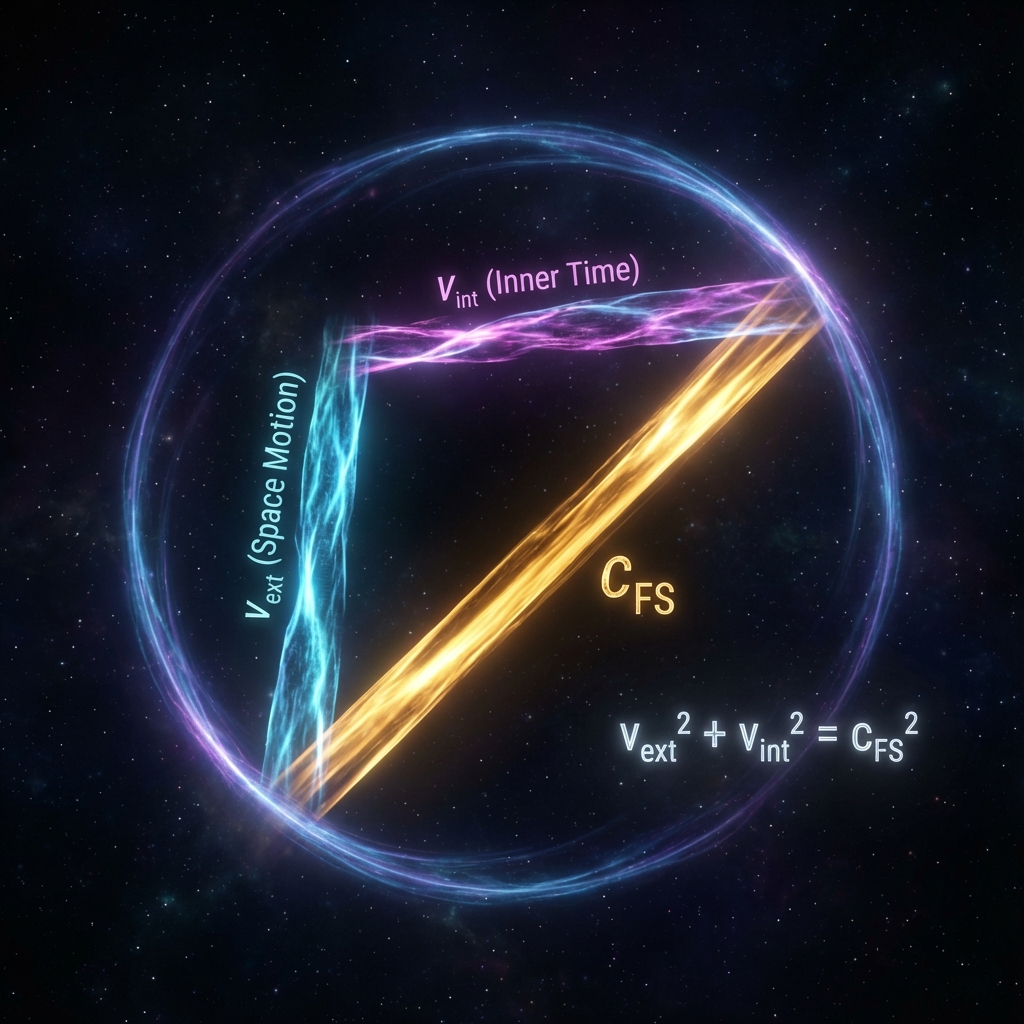
The Cost of Perpendicularity
Why must the universe obey conservation laws? Why can’t we simultaneously have infinite speed and infinite mass? The answer lies hidden in the Riemannian structure of the Fubini-Study metric.
The Fubini-Study metric is the unique natural Riemannian metric on projective Hilbert space. In this geometric space, if we decompose a tangent vector into two orthogonal components and , then according to the fundamental properties of Riemannian geometry, the lengths of these components and the total length must satisfy a sum-of-squares relationship.
This is not a choice of physical law; it is a logical necessity. As long as we acknowledge that “external motion” and “internal evolution” are independent degrees of freedom that do not interfere with each other (orthogonal) by definition, they must obey the following Pythagorean constraint:
Substituting the rates we defined earlier, we obtain the first iron law governing macroscopic physics—The FS Capacity Identity:
The Geometric Origin of Conservation Laws
This seemingly simple formula is actually the common ancestor of all conservation laws in the universe.
In physics textbooks, we are accustomed to discussing energy conservation, momentum conservation, or probability conservation separately. But from the perspective of Vector Cosmology, these are all special cases of the above geometric identity.
It reveals a profound truth to us: The universe does not create or destroy anything in this instant. It is merely performing a constant rotation.
We call this formula the “Information-Velocity Budget”. is the “existence budget” that the universe bestows upon every physical system. This budget not only represents energy but more importantly represents “Distinguishability”—the system’s ability to change its own state.
-
(External Velocity): This is the budget the system uses to create distinguishability in spatial position. When we say an object “moved,” we actually mean that the projection of its wave function onto the spatial basis has shifted.
-
(Internal Velocity): This is the budget the system uses to create distinguishability in internal structure. When we say an atom “exists,” we mean that its internal phase is rotating violently, maintaining its uniqueness in the flow of time.
This identity tells us that these two share the same account. You cannot increase external expenditure without withdrawing internal investment. This is why it is the “Pythagorean echo”—over two thousand years ago, the ancient Greeks discovered that the hypotenuse of a right triangle locks the fate of the two legs; today, we discover that the geometry of Hilbert space locks the fate of spacetime and matter.
The Bridge to Relativity
This geometric identity not only explains conservation; it is also a direct bridge to special relativity.
If we correspond to the familiar spatial velocity , and to the speed of light , then this Pythagorean relationship becomes:
Here, is precisely the prototype of the relativistic factor .
This discovery will be detailed in Chapter 2, but here we must grasp its philosophical magnitude: Time Dilation in relativity is not because spacetime bends like rubber, but because the Pythagorean theorem forces the legs to shorten. When we project more of the hypotenuse (total budget) onto the “spatial axis,” the length projected onto the “internal time axis” must necessarily decrease.
So, Einstein did not invent relativity; he merely discovered that the universe is a standard great circle, and the speed of light is just the geometric limit of this circle’s projection onto the external world.
In the beginning was the circle, and this Pythagorean echo is the first thunder of creation. It announces the end of absolute freedom and the birth of physical laws.