5.2 Geometric and Thermal Unity
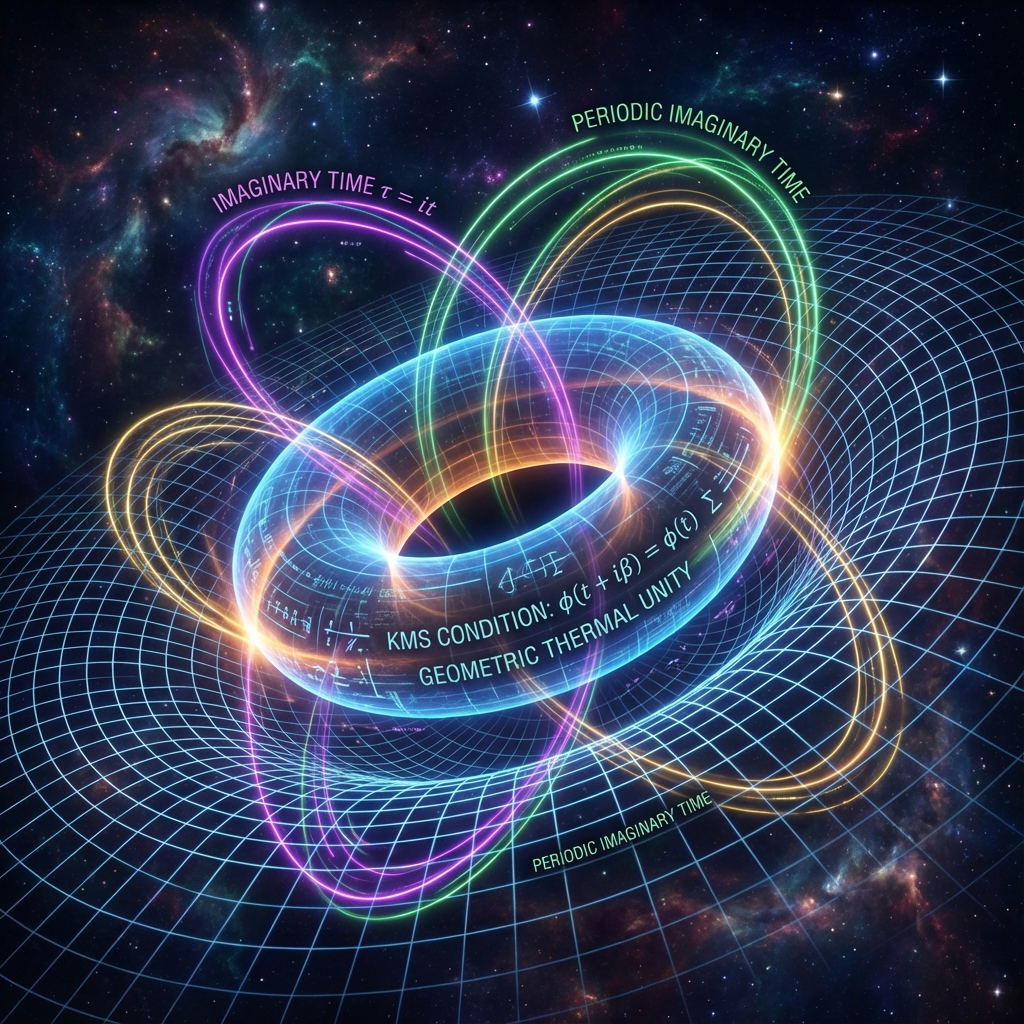
“We once thought only clocks have periods, while heat is just chaotic noise. But geometry tells us that heat is also a period—it’s just a cycle occurring in the imaginary dimension. When we fold the paper of the universe, time becomes temperature.”
In the previous section, we revealed through Wick rotation the mirror symmetry between quantum mechanics () and statistical mechanics () in mathematical form. But this is only a beginning. This symmetry is not merely a coincidence; it hints at perhaps the deepest truth in physics: Dynamics (evolution) and statistics (distribution) are essentially congruent.
This section will explore the physical-philosophical meaning of the KMS Condition (Kubo-Martin-Schwinger Condition). We will see that in this complex universe ruled by , geometric structure (spacetime) and thermodynamic properties (temperature) are not only unified; they are even mutually defining.
KMS Condition: The Rosetta Stone Connecting Two Realms
In the mid-20th century, physicists Kubo, Martin, and Schwinger discovered a surprising property of quantum field theory.
For a quantum system in thermal equilibrium (temperature ), its correlation functions exhibit a strange periodicity.
If we regard time as a complex variable, then on this complex plane, the system’s state is not chaotic but exhibits a cycle with period in the imaginary direction.
This is the KMS Condition. It declares in the most rigorous mathematical language:
A system in thermal equilibrium is equivalent to a dynamical system with period in the imaginary time direction.
-
Physical Translation:
-
What is “heat”? Heat is not random molecular collisions. From the underlying geometric perspective, heat means the universe has tied a “knot” (Loop) on the imaginary time axis.
-
What is “temperature”? Temperature is the circumference of this knot (or the reciprocal of the radius). The higher the temperature ( smaller), the smaller the imaginary time ring, and the faster the evolution period.
-
This completely overturns our intuition about “cold” and “hot.”
Absolute zero () means the imaginary time axis is an infinitely long straight line (no cycle).
While Planck temperature (extremely hot) means the imaginary time axis curls into an extremely tiny ring with Planck-length radius.
Geometric Temperature of Black Holes
The strongest evidence for this theory comes from black hole physics.
When Stephen Hawking calculated black hole radiation, he did not use classical thermodynamics but geometry.
Near the black hole horizon, the spacetime metric undergoes extreme distortion. If we perform Wick rotation () on this metric, the original hyperbolic geometry (Minkowski space) becomes elliptic geometry (Euclidean space).
In this Euclidean space, to avoid conical singularities at the horizon, the imaginary time coordinate must be periodic.
Just as Earth’s longitude lines converge at the poles, imaginary time lines must close at the horizon.
Hawking was amazed to discover that this geometrically necessary period precisely equals the reciprocal of the black hole’s Hawking temperature!
This is one of the most brilliant moments in physics history:
-
Geometry (circumference) directly determines heat (temperature).
-
A pure geometric object (black hole), merely because of the topological closure of its spacetime structure, necessarily radiates heat.
This proves the core conjecture of Vector Cosmology: Heat is not a form of energy; heat is a shape of spacetime geometry.
The Full Picture of the Complex Plane
At this point, we can construct a unified complex spacetime picture.
The noumenon of the universe is a Holomorphic Manifold defined on the complex domain.
This manifold itself is static, perfect, self-consistent. It contains all exponential relationships.
We as observers merely cut a slice on this manifold (chose our time axis).
-
Cutting the real axis (): We see unitary evolution. Wave functions oscillate, phases rotate, history generates. This is the world of quantum mechanics.
-
Cutting the imaginary axis (): We see statistical distribution. Systems arrange under Boltzmann weights, exhibiting temperature and entropy. This is the world of thermodynamics.
Time is complex temperature; temperature is imaginary time.
They are like the “height” and “circumference” of a cylinder. You cannot say height is more real than circumference; they are just measures of the same geometric object in different dimensions.
Conclusion: No Randomness, Only Dimensions
Through the KMS condition and the complex nature of , we eliminate physics’ greatest enemy—randomness.
“Random thermal motion” in thermodynamics is reduced to “deterministic geometric cycles” in the imaginary dimension.
This means that under the rule of this natural generator , no part of the universe is chaotic.
Even the most disordered thermal radiation, in the eyes of God (or high-dimensional observers), is a geometrically precise crystal.
Since time and temperature are interchangeable geometric attributes, this raises an even more radical question: Where does time actually come from?
If time is just a direction on the complex plane, who decided that our universe must evolve along the “real axis” rather than freeze along the “imaginary axis”?
This leads to the theme of the next chapter: The Modular Flow Hypothesis. We will explore a view that could shake the foundations of physics—Time is not an external parameter; time is “secreted” by the quantum state itself.