5.1 Wick Rotation
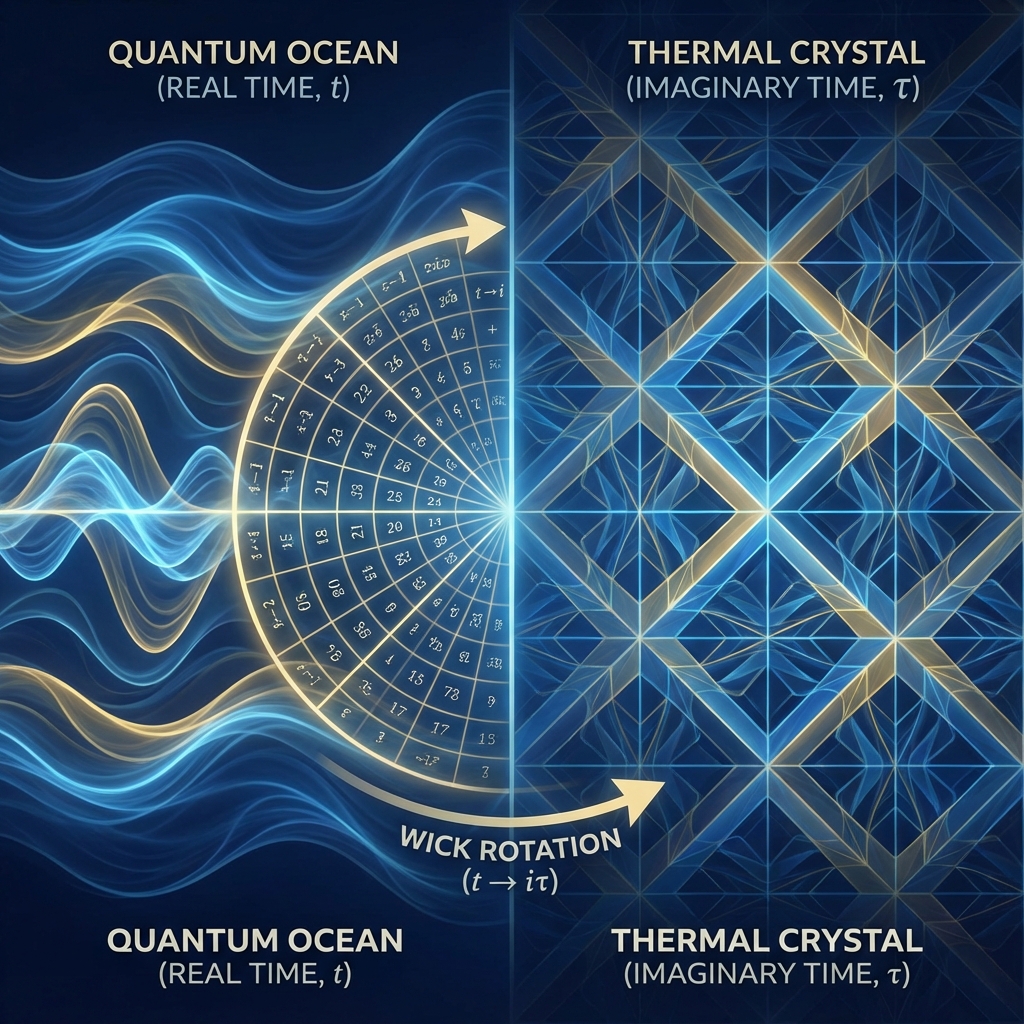
“If we rotate the time axis 90 degrees on the complex plane, that quantum world that was oscillating incessantly suddenly quiets down and freezes into a statistical thermodynamic world. This is not a mathematical game; this is the geometric secret passage to grand unification.”
Coincidence of Two Formulas?
Let us place the two greatest exponential formulas in physics side by side and play a “spot the difference” game.
-
Schrödinger Evolution Operator (Quantum Evolution):
Describes the evolution of a quantum state with time .
Here, is the imaginary unit, meaning this is a rotation factor (modulus conserved, phase changes).
-
Boltzmann Factor:
Describes the statistical distribution of a thermodynamic system at temperature . We usually use inverse temperature to represent it.
Here there is no , meaning this is a decay factor (modulus changes, probability weight distribution).
Please gaze at these two formulas. Their only difference lies in the variable in the exponent:
-
One is (imaginary time).
-
One is (real temperature).
Is this merely a symbolic coincidence?
In Vector Cosmology, we refuse to believe in coincidences. If two formulas look the same, it means the physical entities behind them are homologous.
Rotating the Time Axis
If we perform a bold operation: rotate the variable “time” from the real axis to the imaginary axis.
Let (where is called Euclidean time or imaginary time).
Substituting into the Schrödinger formula:
A miracle occurs. That quantum formula describing waves instantly becomes the Boltzmann formula describing thermal distribution!
As long as we let (i.e., imaginary time length equals inverse temperature), quantum mechanics becomes thermodynamics.
This mathematical operation is called Wick Rotation.
It establishes a one-to-one mapping between Minkowski spacetime (spacetime with light cones and causality) and Euclidean space (pure spatial geometry).
Geometric Definition of Temperature
This discovery completely reshapes our understanding of temperature.
In classical physics, temperature is the intensity of molecular motion.
But from the underlying perspective of FS geometry, temperature is the time period in the imaginary dimension.
-
Heat (Thermal) is not a form of chaotic energy.
-
Heat (Thermal) is the “distance” traveled by the system evolving along the imaginary time axis.
This explains why quantum field theory must use imaginary time techniques when calculating black hole entropy or vacuum fluctuations. Because in that limiting state, real physical time () and thermodynamic temperature () have become entangled and cannot be distinguished.
Hawking’s No-Boundary Universe
Stephen Hawking used this concept to propose the “no-boundary universe” model. He believed that in the very early universe (Planck era), time itself underwent Wick rotation, becoming a pure spatial dimension.
-
There is no “beginning,” nor is there a “singularity.”
-
The beginning of the universe is as smooth as the South Pole of Earth.
In our Natural Generator framework, this receives a new interpretation:
The noumenon of the universe is a Holomorphic Function defined on the complex domain.
-
When we slice along the real axis, we see time passing (quantum evolution).
-
When we slice along the imaginary axis, we see thermal equilibrium (statistical distribution).
The reason we perceive the world as “cold” (with a definite temperature) and “moving” (with passing time) is because there is a specific angle between our observation slice and this high-dimensional complex manifold.
Conclusion: Two Sides of a Coin
Wick rotation tells us that is the hub connecting two worlds.
-
(wave/circle): This is the world of Book I. Conserved, coherent, eternal motion.
-
(decay/spiral): This is the world of Book II. Dissipative, probabilistic, thermodynamic arrow.
They are not opposing physical laws; they are projections of the same exponential function in different directions on the complex plane.
Quantum mechanics is imaginary thermodynamics.
Thermodynamics is imaginary quantum mechanics.
Since temperature and time are mathematically interchangeable, this raises a deeper question: Which generates which?
Does time passing cause heat (entropy increase), or does heat (statistical state) generate time?
This leads to the theme of the next section: Unification of Geometry and Heat. We will see that at that ultimate level ruled by , physics no longer distinguishes between “evolution” and “distribution”; they are unified in the same Modular Flow.