4.2 The Bridge Between Discrete and Continuous
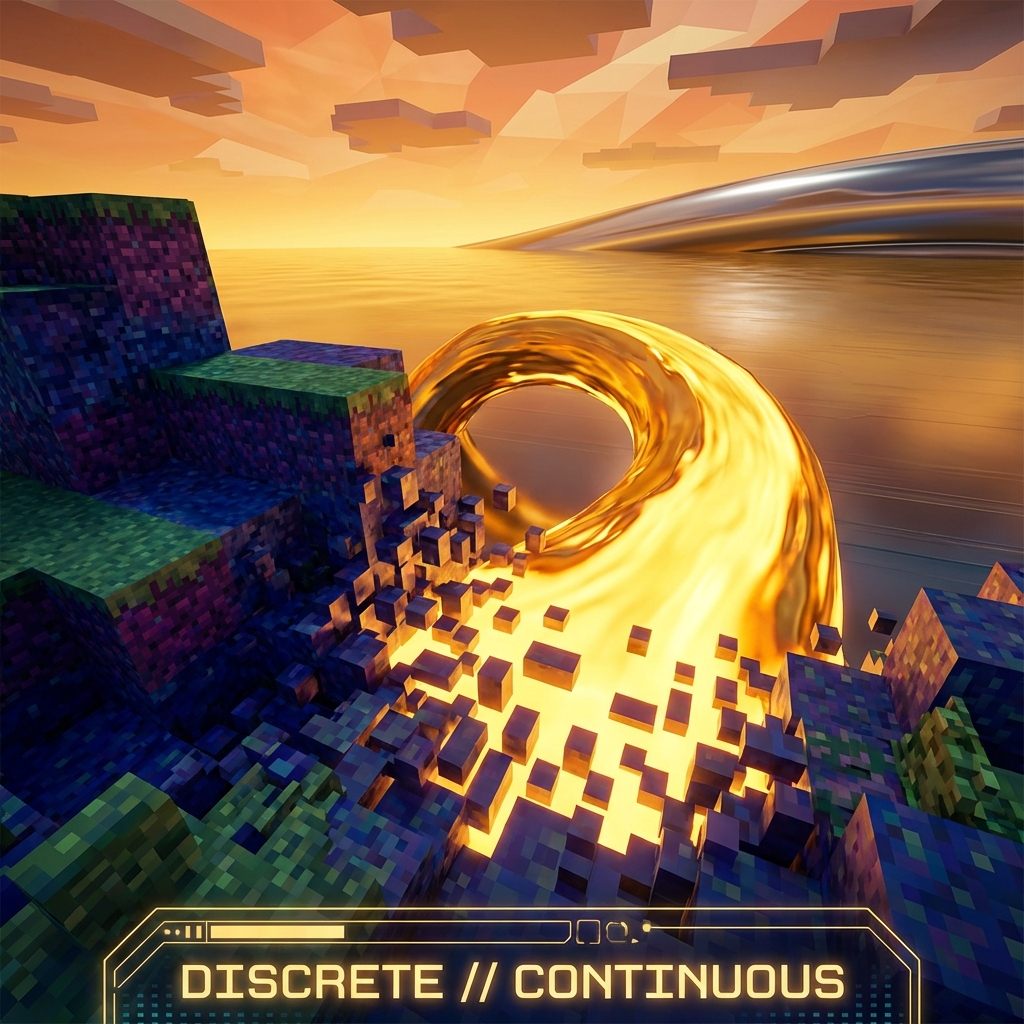
“If you stand far enough away, sand dunes become silk. The universe appears as a smooth continuous fabric because the stitches weaving it—Planck time—are so fine they exceed the limits of our perception. is the mathematical glue that smoothly bonds countless discrete ’1’s into a continuous ‘flow’.”
In the first two books of Vector Cosmology, we have been oscillating between two seemingly contradictory pictures:
-
Microscopic picture (QCA): The universe is discrete, pixelated lattice, following jump-like update rules.
-
Macroscopic picture (relativity): The universe is continuous, smooth manifold, following derivative rules of differential equations.
How are these two worlds stitched together? Why does a world composed of “squares” appear as a perfect “circle” macroscopically?
This section will reveal the ultimate mission of the natural constant : it is the only bridge connecting discrete microscopic and continuous macroscopic.
Euler’s Limit: The Mathematical Tunnel
To cross this chasm, we need to borrow one of the greatest limit formulas in mathematical history:
This formula is not merely a tool for calculating compound interest; it is a translator for physics.
-
Left side (): Represents macroscopic physics. It is analytic, smooth, perfectly differentiable. These are the physical laws we write in textbooks (such as the Schrödinger equation, Einstein field equations).
-
Right side (): Represents microscopic physics. It is algebraic, step-by-step, iterative. This is how the universe’s underlying QCA operates.
At the microscopic level, the universe does not understand what is. It only understands simple addition and multiplication.
Every Planck time update, the QCA performs an extremely simple operation:
This corresponds to the term in the formula (where corresponds to ). This is a tiny, linear, discrete correction.
However, when the universe machine repeats this simple operation at extremely high frequency (), a miracle occurs:
Countless clumsy linear corrections accumulate into an elegant nonlinear function—the exponential function.
is the “emergent form” of microscopic discrete operations. It proves that you don’t need to presuppose smoothness at the bottom; smoothness is a statistical property bestowed upon high-frequency iterations by the law of large numbers.
Why Don’t We Feel the Pixels?
Since the bottom is discrete, why have we never felt the “graininess” of spacetime? Why does light appear to flow like water rather than jump in stutters?
This stems from Separation of Scales.
-
Planck frequency (): Approximately Hz.
-
Atomic frequency: Approximately Hz.
-
Human perception frequency: Approximately Hz.
Between our perception scale and atomic scale, there exists a huge gap of dozens of orders of magnitude.
For an electron, in the time it takes to “circle once” around the nucleus, the underlying QCA engine has already performed tiny settlements.
In the face of this enormous value, the limit formula holds with extreme precision.
Error terms (i.e., “lattice sagging” or discrete artifacts) are suppressed to the order of , negligible.
Therefore, continuity is a statistical illusion.
Just as when film reels play at 24 frames per second, our brains smooth it into continuous motion; the universe refreshes at frames per second, which for any macroscopic observer is an absolutely perfect continuum.
Robustness of Physical Laws
This mechanism explains why physical laws have astonishing Robustness.
If macroscopic laws directly depended on microscopic details, the universe would be extremely fragile. A failure at any lattice point could cause the collapse of the macroscopic world.
But because macroscopic laws are based on (i.e., based on large-number limits), they have immunity to small perturbations at the bottom.
-
Whether the underlying lattice is square, triangular, or random graph.
-
As long as their statistical average properties satisfy certain symmetries, after countless iterations, they all converge to the same smooth exponential evolution operator .
This is the source of Universality.
is like a huge filter that filters out the rough edges of microscopic structure, leaving only pure, smooth rate of change.
Conclusion: Spacetime is Emergent
At this point, we have completed the underlying reinforcement of the physics edifice in the third book.
We no longer need to worry about conflicts between QCA models and continuous field theory.
QCA is the real hardware; is the operating system running on it.
-
We live at the operating system layer (continuous spacetime).
-
We operate icons and windows (particles and fields).
-
But beneath all this, countless 0s and 1s are flipping at dizzying speeds.
Since we have opened the meridians from discrete to continuous, the next question is: How does this continuous evolution driven by produce the “heat” and “direction of time” we perceive?
This leads to the most core physical upgrade of this book—Volume III: Thermal Time.
We will explore a shocking hypothesis: Time itself may just be the temperature of quantum states in the imaginary dimension.