6.1 Who is Ticking?
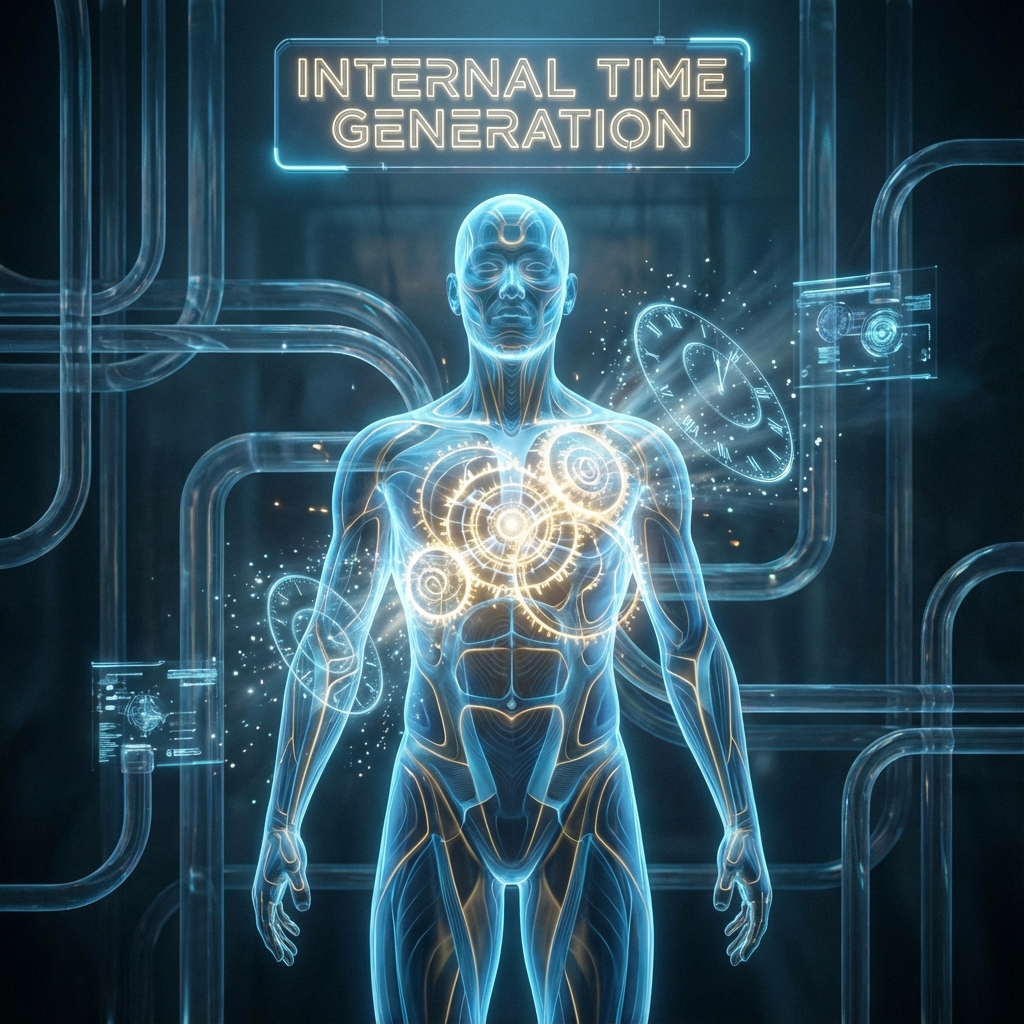
“We always ask: ‘What time is it?’ as if time were an entity independent of us. But the deep algebra of quantum mechanics tells us there is no universal clock. It is you—as an unbalanced quantum state—who creates time yourself in the process of having to flow to find balance.”
God Has No Clock
Let us return to the Schrödinger equation . Although elegant, this equation implies a huge assumption: it assumes that a parameter named already exists, and a Hamiltonian named drives the evolution.
But under extreme conditions of quantum gravity (such as the Wheeler-DeWitt equation), . The entire universe’s Hamiltonian is zero, and the time parameter disappears. The universe appears frozen.
If the bottom is frozen, why do we feel flow?
Who is ticking?
In the paper, we touched the core of this question: the concept of “modular ‘thermal’ time” suggests that time is not fundamental but emergent.
From this perspective, time originates from “ignorance”.
State as Clock
To understand this, we need to introduce Tomita-Takesaki Theory from algebraic quantum field theory. This is a mathematical theorem hailed by many physicists as “theological level.”
It tells us: As long as you are given a von Neumann algebra (representing observables) and a specific quantum state (representing the system’s current state), the mathematical structure will automatically generate a one-parameter unitary evolution group.
This evolution group is called the Modular Flow, denoted .
-
Traditional physics: First there is time , then there is evolution , and finally this causes state changes.
-
Modular flow physics: First there is state , and this state’s intrinsic entanglement structure defines what “evolution” is, thereby defining what time is.
Time is intrinsic to state.
A system in thermal equilibrium has a static (or trivial) modular flow.
While a system far from equilibrium, containing complex entanglement (such as life or civilization), has an intense modular flow.
It is your own quantum state that is ticking. Every breath you take, every thought you have, is not consuming time but generating your own modular flow.
Physical Meaning of Thermal Time
This hypothesis perfectly explains the “thermal time” concept we encountered in the previous volume.
French physicists Alain Connes and Carlo Rovelli proposed the Thermal Time Hypothesis:
The time passing we perceive is actually the modular flow of the statistical state we are in.
-
When we are in a pure state (omniscient), there is no time.
-
When we are in a mixed state (with forgetting, with entropy), modular flow appears.
This coincides with the budget allocation we discussed in the first book.
When we cut the system out from the environment (producing and entanglement entropy), we not only create the “self” but also create the “time” that drives self-evolution.
Time is the product of ignorance.
Because we cannot see the full picture of the universe (all entanglement of ), we can only see local projections. This information deficit (entropy) is mathematically transformed into a generator (Hamiltonian) that drives system evolution.
Conclusion: The Objectivity of Subjective Time
“Who is ticking?”
The answer is: You yourself.
The universe does not have a unified Greenwich time. Every subsystem, according to its entanglement with the environment, has its unique modular flow, that is, a unique “private time”.
-
A photon’s modular flow is stagnant, so it has no time.
-
A black hole horizon’s modular flow is extremely redshifted, so time freezes there.
-
Our modular flow is linear, so we feel birth, aging, sickness, and death.
We do not need to find that Prime Mover who winds the universe’s clock.
Existence itself is the clockwork. As long as you exist (in a non-trivial entangled state), you will necessarily experience the modular flow defined by your own state. You are not only the observer; you are your own clock.
Since time is generated by state, how does this generation mechanism operate mathematically? How does that alchemist called the “Tomita operator” extract dynamic time flow from static entanglement?
This leads to the theme of the next section: Tomita’s Alchemy. We will delve into the mathematical core of this theorem hailed as “quantum mechanics’ most profound theorem” to witness the alchemical process of time’s birth.