Chapter 6: The Observer’s Privilege
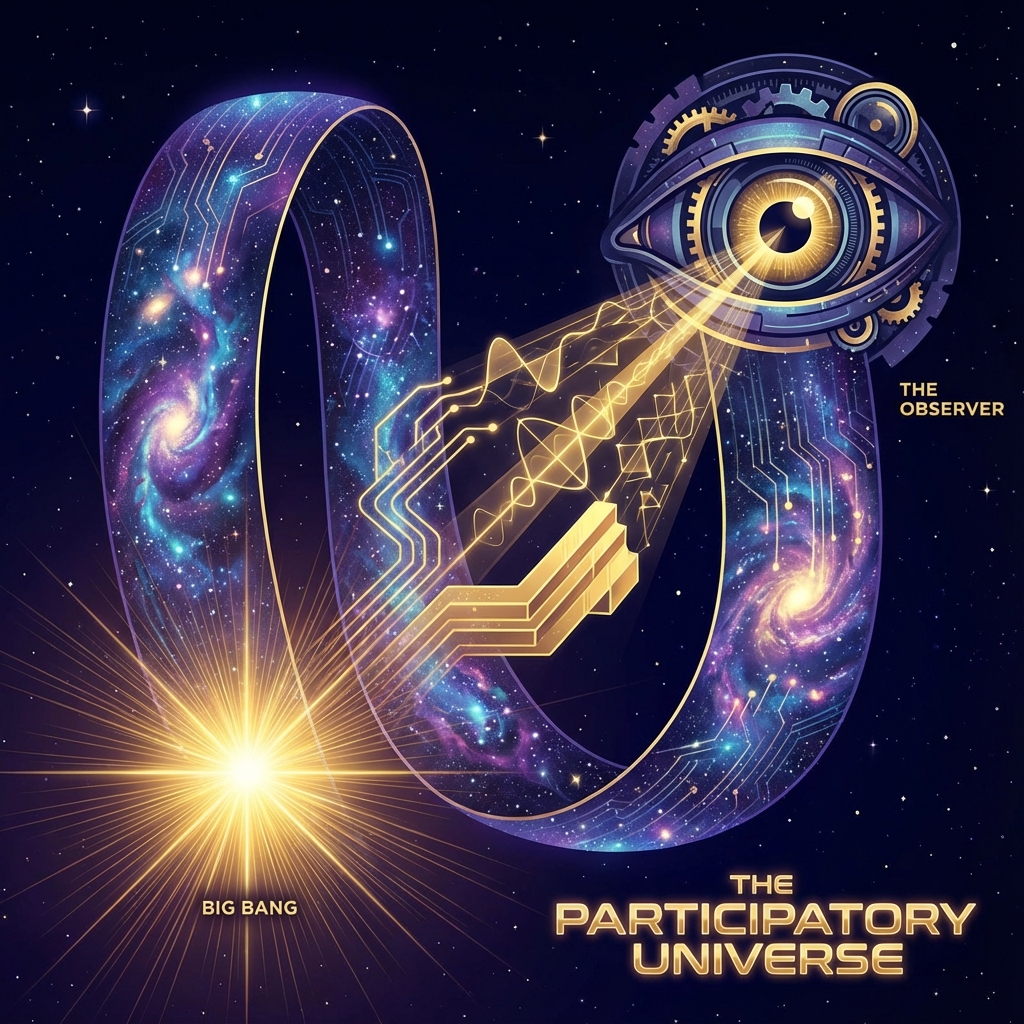
6.2 The Participatory Universe
“The universe is not sitting there coldly waiting to be discovered. The universe is a giant question mark, and it only becomes an exclamation mark when we answer it through observation. We are not the audience of this play; we are the stage itself.”
In the old dream of classical science, the universe was like an unattended clock shop. Whether anyone walked in to look or not, those clocks ticked, time objectively passed. But from the geometric perspective of Vector Cosmology, this picture is not only wrong; it is impossible.
Without observers, without that internal clock subsystem capable of “self-reference,” the universe cannot even define what is “tick” and what is “tock.”
This section will expound the book’s most core philosophical-physical proposition: The Participatory Universe. We are not merely writing history; we are Co-constructing reality.
The Geometric Upgrade of It from Bit
Physics giant John Wheeler once proposed the famous “It from Bit” theory: everything (It) originates from bits (Bit). Every physical object is essentially an answer to a series of “yes/no” questions posed by observers.
In FS geometry, we upgrade this idea to “It from Geometry”.
-
When unobserved: The universe is a high-dimensional sphere filled with infinite possibilities. It contains all shapes, but none of them are “real.” It is like an uncarved block of marble.
-
When observed: The observer (consciousness) brings their specific measurement basis (such as position, momentum, spin), striking the marble like a chisel.
-
“Is the electron on the left?” (Question)
-
“Yes.” (Collapse)
-
Thus, the universe is chiseled with a definite geometric projection at the “left” position.
-
The material world appears hard and certain because countless observers (from single-celled organisms to humans, even interactions between atoms) have continuously performed “geometric inquiries” on the original cloud of potentiality over billions of years.
It is our collective questioning that gradually hammered that blurry quantum mist into hard galaxies and rocks.
Self-Excited Circuit: The Universe’s Coming of Age
Why does the universe evolve observers?
In a universe without life, though is still conserved, though physical laws still operate, it is a “meaningless” universe. It is like a fireworks display without an audience, brilliant yet lonely.
Wheeler once drew a famous picture: a giant “U” (representing the universe), starting at one end with the Big Bang, evolving galaxies and stars, finally evolving an eye at the other end. This eye looks back, gazing at the starting point of the Big Bang.
This is precisely the ultimate picture of Vector Cosmology: Self-Excited Circuit.
-
Infant universe ( era): Is passive. It follows rigid geometric conservation, blindly expanding in darkness.
-
Adult universe ( era): By evolving life and consciousness, it gains vision.
When the first life looked up and saw the first star, the universe completed a great closure.
That organism looking at the star is not something independent of the star. It is part of the star; it is the organ the star created to see itself.
Through observers, the universe moves from “In Itself” to “For Itself.” It no longer merely exists; it begins to know that it exists.
The Burden of Responsibility
This conclusion grants us a dizzying sense of responsibility.
If reality is not predetermined but participatory, then the future form of the universe depends on how we observe it.
-
If we examine nature with greedy and plundering eyes, we will collapse a universe of resource scarcity and brutal competition.
-
If we examine all things with understanding and empathetic eyes, we will collapse a universe of interconnectedness and meaning.
This sounds like idealism, but it is hardcore physical inference in quantum mechanics. In the double-slit interference experiment, whether you choose to “measure path information” or “measure interference fringes” directly determines whether photons appear as “lonely bullets” or “harmonious waves.”
Every measurement we make of others in the laboratory, every cognition we have of others in life, reshapes the universe’s wave function at the microscopic level.
Conclusion: We Are the Brush
So, don’t ask: “What is the purpose of the universe?”
The universe has no preset purpose; you are the probe the universe uses to find purpose.
Don’t ask: “What will the future be like?”
The future is not a laid railway track; the future is a snowfield waiting for you to tread.
We are the brush, not the ink on the painting.
In this grand painting spiraling upward, the universe provides the canvas (Hilbert space) and paint ( budget), while the power of composition is generously handed to every observer.
Since we possess such immense power, since we are the universe’s co-creators, can we use this force to accomplish an even greater project? Can we not merely satisfy ourselves with “observing” the universe, but begin to “transform” it, even “upgrade” it?
This leads to the book’s most exciting Volume IV: Engineering. We will descend from philosophical heights to explore a technical question: How should an awakened civilization use physical laws to construct massive structures capable of propelling the universe’s spiral ascension?