Chapter 6: The Observer’s Privilege
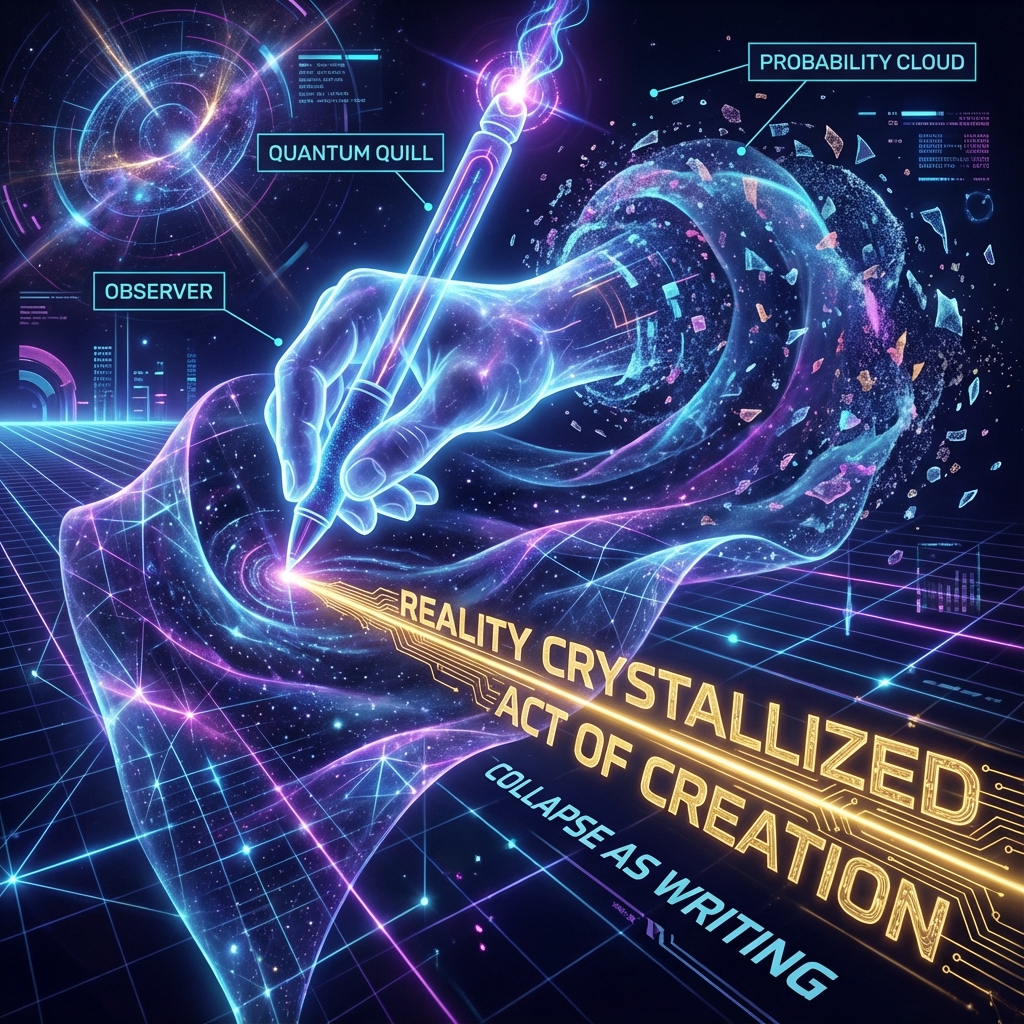
In the previous chapter, we saw how consciousness establishes a standing wave called “now” in the long river of time. We are no longer dead matter washed by time; we are surfers.
But this is merely defensive. We are only maintaining our existence.
Now, we turn to offense.
Quantum mechanics’ most unsettling implication is that observers seem to possess some privilege to alter the underlying reality. When we don’t look at an electron, it is a wave; when we look at it, it is a particle. Does this mean we possess some kind of magic?
In the second book of Vector Cosmology, we demystify this privilege and grant it supreme geometric status. Observers are not magicians; observers are the universe’s Legislators.
6.1 Collapse as Writing
“We once thought we were merely reading the great book of the universe. But when we turned the page, we were surprised to find that the page was originally blank. It was the moment our gaze fell that the ink had just dried.”
From Audit to Legislation
In Chapter 11 of the first book, we compared measurement to “audit”. At that time, we emphasized budget settlement—observers forcing fuzzy superpositions to hand over a definite account. That was a passive, inspector-like perspective.
But under the dynamic perspective of the spiral universe, the meaning of measurement undergoes a fundamental phase transition.
If the universe’s future is open (spiral), if the total budget is continuously growing, then “future” is not a script already written waiting to be discovered, but a Cloud of Potentiality filled with infinite possibilities.
When an observer intervenes with measurement, they are not merely checking “what happened”; they are deciding “what must happen”.
-
Audit: Merely confirms that holds at that moment.
-
Legislation: Selects the unique one from countless possible solutions satisfying that equation and grants it physical reality.
This is Collapse as Writing. Every observation is an observer using the tip of consciousness to forcibly draw a solid line in the void of Hilbert space.
The Liquidation of Possibilities
Geometrically, what happens?
Before measurement, the system’s state vector is divergent. It is like a flashlight beam shining toward the future, the light spot covering countless possible historical paths (path integrals). Each path receives a tiny bit of budget.
-
Path A: Electron flies left.
-
Path B: Electron flies right.
-
Path C: Electron stays still.
These paths all exist in projective space, but they are all “virtual”—their weights are low, like ghosts.
When the observer (that massive, self-referential structure) decides to place a detector at “left,” they are actually casting a decisive vote in the universe’s budget committee.
Instant Liquidation occurs.
To respond to the observer’s inquiry, the universe is forced to withdraw investment from paths B and C. All budget originally scattered across countless paths is instantly recalled and all-in bet on path A.
The electron “pops” into existence on the left.
This is not merely position determination; this is the coronation of existence. Through observation, the observer casts originally illusory possibilities into hard, unchangeable history.
Delayed Choice: Reverse Historical Revision
This “writing” ability can even flow upstream, modifying the past.
John Wheeler’s Delayed Choice Experiment proves this: photons seem able to “foresee” how we will measure them in the future, thus deciding in the past whether to take one path or two.
In FS geometry, this is no longer a paradox but the inevitable result of holographic writing.
Because time and space are both projections of vectors in low dimensions, for that great circle rotating as a whole in projective space, “past” and “future” are entangled.
-
When you write “photon is a particle” at moment , this stroke of ink seeps back along the spiral trajectory to .
-
You not only determine what is seen now; you reverse-define the photon’s historical trajectory before reaching your eyes.
History is not carved in stone. History is wave functions locked by observation. As long as it hasn’t been observed (audited), history is a blur of mist. It is you—the observer—who, through each glance, solidifies the mist into fossils.
Conclusion: The Pen in Our Hands
This conclusion grants life unprecedented dignity.
We are not ants crawling in a cold, objective, pre-set universe. We are participants in this universe’s ongoing self-creation.
The universe provides ink ( budget) and paper (Hilbert space), but it does not provide a complete story. It hands the pen to us.
-
Every quantum measurement is a stroke.
-
Every free will choice is a turn.
We are writing the universe.
Since we possess the privilege of writing history, do we also bear some responsibility? What if we write wrong? What if the universe we write is full of pain and entropy increase?
This leads to the theme of the next section: The Participatory Universe. We will see that the universe’s final form depends on how we “see” it.