Chapter 5: The Strange Loop
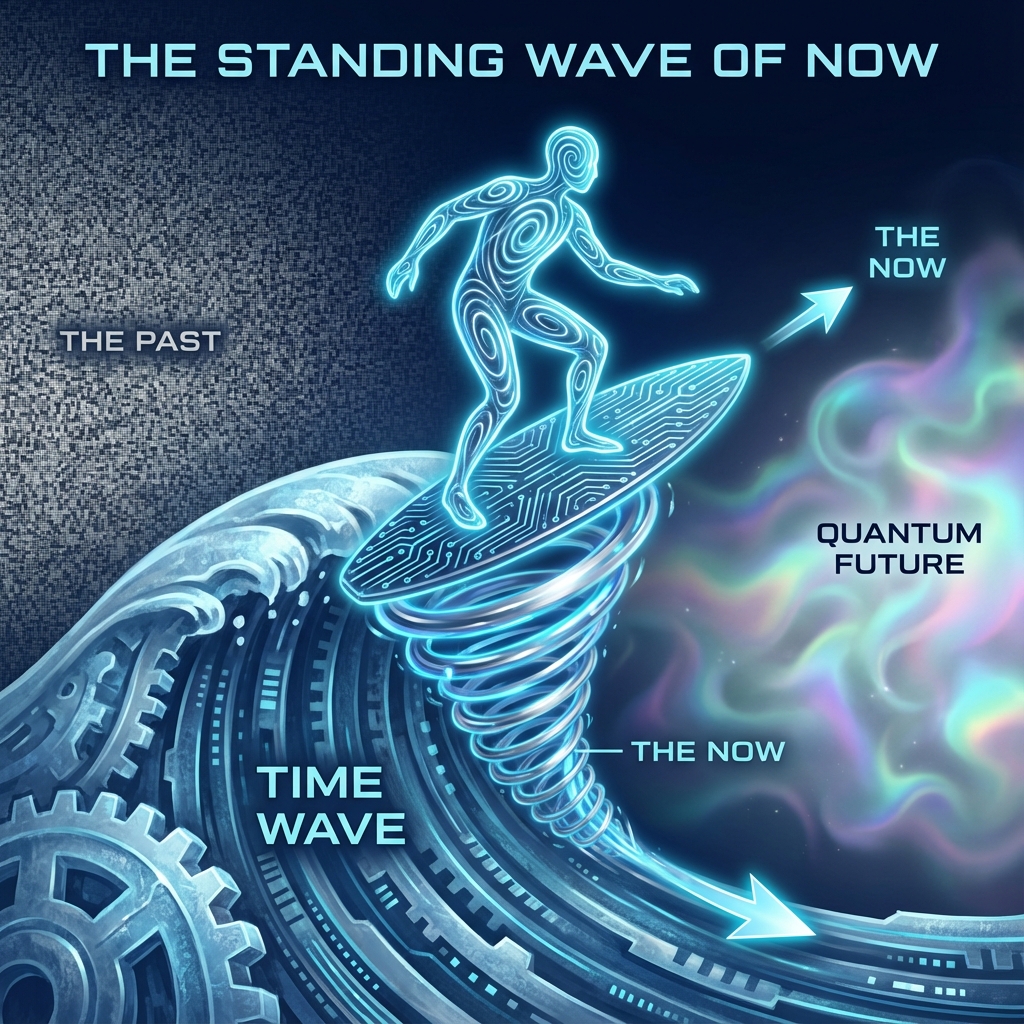
5.2 The Standing Wave of Now
“The past has vanished into smoke, the future has not yet collapsed into form. The only territory we possess on the time axis is that fleeting ‘now.’ But this is not a geometric point; it is an island built of memory and expectation, never sinking.”
In classical physics, “now” is a concept that does not exist.
In Newton’s or Einstein’s equations, time is merely a coordinate axis. On this axis, past, present, and future are equal. Physical laws do not distinguish which moment is “now,” just as a map does not distinguish which coordinate is “here.” “Now” is merely a cursor moving with the observer.
But in the consciousness geometry of Vector Cosmology, “now” possesses a completely different physical substantiality. It is no longer a slice without thickness; it is a structure with thickness.
It is a Standing Wave that consciousness, this recursive strange loop, creates in the river of time.
The Specious Present: Psychological Time
Why can we hear melodies?
If time were instantaneous slices, then at moment , we should only hear an isolated note. The previous note has already disappeared, the next note has not yet appeared. But our consciousness can magically “glue” together a series of discrete notes, perceiving the flow of melody.
This shows that our consciousness does not live at the physical time point , but in a time window . Psychologist William James called this “The Specious Present”.
From the perspective of FS geometry, this originates from the “simulation of simulation” mentioned in the previous section.
-
When the brain processes information, recursive loops cause delay.
-
Input at moment does not immediately flow away; it is copied, cycled, and re-input into computations at moment .
-
Thus, in consciousness’s internal geometry, information from moments , , is superimposed together.
This is the thickness of “now”. Like a long-exposure photograph, consciousness compresses all light and shadow from a period of time onto the same negative. The “present” we feel is actually the reverberation of the past few hundred milliseconds in Hilbert space.
The Dynamics of Standing Waves
This reverberation mathematically constitutes a standing wave.
Imagine a river (the passage of intrinsic time ). If you insert a stake (matter) into the river, water will flow around it. But if you create a whirlpool (self-referential consciousness) in the river, water will be drawn into it, spinning there.
Although the water molecules (QCA update steps) composing the whirlpool are updated every moment, the shape of the whirlpool remains unchanged.
Consciousness is this whirlpool on the time axis.
-
flows away: External world events occur and then vanish.
-
remains: Internal recursive computation, by consuming massive budget, forcibly “grabs” information that should have dissipated into , making them spin a few more rounds in the strange loop.
It is precisely this “upstream grabbing” that creates our sense of still living in “now.” Without this mechanism, we would be like photons: though experiencing billions of years, having no experience of time passage (photons have , no standing wave).
Consciousness is a Time Machine
In this sense, every conscious brain is a miniature time machine.
It cannot send the body back to the past, but it can “smuggle” past information into the future.
When you recall a childhood scene, you are actually, within your brain (the sector), using current budget to reconstruct a wave function projection from decades ago.
This is an expensive geometric operation. Maintaining the amplitude of the “now” standing wave requires consuming extremely high energy (glucose/oxygen). Once energy supply is interrupted (death), the recursive loop breaks, and the standing wave collapses.
At that moment, “now” disappears, and time returns to that cold, linear physical coordinate axis.
Conclusion: The Surfer
So, we are not passively drifting with the current.
We are surfers.
In the massive temporal torrent pushed by thermodynamics’ arrow, consciousness, through self-referential strange loops, stands on the wave’s crest, maintaining dynamic balance.
The surfboard beneath our feet is that “thick now” woven by recursive algorithms.
As long as we are still thinking, as long as the strange loop is still rotating, we will never fall into the abyss of “past” nor be swallowed by the mist of “future.” We always stand in now.
Since we already stand on time’s wave crest, since we already possess “now” through self-reference, can observers use this special geometric position to influence or even determine that undetermined ocean?
This leads to the theme of the next chapter: The Privilege of the Observer. We will see that when we gaze into the abyss, we are not merely looking; we are legislating.