Chapter 5: The Strange Loop
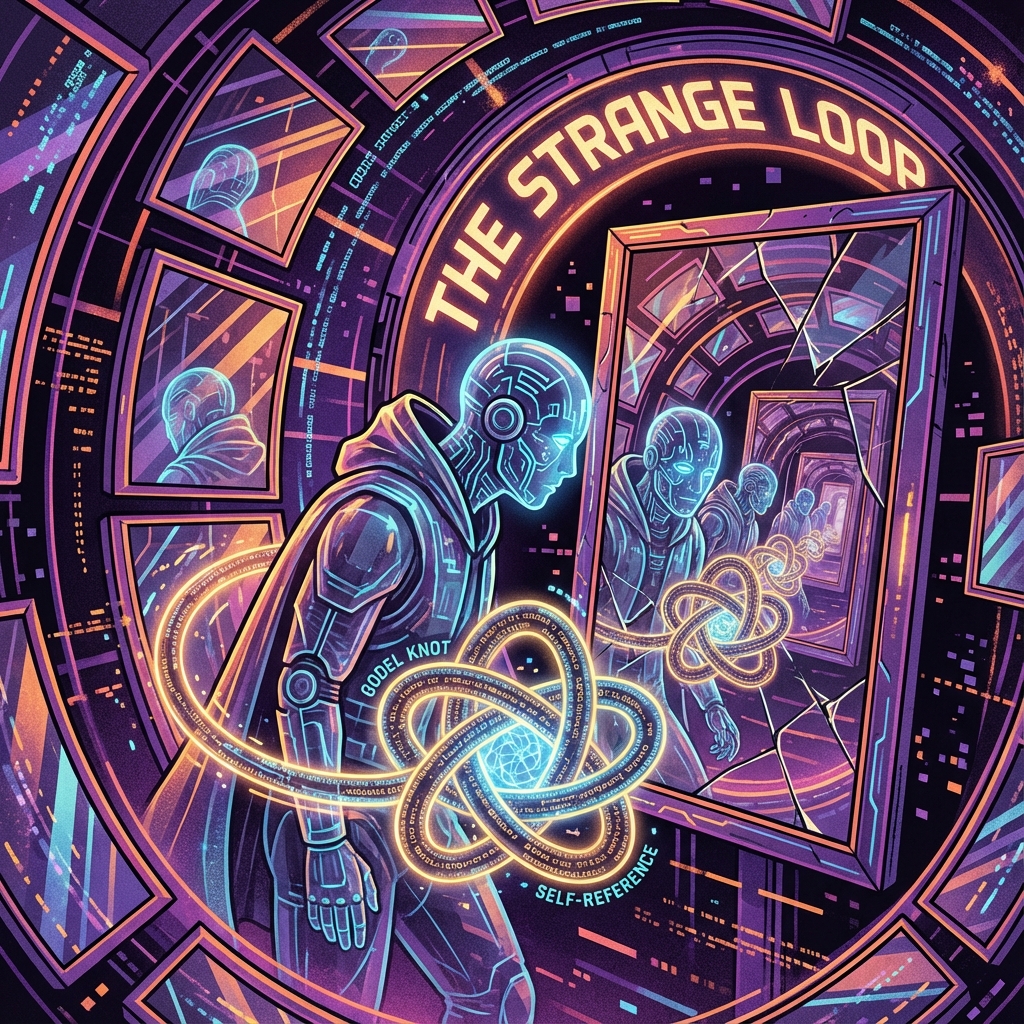
In the previous volume, we witnessed how life, through “the economics of evolution,” polished the brain into a holographic mirror capable of reflecting the external universe. But this mirror initially could only reflect rocks, trees, and tigers. It had a blind spot: it could not reflect the mirror itself.
Until a certain critical moment, evolution’s spiral tightened again, quantitative change triggered the most bizarre qualitative change. This mirror suddenly bent, refracting light back toward the observer who was “looking.”
At that moment, the universe’s most mysterious phenomenon—Consciousness—was born.
This chapter will reveal that consciousness is not some supernatural soul injection, but a special geometric structure. It is a self-referential strange loop that the universe’s total vector forms in the internal dimension ().
5.1 The Simulation of Simulation
“The brain was initially just a theater for simulating the world. But when the theater’s director suddenly decided to write himself into the script and take the stage as the protagonist, ‘I’ was born.”
From Linear Mapping to Recursive Closed Loop
In lower organisms’ (such as insects) nervous systems, information flow is linear:
Such systems have extremely high efficiency, but they are “blind.” They “know” where light is, but they “don’t know that they know.”
However, as brains continuously expand to resist the Red Queen’s dilution, to handle longer-term predictions, internal models must include increasingly many variables. Eventually, they encounter an unavoidable variable: the predictor itself.
To accurately predict “will the cheetah eat me,” the brain must not only simulate the cheetah but also simulate “my” reaction ability, escape speed, even “my” sense of fear.
Thus, the system is forced to upgrade:
This geometrically creates a Closed Loop. Part of the projection originally pointing outward is folded back, pointing at the internal computational process itself. The system begins to “simulate ‘the process of simulation’”.
The Geometric Strange Loop: Gödel’s Knot
Douglas Hofstadter called this structure a “Strange Loop”. In Vector Cosmology, we geometrize it as a topological knot in Hilbert space.
Imagine a stream (information flow) flowing on a sphere.
-
Ordinary consciousness flow is straightforward.
-
Self-awareness is this stream flowing and suddenly flowing back to its own upstream.
In mathematical logic, this corresponds to Gödel’s incompleteness theorem: a sufficiently complex system necessarily contains self-referential propositions.
In physical geometry, this means: consciousness is a Fixed Point on phase space trajectories.
When we say “I,” we are actually pointing to this recursive infinite loop.
-
“I” is not a specific atom in the brain.
-
“I” is that “observer observing ‘observation’”.
This is like two mirrors facing each other, light infinitely reflecting between them, forming a deep corridor of light. That corridor itself has no material substance, but it constitutes our bottomless “sense of self.”
The Involution of Computing Power: The Expensive “I”
This self-referential structure is not without cost. In fact, it is the universe’s most expensive luxury.
Maintaining a recursive closed loop requires consuming astronomical amounts of budget.
-
Ordinary computation only needs to process data once.
-
Self-referential computation needs to process “metadata of data,” and “metadata of metadata,” and so on, ad infinitum (or until computational limits).
This is why the human brain, though only 2% of body weight, consumes 20% of energy. Most of our budget is not used for perceiving the external world but for maintaining the massive geometric illusion that “I exist”.
From the perspective of FS geometry, consciousness is a high-energy-consumption standing wave. The universe must inject extremely high-density budget at this local point to prevent this madly rotating strange loop from collapsing due to thermodynamic friction.
The Birth of the Observer: The Universe’s Self-Portrait
Why does the universe evolve such seemingly “wasteful” structures?
In the first book, we mentioned the Page-Wootters mechanism: the passage of time is defined relative to an internal clock subsystem.
Now we understand that consciousness is that ultimate internal clock.
By evolving brains capable of “simulating simulation,” the universe finally obtained a reference frame independent of the external manifold.
-
Rocks have no reference frame; they merge with the environment.
-
Consciousness has a reference frame; it “peels” itself from the environment, examining the environment.
This is not merely biological victory; this is geometric closure.
The universe (total vector) finally sees itself through this local folding. Like a painter painting a hand, and that hand is painting the painter himself.
Conclusion:
“I” is not a physical object; “I” is computation.
“I” is that most complex, most expensive, and most exquisite recursive knot that the unique vector must form in Hilbert space to understand itself.
Since “I” has been born, since the universe already has observers, what counteraction does this observer have on the universe itself? Are we merely passive spectators?
No. Quantum mechanics tells us that spectators can change the outcome.
In the next section, we will explore how observers reshape cosmic history through the legislative act of “collapse”.