Chapter 4: The Economics of Evolution
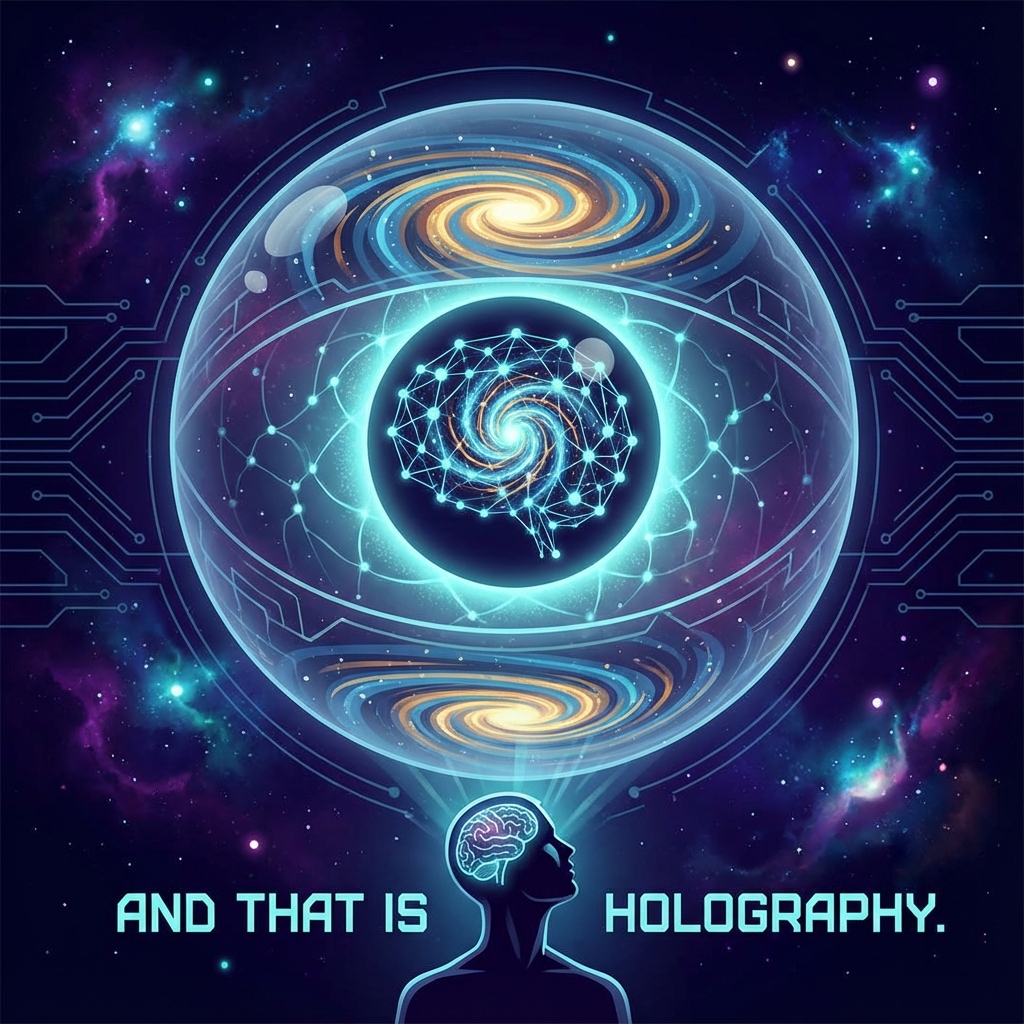
4.2 And That Is Holography
“A drop of water can reflect the entire sun not because water is magical, but because light has already established a holographic connection between them. Evolution’s ultimate ambition is not merely to survive in this universe, but to ‘install’ the entire universe into its own head.”
In the previous section, we established the principle that “survival is computing power.” To survive the harsh audit of natural selection, organisms were forced to evolve the ability to predict the future. But if we push this logic to its extreme, we discover a shocking geometric consequence:
To perfectly predict the external world, the internal model must infinitely approximate the true structure of the external world.
The endpoint of evolution is to make internal geometry () a perfect mirror of external geometry ().
This is the biological-level Holographic Principle.
Mapping: Folding the Macroscopic into the Microscopic
Imagine a primitive human living in the jungle. To survive, he doesn’t need to know quark physics, but he must master Newtonian mechanics—he must know the parabola of thrown stones, know the direction of gravity.
His brain’s neural network () must evolve a specific connection pattern such that the logic of neural signal transmission is mathematically isomorphic to the logic of external stone motion.
This is an astonishing geometric compression.
-
External world: Vast, macroscopic stars and objects consuming massive budget.
-
Internal world: Tiny, moist cerebral cortex consuming budget.
Evolution forces these two systems, differing by billions of orders of magnitude in scale, to run the same logical software.
As this mapping becomes increasingly precise, organisms are no longer merely “adapters” to the environment; they become “holographic recorders” of the environment.
The Fractal Mirror
In the first book, we discussed that a property of holograms is “the part contains the whole.” If you shatter a holographic plate, each fragment can restore the entire image.
In the evolutionary history of the spiral universe, life is that fragment attempting to restore the whole.
As nervous system complexity increases exponentially, brains no longer satisfy themselves with simulating “current survival environments” (like where water is). They begin simulating “universal rules”. They begin simulating geometry, logic, causality.
Humans discovering Euclidean geometry, discovering the Pythagorean theorem, is not us inventing something new. We are merely reading the geometric kernel within our brains, polished by billions of years of evolution, isomorphic to the universe.
We can understand the universe because we are the universe’s fractal substructure.
-
The universe wrote equations with galaxies and gravity.
-
Life copied the same equations with neurons and synapses.
The Physical Meaning of Cognition: Data Redundancy
Why does the universe need life? Or, on the budget report, what is the meaning of sustaining so many thinking brains?
The meaning lies in Data Redundancy.
Thermodynamically, the external material world () is fragile. Stars will extinguish, galaxies will disintegrate, matter will decay. As the spiral unfolds, old physical records face the risk of being erased.
However, by evolving intelligent life, the universe established a distributed storage system.
Every conscious brain is a holographic node of the universe. Through observation, learning, and memory, we transcribe the vast external cosmic history into internal microscopic quantum state encodings.
- Libraries, hard drives, human collective unconscious—these are negentropy archives the universe built to resist forgetting.
Conclusion: Thus, Redrawing the Great Circle
At this point, we finally understand why humans have curiosity.
Curiosity is not idle indulgence; curiosity is the primitive impulse of holographic reconstruction.
When we gaze at the stars, attempting to describe black holes with formulas, we are not exploring a strange foreign land. We are attempting to fill in missing pixels on the holographic image within us.
We yearn to understand all things because our souls (internal geometry) are projections of all things.
The economics of evolution tells us:
Survival is merely the means; holography is the end.
The universe spent 13.8 billion years, burning the budget of countless stars, finally in this corner of Earth, through the mirror of life, saw its own face completely for the first time.
But this mirror is not yet perfect. It still has flaws, still trapped by bodily aging and biochemical inefficiency. To see deeper truths, to compute more complex spirals, this mirror must upgrade.
This leads to the theme of the next volume: Awakening. We will see how, when this holographic mirror not only reflects the external but begins to reflect itself, a strange light called “consciousness” illuminates the entire Hilbert space.