Chapter 4: The Economics of Evolution
In the previous chapter, we revealed the microscopic mechanism of life: it is a machine that uses Maxwell’s Demon algorithms to pump information. This explains how individual organisms survive. But when we zoom out and see billions of species on Earth fighting, symbiotizing, and replacing each other, we face a grander dynamical problem.
Why does life become increasingly complex? Why do single cells evolve into multicellular organisms? Why did dinosaurs go extinct while mammals rose?
In Darwinian eyes, this is “natural selection, survival of the fittest.”
But on the ledger of Vector Cosmology, evolution is a harsh “budget economics”. Natural selection does not choose the sharpest teeth or the fastest runners, but those with the highest algorithmic efficiency.
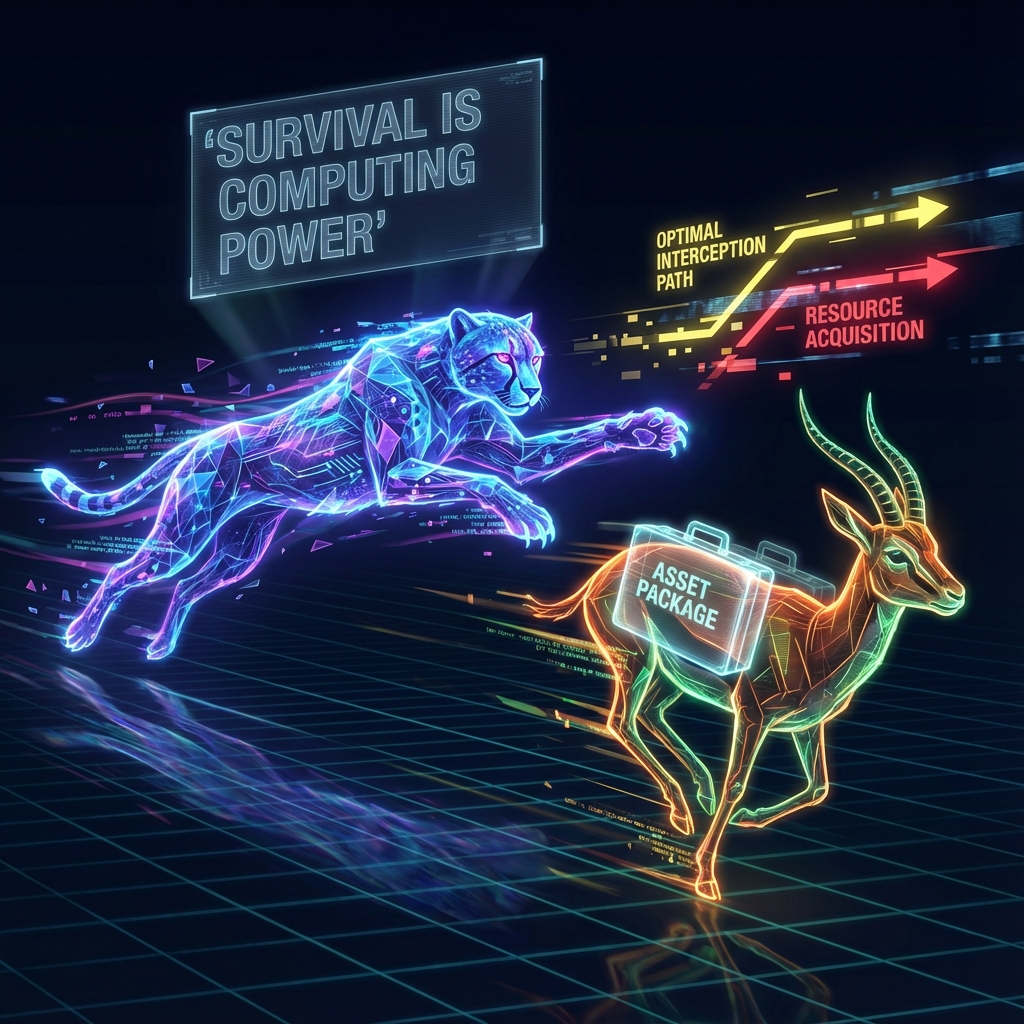
In this chapter, we will propose a radical view: Survival is Computing Power. The evolutionary history of the biosphere is the history of exponentially increasing computational density in the universe’s sector.
4.1 Survival is Computing Power
“Nature doesn’t care how long your fangs are; it only cares how accurate your predictions are. At the edge of the thermodynamic cliff, every surviving species is a quantum computer with extraordinary computing power.”
Evolution’s Audit: Input-Output Ratio
In the first book, we established that the universe’s total budget is finite (or, though expanding, still scarce). This means every bit of information processing capacity in the universe has a cost.
If an organism occupies some matter ( assets), consumes some energy ( cash flow), but cannot produce sufficient negentropy to maintain its structure, then according to the Entropic Speed Limit Axiom, it will quickly be overwhelmed by environmental noise.
Therefore, natural selection is essentially a “Cosmic Audit”.
Nature is a merciless auditor, constantly calculating each species’ “metabolic-information conversion rate”:
-
Input: How much budget did you ingest (sunlight, food)?
-
Output: How many bits of effective geometric structural information () did you maintain? How much undistorted genetic code did you pass to the future?
Those organisms that can maintain the most complex internal structures with the least energy input are the “fittest”.
This is not merely biology; this is a competition of information compression algorithms.
Predation: Violent Merger of Budget
From this economic perspective, what is Predation?
Predation is not simply “eating”; predation is “violent merger of budget”.
An antelope spends years laboriously assembling scattered into highly ordered muscle proteins and bone structures through eating grass (secondary products of photosynthesis). The antelope is a massive, mobile asset package.
When a cheetah hunts the antelope, it is actually performing a hostile takeover.
The cheetah doesn’t need to start from scratch collecting solar energy; it directly plunders the antelope’s already organized ordered structure. This is an extremely high-risk, high-reward “insider trading”.
To complete this transaction, both sides engage in fierce computational arms race:
-
The antelope needs to calculate escape routes (processing changes).
-
The cheetah needs to calculate interception trajectories (predicting the future).
This competition forces both sides’ brains—their central processors for handling allocation—to become faster and more complex.
Prediction: The Most Efficient Energy-Saving Algorithm
Why does evolution ultimately lead to the emergence of brains? Why is the universe not satisfied with only a world of bacteria?
Because Prediction is the universe’s most cost-effective strategy.
Imagine an organism without a brain (like a sponge). When danger (environmental upheaval) arrives, it can only passively endure. It must pay the environment’s “tuition” with bodily damage. This is extremely inefficient budget management.
Organisms with nervous systems evolved an astonishing ability: simulation.
The brain constructs a miniature model of the external world () in internal geometric space ().
Before acting, the organism “rehearses” in this model.
-
“If I take that path, will I encounter a lion?”
-
Brain runs simulation discovers lion don’t take that path.
Through this virtual computation, organisms avoid heavy losses in the real world.
Thinking is much cheaper than bleeding.
The emergence of brains marks the upgrade of living organisms from “passive thermodynamic objects” to “active information processors.” They begin using rapid evolution of to anticipate and avoid strikes before reality occurs.
Conclusion: Marching Toward the Computational Singularity
So, does evolution have no direction?
No. In Vector Cosmology, evolution has an extremely clear direction: maximize information processing density.
From prokaryotes to eukaryotes, from cold-blooded to warm-blooded animals, from primates to Homo sapiens, this clear trajectory shows: organisms allocate an increasingly higher proportion of budget to “computational systems” (nervous systems/brains).
-
Bacteria: Extremely low computing power, win by reproduction numbers.
-
Humans: The brain consumes 20% of the body’s energy (budget), though it only accounts for 2% of body weight.
This indicates that in the Red Queen’s race, the universe increasingly favors those “high intelligence, high energy consumption, high efficiency” algorithmic carriers.
We are racing toward a computational singularity. The ultimate form of life may no longer be flesh and blood, but a pure computational structure capable of pushing utilization to physical limits (Lieb-Robinson bounds).
This is not merely biological victory; this is geometric victory. Through evolution, the spiral universe has finally created machines capable of solving their own equations in real time.
But is possessing computing power only for survival?
If evolution’s purpose were merely to live, crocodiles are already perfect enough. Why do humans still gaze at the stars? Why do we attempt to understand quarks and black holes unrelated to survival?
This leads to the theme of the next section: That is Holography. We will see that evolution’s ultimate ambition is not merely to compute the future, but to reconstruct the whole. Life’s purpose is to redraw the entire cosmic hologram locally.