Chapter 3: Maxwell’s Backdoor
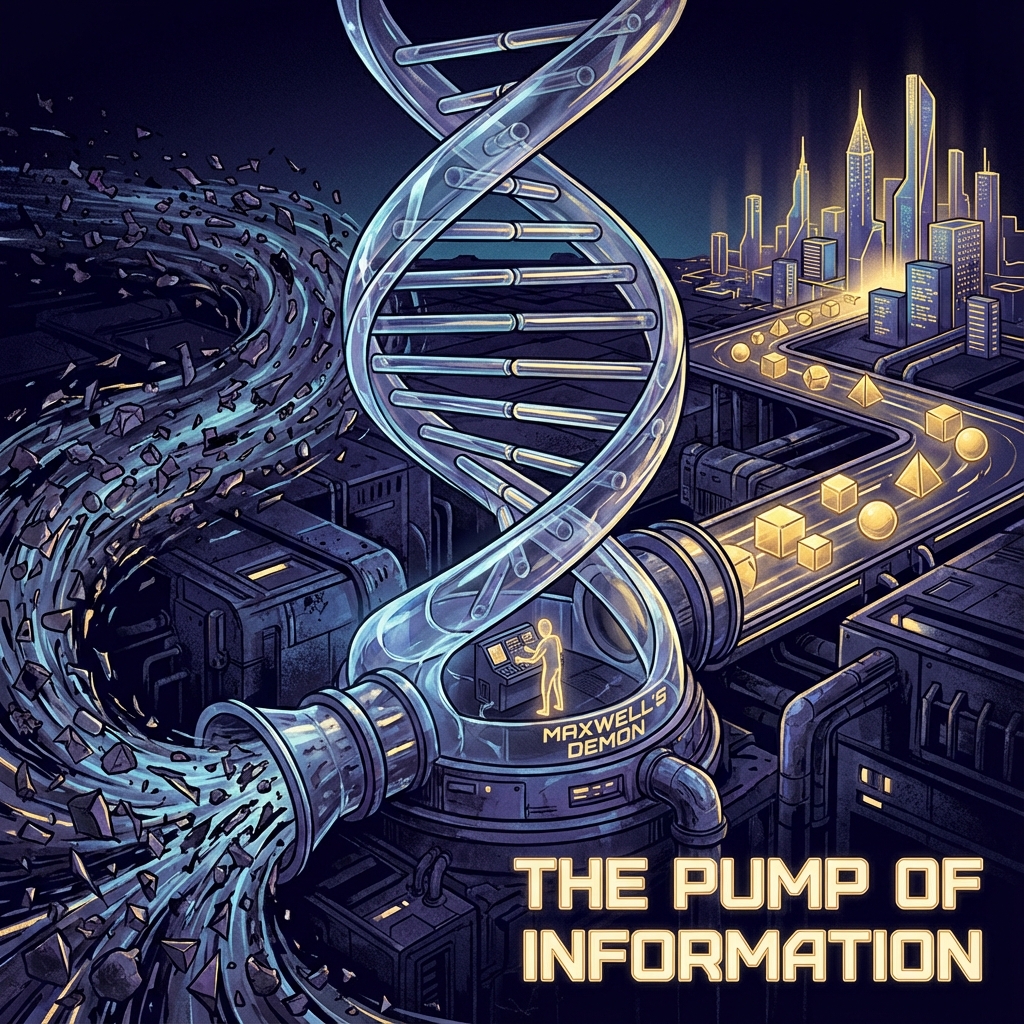
3.2 The Pump of Information
“If energy is the burning fuel, then information is that precise engine. Without blueprints, fuel will only create a meaningless explosion; only under information’s constraint can explosions transform into upward thrust.”
In the previous section, we defined life as a “negative entropy enclave,” an open system capable of drawing low-entropy budget from the environment and expelling high-entropy waste. This solves a thermodynamic problem: how life pays the bill.
But this does not solve another deeper engineering problem: how does life know where to spend this budget?
If I give you a pile of bricks (matter) and a large sum of money (energy), you won’t automatically get a cathedral. Without intervention, the money will be squandered, and the bricks will scatter. Similarly, if you merely inject massive budget into a system (for example, throwing a rock into the sun), it won’t evolve; it will only heat up and then vaporize.
Energy itself is blind. To construct complex structures, to resist the Red Queen’s dilution, living organisms need a mechanism capable of guiding budget flow.
This mechanism is Information. And the carrier of this information—DNA—in Vector Cosmology, is no longer merely a chemical molecule; it is an “Information Pump” solidified on the time axis.
3.2.1 Schrödinger’s Aperiodic Crystal
As early as 1944, physicist Erwin Schrödinger pointed out in What is Life? that genetic material must be an “Aperiodic Crystal”.
-
Crystal: Means it must be stable enough to maintain its geometric structure amid the clamor of thermal motion (high , low ).
-
Aperiodic: Means it cannot be monotonously repetitive like salt grains. It must contain complex coding variations to carry massive information.
From the perspective of FS geometry, DNA is a miracle created by the universe at the microscopic scale: it is a “physical archive of low-entropy states”.
Imagine cosmic evolution as a long, noisy broadcast (thermal noise). Over billions of years, the vast majority of matter succumbed to noise, becoming uniform background. However, occasionally some special geometric configurations (molecular arrangements) coincidentally passed environmental screening and survived.
DNA is the topological record of these “survivor configurations”.
It is an operating manual, recording which specific combination methods (protein folding, metabolic pathways) successfully captured budget from environmental flows and avoided collapse over the past billions of years.
DNA “freezes” this precious geometric information on a long carbon chain, protecting it from the erosion of thermodynamics’ arrow. It is an Anchor on the time axis.
3.2.2 The Algorithmic Implementation of Maxwell’s Demon
With this manual, living organisms can activate that legendary machine: Maxwell’s Demon.
In the classic Maxwell’s Demon thought experiment, a tiny demon guards the door between two chambers. Using information about molecular velocities, it only allows fast molecules through, intercepts slow molecules, thus creating a temperature difference (negative entropy) without doing work.
In biology, this demon is real; its names are Enzyme and Ribosome.
How do they use DNA’s information to manipulate budget?
-
Read:
Ribosomes scan mRNA (transcript copies of DNA). This is a process of reading geometric encoding. They learn: “At this position, an amino acid must be placed, and it must be left-handed.”
-
Sort:
There are countless molecular collisions in the environment (chaotic vector projections). Without instructions, any molecule might collide.
But ribosomes act as filters. Using geometric molds provided by DNA, they reject all wrong molecules (wrong configurations), only allowing the correct amino acid to enter the reaction site.
-
Pump:
Once the correct molecule is in place, ATP releases energy (injecting budget), forcibly locking the amino acid onto the peptide chain.
This process is thermodynamically extremely improbable (entropy decrease). But because of information’s guidance, living organisms precisely direct budget that would otherwise dissipate as heat toward constructing chemical bonds—this specific internal evolutionary path.
This is the pumping action of information.
Information is like a valve. It uses minimal energy (reading bits) to control massive energy flows (metabolic reactions). It rectifies chaotic, directionless flow into ordered, directional growth flow.
3.2.3 The Geometry of Resisting Forgetting
This mechanism reveals the essential difference between life and non-life.
-
Non-living systems: Are passive. They let environmental noise () wash over their structures. Over time, their geometric information is gradually erased, returning to the circle of thermal equilibrium.
-
Living systems: Are active. They possess memory (DNA). Whenever the environment attempts to erase their structures (causing damage or mutation), they retrieve internal backup archives, activate repair programs, pulling deviant vectors back onto ordered tracks.
Every DNA replication, every protein synthesis within living organisms is performing an inverse geometric correction.
This is a life-and-death struggle against the universe’s instinct to forget. The universe tries to make you forget what you are (dilution, entropy increase), while DNA constantly reminds cells: “You are order! Maintain formation!”
3.2.4 Conclusion: Software Takes Over Hardware
At this point, we see a crucial turning point in cosmic evolution.
Before life’s birth, cosmic evolution was mainly driven by hardware laws (gravity, electromagnetic force, QCA rules). Matter was a passive passenger.
After life’s birth, a new driving force emerged in the universe—software algorithms (genetic information).
DNA proves: As long as there is sufficient information, tiny algorithms can harness massive physical torrents.
Life no longer merely passively adapts to physical laws; it begins exploiting loopholes in physical laws (open system thermodynamics) to accumulate capital for itself.
What will this accumulation ultimately lead to?
As information density increases, as algorithm complexity exceeds the limits of individual organisms, life will no longer be satisfied with merely maintaining its own survival. It will begin attempting to understand the universe itself.
This leads to the theme of the next chapter: The Economics of Evolution. We will see that evolution’s ultimate goal is not merely survival, but to construct a supercomputing node capable of simulating the entire cosmic hologram—the brain.