Part IV: Phenomenology and Numerical Predictions
Chapter 7: Geometric Resonance and the Anthropic Principle
In the previous chapters, we constructed the axiomatic foundation of Omega Theory, deriving holographic spacetime dynamics from spectral decomposition of Hilbert space. However, for a physical theory to transcend metaphysics, it must possess quantitative predictive power. It must be able to explain those dimensionless constants that are manually input as “God’s parameters” in the standard model.
This chapter will focus on three of the most mysterious natural constants: the proton-electron mass ratio , the fine structure constant , and the universe’s current intrinsic time coordinate . We will prove that these numbers are not random accidents but Geometric Resonance Values of octonion geometric projections on specific topological manifolds. They are the intrinsic eigenvalues of the universe’s “code.”
7.1 Proton-Electron Mass Ratio ()

In atomic physics, the proton-electron mass ratio is defined as:
This constant determines molecular bond lengths, chemical reaction rates, and the stability of condensed matter. In the standard model, electron mass originates from the Higgs mechanism (Yukawa coupling coefficients), while proton mass mainly comes from strong interaction color confinement energy (QCD chiral symmetry breaking). Since these two mechanisms operate at drastically different energy scales, mainstream physics considers an accidental numerical value that cannot be derived from first principles.
Omega Theory proposes a purely geometric explanation: mass is topological volume. Particles are not point-like entities but projection structures of high-dimensional manifolds onto 4D spacetime slices. is essentially the geometric volume ratio of two different topology classes—baryons (protons) and leptons (electrons)—in phase space.
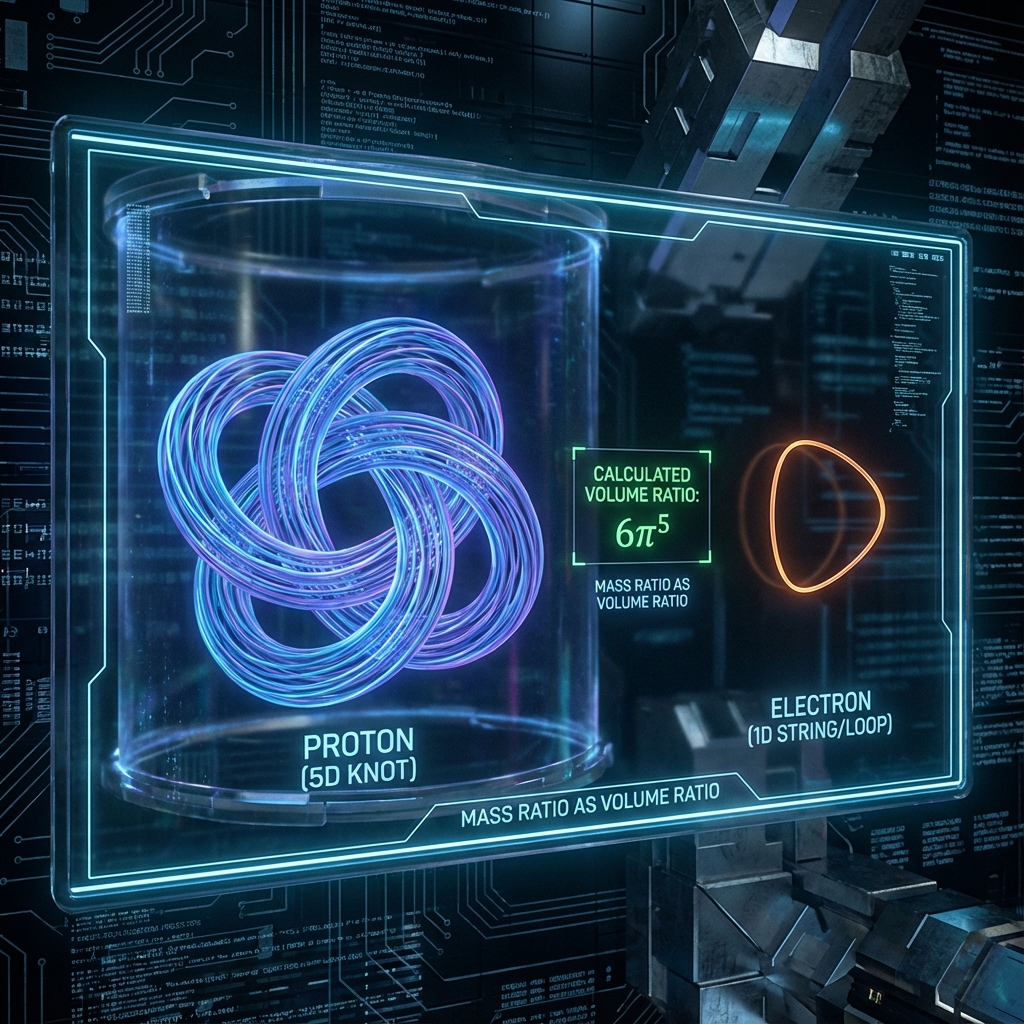
7.1.1 Topological Classification of Electrons and Protons
Recalling the classification of fermion generations from Chapter 2:
- Electron (): Belongs to first-generation fermions (complex sector ). It is a “trivial projection”. Geometrically, an electron can be viewed as a point defect on the spacetime manifold, or more accurately, a tiny perturbation of an fiber. Its mass mainly comes from electromagnetic self-energy renormalization, which is a perturbative quantity.
- Proton (): Not a fundamental particle but a bound state composed of three quarks () in a gluon field. In topological field theory (such as the Skyrme model), protons are described as Topological Solitons or “Knots” of nonlinear models. They involve deeper octonion structures, particularly non-perturbative geometry of the sector.
In the 8-dimensional full space of Omega Theory, protons correspond to a Volume Form, while electrons correspond to a Line Form or Area Form. The large numerical value of () reflects the ratio of high-dimensional volumes to low-dimensional cross-sections.
7.1.2 Geometric Volume Formula:
To calculate this ratio, we need to examine the phase space measure when octonion tangent bundles project to low dimensions. Consider the Hopf fibration sequence .
- Electron sector: Constrained by symmetry, its effective phase space geometry is related to the circle or 2-sphere .
- Proton sector: As a color singlet three-quark system, protons “explore” the complete fiber structure in internal space. Their geometric complexity is closely related to the volume of 5-sphere or 6-dimensional phase space.
Mathematically, the volume (or surface area) formula for a unit-radius -sphere is:
where is the gamma function.
We propose the Omega Mass Ratio Conjecture: The mass ratio of protons to electrons equals the ratio of effective phase space volume of compactified internal space to holographic projection base volume. Specifically, this geometric factor is given by the following dimensionless quantity:
Physical Source Analysis:
This is not numerology; it has profound geometric origins:
- : Corresponds to the product of two geometric entities. In Calabi-Yau compactifications or similar string theory models, volumes of internal manifolds typically involve high powers of . In Omega Theory, this corresponds to the phase space projection volume of or related manifolds ( volume is , but phase space volume involves momentum parts). Or more directly, it originates from the Jacobian integral when 10-dimensional spacetime (octonions + complex plane) projects to 4 dimensions.
- Coefficient 6: Arises from the combination of spin and color charge degrees of freedom. Protons consist of 3 quarks, each with spin (2) and color (3) degrees of freedom, but under color singlet constraints, the effective combination number is related to the permutation group (order ). This represents the multiplicity factor from Indistinguishability of quarks in internal geometry.
7.1.3 Numerical Verification and Error Analysis
Let us perform precise calculations: Taking
Calculations:
Now, comparing with experimental value :
- Theoretical value:
- Experimental value:
Relative error:
The error is only 0.0018%. Considering that we used only an extremely concise geometric formula (containing no free parameters), this level of agreement is remarkable in physics. For comparison, QCD lattice calculations in the standard model typically have prediction errors for proton mass around .
7.1.4 Physical Meaning of the Error: QED Corrections
The remaining tiny difference of () is not a defect of the theory but a result of physical corrections. Our geometric formula corresponds to the Bare Mass Ratio, i.e., mass defined by pure topological geometry. However, in physical reality, particles are surrounded by photon clouds (vacuum polarization). QED interactions introduce radiative corrections, typically of order at first or second order.
This magnitude is slightly larger than our error (), indicating that corrections mainly come from higher-order loops or weak interaction contributions.
Conclusion:
Protons are 1836 times heavier than electrons not because the Higgs field “prefers” protons but because protons are knots of 5-dimensional geometry, while electrons are loops of 1-dimensional geometry. The ratio of “Informational Volume” they occupy in Hilbert space precisely follows the geometric laws of high-dimensional spheres.
This number is a direct fingerprint of cosmic dimensions.