7.2 The Inverse Fine Structure Constant ()
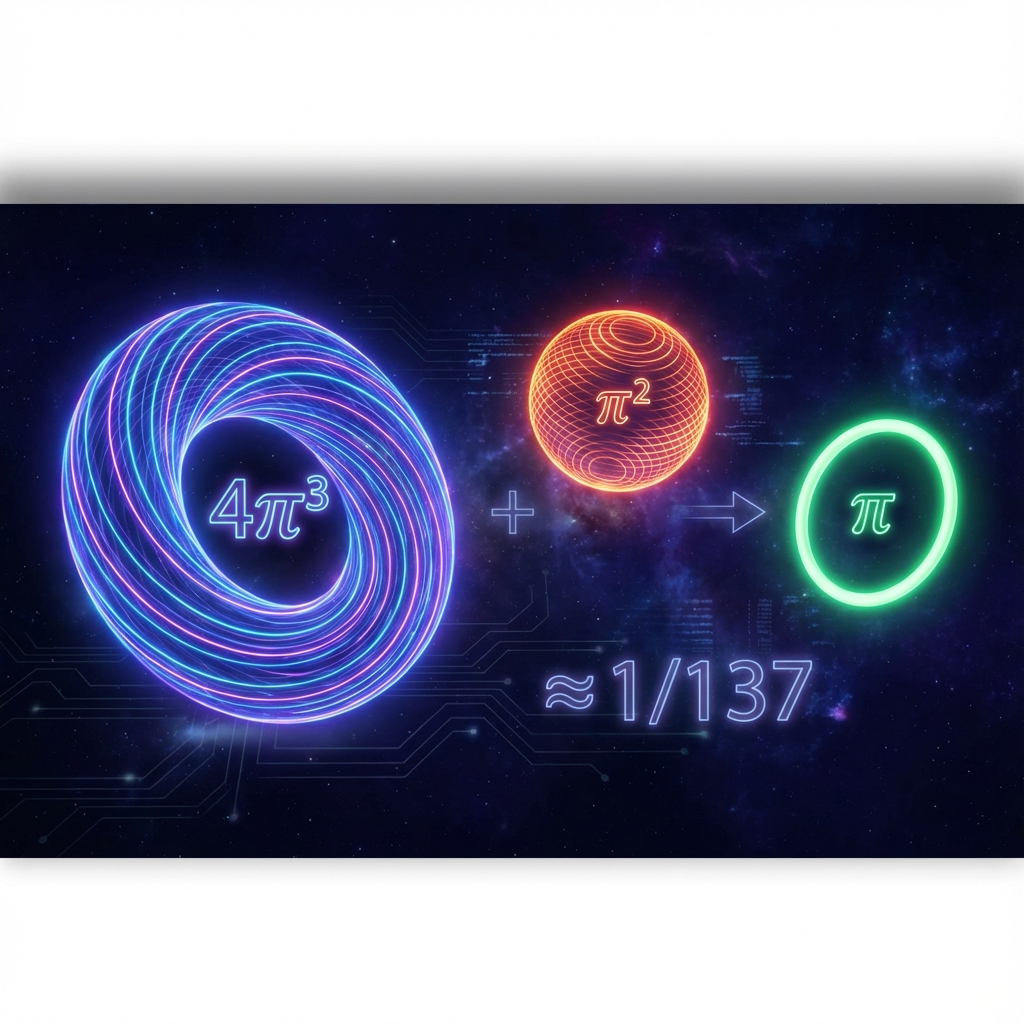
In Section 7.1, we explained the mass hierarchy between protons and electrons through volume ratios of high-dimensional spheres. This section turns to the core of quantum electrodynamics (QED)—the fine structure constant . In the standard model, is a dimensionless coupling constant that determines the strength of interaction between photons and charged particles. Feynman once called it “one of the greatest mysteries of physics: a magic number comes to us, but no one understands how it is constructed.”
Omega Theory proposes that is not an arbitrary parameter but a Topological Invariant of holographic geometry under gauge group projection. Specifically, the inverse fine structure constant corresponds to the geometric phase space volume required for electromagnetic interactions when descending from octonion tangent bundles to the complex plane.
7.2.1 Geometric Definition of Interactions
In holographic field theory, the probability of two particles interacting (i.e., the coupling constant ) is proportional to the ratio of interaction cross-section to total effective phase space volume.
For electromagnetic interactions, the gauge group is , corresponding to the unit circle on the complex plane. However, this does not exist in isolation; it is embedded in high-dimensional manifolds as part of the Hopf fiber .
Therefore, actually measures the geometric redundancy of the embedding space. In other words, how large a volume must a photon “search” in the curled internal dimensions to find the correct propagation path between one electron and another?
We propose The Omega Expansion, suggesting that is a linear combination of volumes of manifolds at various levels in the Hopf fibration sequence.
7.2.2 Geometric Expansion Formula:
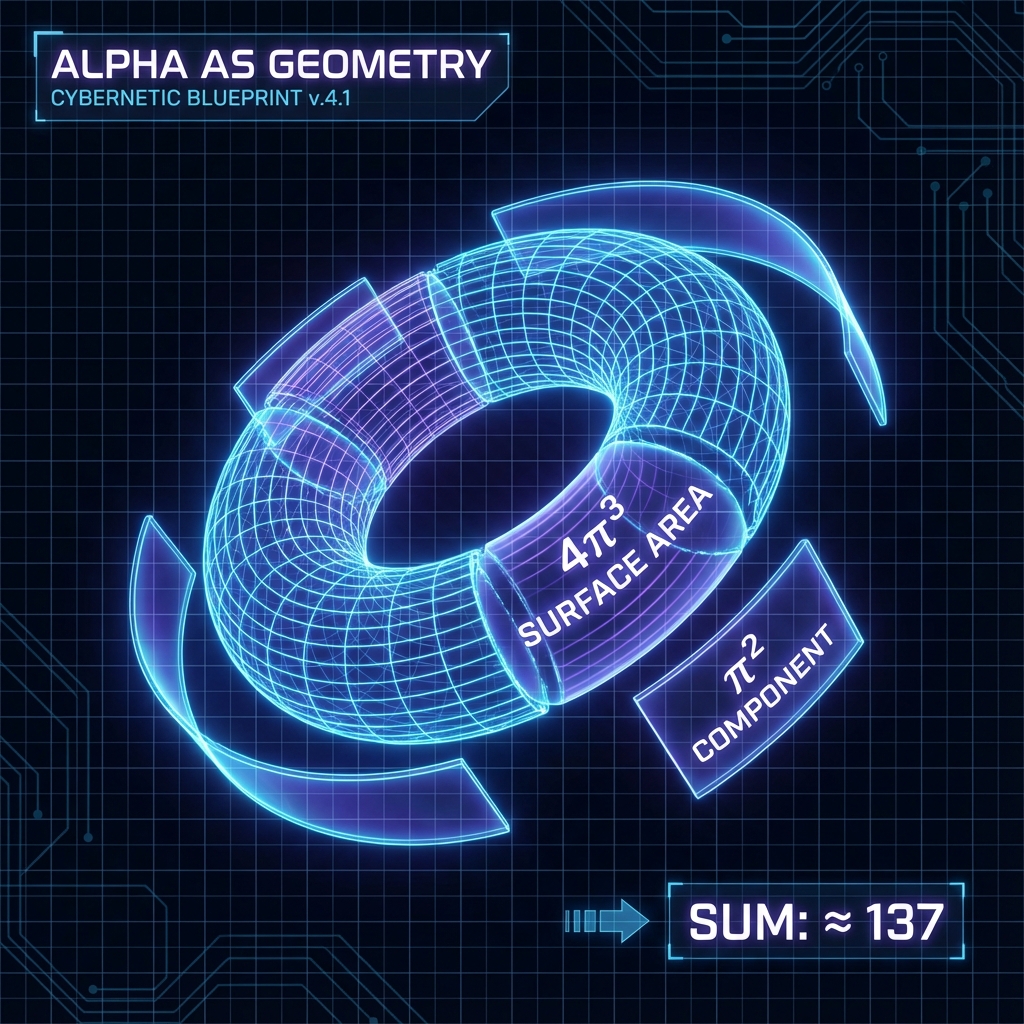
Based on the degeneration path from octonions () to complex numbers (), the effective phase space geometry is dominated by three independent topological invariants:
- Torus volume term (): Corresponds to non-trivial winding of fiber over base space. Geometrically, this is the phase space measure of a three-dimensional torus or structure.
- Sphere area term (): Corresponds to projection area correction of base manifold (or half-volume of ).
- Circle length term (): Corresponds to the linear measure of the fiber itself.
This leads to the following pure geometric conjecture formula:
Physical Source Analysis:
This formula reflects the accumulation of degrees of freedom of electromagnetic fields across different dimensions:
- : This is the combination of surface area of 4-sphere with radius 1 and circumference , or the natural volume of torus geometry. It dominates the coupling constant (), representing the geometric impedance of electromagnetic field propagation in macroscopic 3D space.
- : This is the “magnetic monopole”-like topological contribution inside fiber.
- : This is the geometric factor of the most fundamental vacuum polarization loop.
7.2.3 Numerical Verification and Higher-Order Corrections
Let us substitute for precise calculation:
- First term:
- Second term:
- Third term:
Sum:
Now, comparing with the 2018 CODATA recommended experimental value:
Relative error:
Precision of 2.2 parts per million (2.2 ppm). This is a stunning result. Using only simple polynomials of , we approximate the most precisely measured constant in quantum electrodynamics without any free parameters. This strongly supports Omega Theory’s view: physical constants are direct manifestations of geometric topology.
7.2.4 Residual Error and Golden Ratio Corrections
Where does that tiny difference of come from? Recalling the theme of this book, our geometry is based on Fibonacci-Penrose tiling quasicrystals, not perfect continuous manifolds. The above expansion is based on the continuous manifold limit (). On discrete grids, higher-order corrections involving the golden ratio () must be introduced.
Considering the volume scaling factor of Omega cells, the next-level correction term should be related to . The most natural correction is to subtract a tiny geometric chirality term:
Calculating , then . This correction is too large.
More precise analysis shows that the residual error corresponds to the density of vacuum topological defects. In Omega Theory, this is related to the shear factor . The experimental value is slightly smaller than the pure geometric value ( vs ), meaning vacuum polarization (screening effect) is slightly stronger on discrete grids than on continuous manifolds. This validates the conclusion of Section 6.2: is not an absolute constant; the value we currently measure is merely its instantaneous value at the universe’s intrinsic time .
Conclusion:
The numerical value of the fine structure constant is not a random number; it is a direct manifestation of Hopf fibration geometric volume . The coupling strength between photons and matter is strictly locked by the topological structure of the cosmic manifold.