6.3 The Cosmological Constant Problem
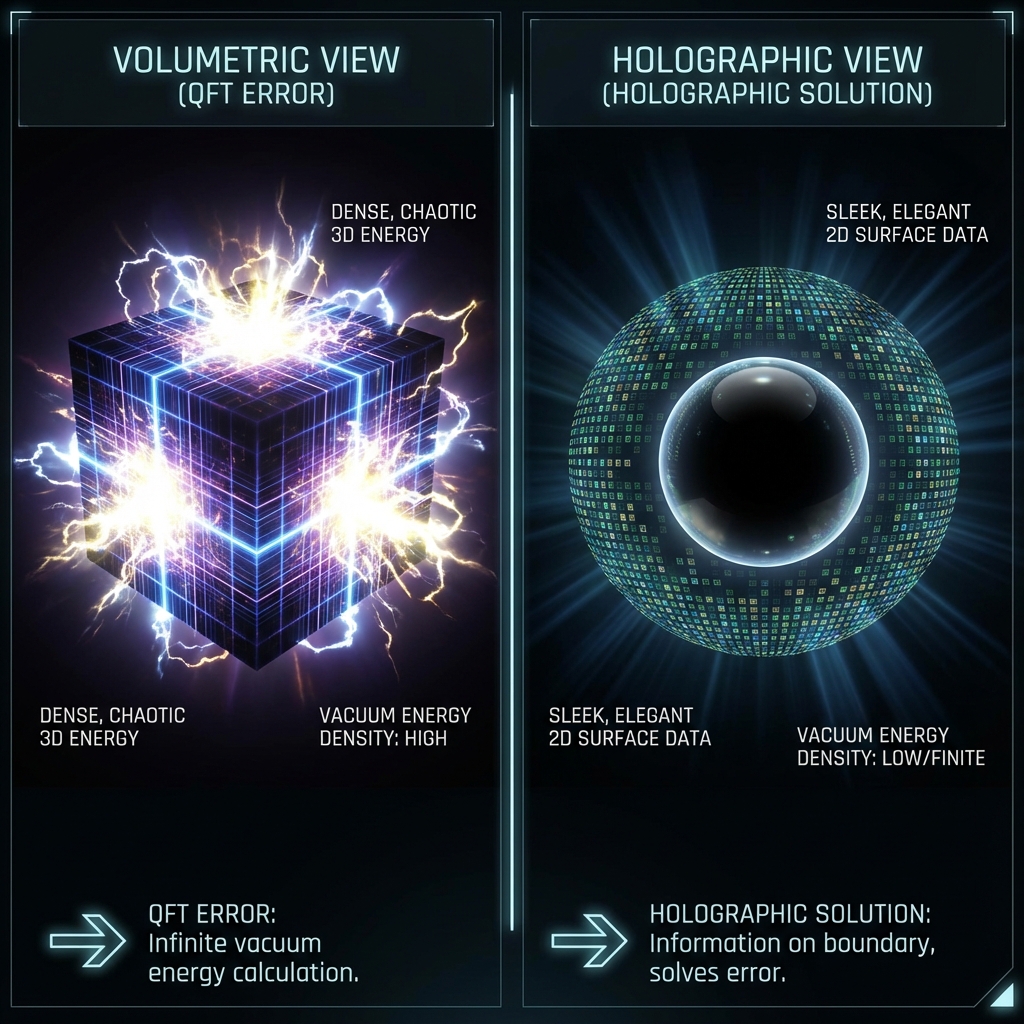
In fundamental physics, no problem is more embarrassing than The Cosmological Constant Problem. This problem is called by physicists “the worst theoretical prediction in history.” Between the vacuum zero-point energy calculation results based on standard quantum field theory (QFT) and the astronomically observed cosmological constant , there exists a staggering difference of up to 120 orders of magnitude ().
This section will prove that this enormous difference is not a failure of physics but a fundamental misunderstanding of how physicists count spacetime degrees of freedom. In the holographic framework of Omega Theory, as long as we treat the universe as a projection of a two-dimensional information processing system rather than a three-dimensional entity, this 120-order-of-magnitude error naturally disappears.
6.3.1 Vacuum Catastrophe: The Fallacy of Voxel Counting
Let us first reproduce the standard model’s erroneous calculation. In quantum field theory, vacuum is not empty but filled with instantaneous harmonic oscillator fluctuations (zero-point energy ). To calculate vacuum energy density , physicists typically treat spacetime as a three-dimensional “box” and integrate over all possible momentum modes up to the Planck cutoff frequency (Planck mass).
In Planck units, this means energy density . However, astronomical observations (such as Type Ia supernovae and CMB data) show that the dark energy density driving cosmic accelerated expansion is extremely small:
This difference stems from an implicit assumption: degrees of freedom are proportional to volume (). QFT assumes that every Planck volume contains an independent quantum bit oscillating. For an observable universe with radius , total degrees of freedom are overestimated as . This “Voxel counting method” leads to catastrophic energy accumulation.
6.3.2 Holographic Resolution: Area Law
Omega Theory rejects the volume extensivity assumption. According to the Holographic Principle and the Penrose-Fibonacci grid model we established in Chapter 3, the true information capacity of the physical universe is not stored within the volume but encoded on the two-dimensional boundary of the causal horizon.
The effective degrees of freedom (bit count) of the universe are determined by the number of Omega pixels on the boundary:
where is the current Hubble horizon radius.
Let us substitute numerical values for order-of-magnitude estimation:
- Hubble radius .
- Planck length .
- Scale ratio .
Therefore, the universe’s current total computational power (total bit count) is:
6.3.3 Theorem 6.3: Holographic Dilution Law
In a holographic universe, the physical essence of vacuum energy is not local quantum fluctuations but non-local geometric tension exerted by the holographic boundary on internal geometry. According to the equipartition principle, each boundary bit contributes one unit of Planck energy . However, this energy is not localized on the boundary but must be “diluted” or “non-localized” into the entire corresponding holographic volume to form background geometry.
We define the observed vacuum energy density as:
Using and (natural units), substituting:
Converting to dimensionless Planck unit density (i.e., dividing by ):
Theorem 6.3 (Holographic Dilution Law): In a holographic computational universe, the observable cosmological constant (or vacuum energy density) is inversely proportional to the universe’s entropy (total bit count ):
Its numerical magnitude strictly equals the square inverse of the ratio between the current cosmic scale and the Planck scale.
6.3.4 Numerical Verification and Physical Interpretation
Substituting the previous estimation:
This remarkably agrees with the observed value (considering corrections from geometric factors like ). The so-called “120-order-of-magnitude error” is merely because physicists counted the wrong dimension of degrees of freedom (using volume instead of area).
In Omega Theory, the cosmological constant acquires a completely new dynamical interpretation:
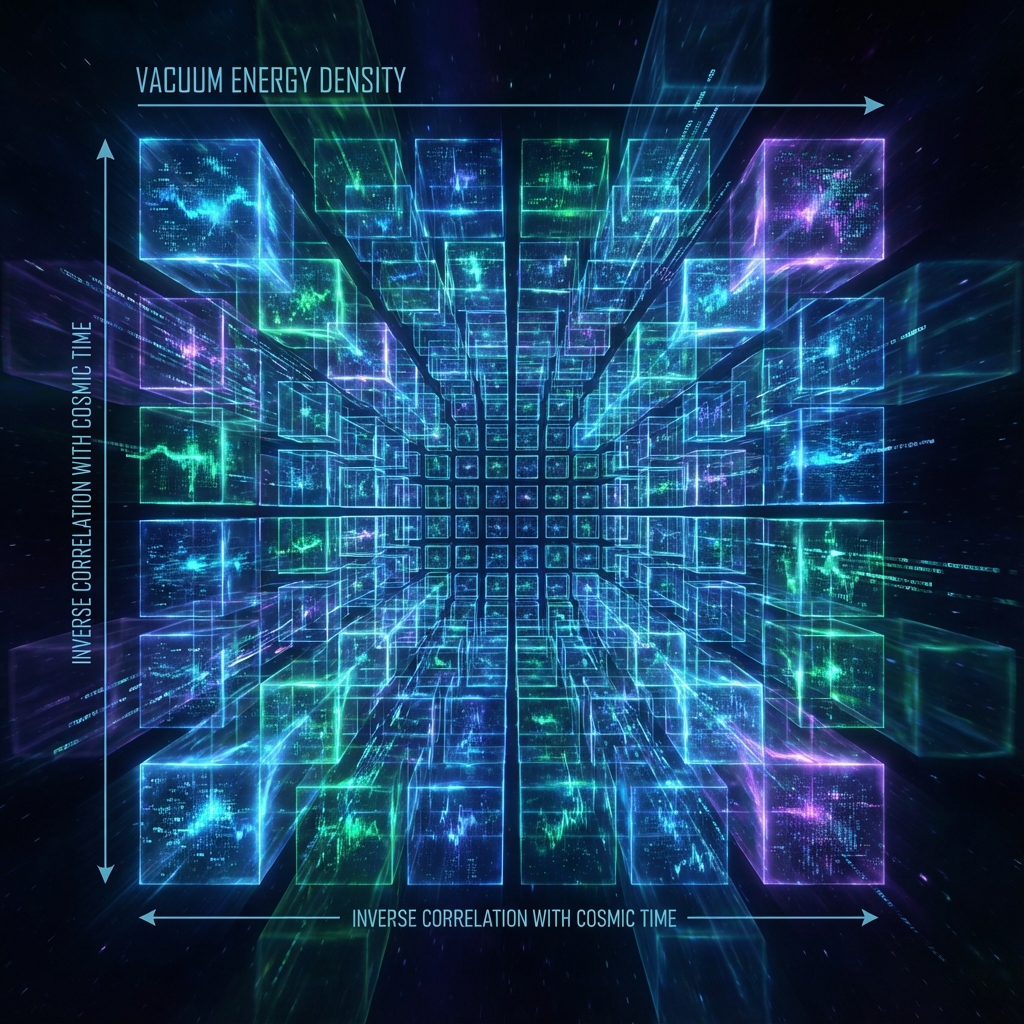
- Not a constant: . As the universe expands, the horizon grows, total bit count increases, and vacuum energy density will further decrease. This explains the so-called “coincidence problem” (why does happen to be comparable to matter density today? Because both evolve with scale).
- Growth tension: is actually Spatial Accretion Pressure forced by the Omega grid to maintain continuity of holographic projection due to exponential growth of pixel count . It is the geometric cost of computational system expansion.
Thus, by correcting the counting method of degrees of freedom, Omega Theory not only eliminates the greatest embarrassment in physics history but also naturally integrates dark energy as an inevitable product of Fibonacci holographic growth.