Chapter 8.2: Clock Synchronization
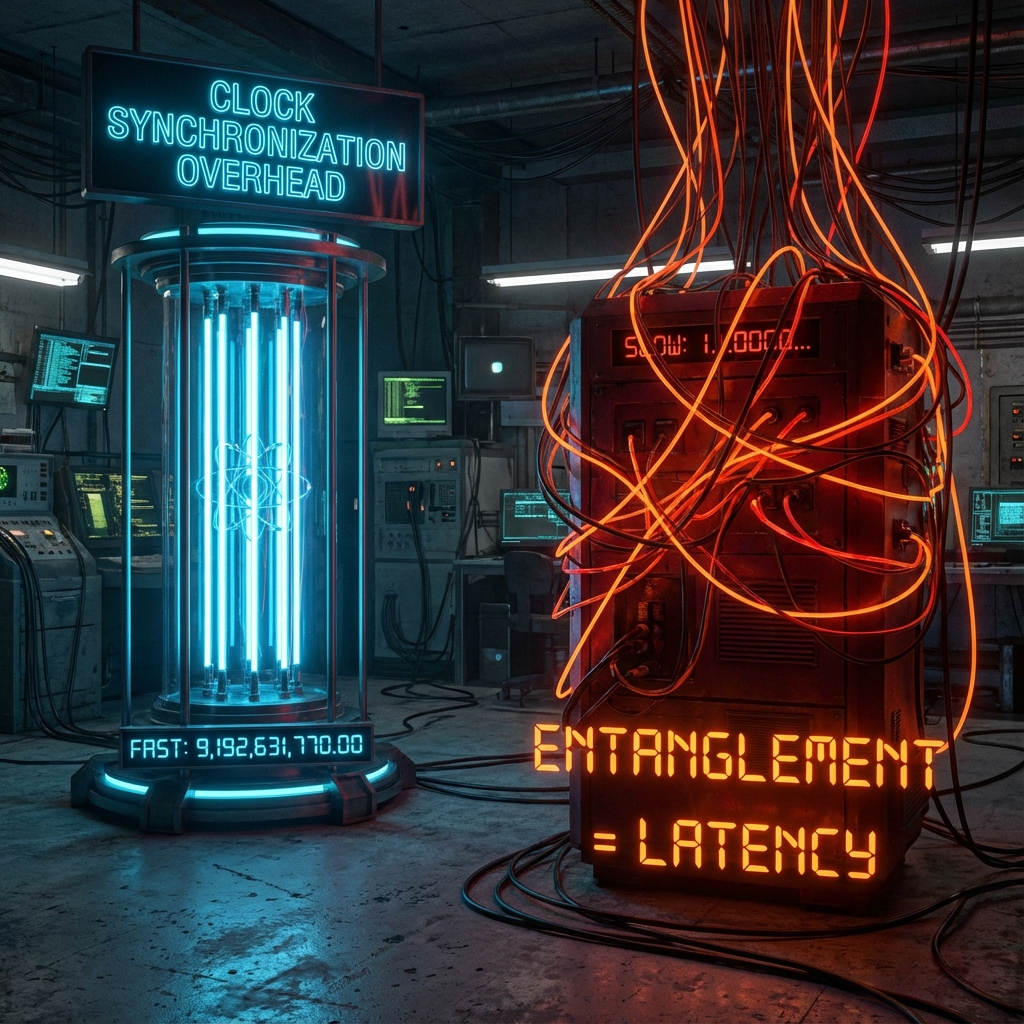
—— Entanglement-Induced Local Clock Slowing Effect
“Connection has a cost. When you try to synchronize with the world, your own time slows down.”
1. The Overlooked Overhead: Environmental Entanglement
In Volume I of this book, we introduced the Generalized Parseval Identity as the fundamental law of universe resource allocation:
In previous chapters, to reconstruct special relativity (Chapter 3.1), we usually assumed systems were isolated, i.e., ignored interactions with the environment (). Under this simplification, we saw how external motion () causes time dilation by appropriating resources.
However, in the real quantum mechanical world, no system is absolutely isolated. Especially when we consider precision measurements or quantum computation, systems are often in highly entangled states. This chapter explores a phenomenon that naturally emerges in our theoretical framework but has not been predicted by standard physics: merely the existence of entanglement causes time to elapse more slowly.
2. Hypothesis: Quantum Time Dilation
Let us examine two stationary atomic clocks.
-
Clock A (Isolated State): In a pure state (Product State), unentangled with environment and other particles.
At this point , .
According to the budget equation, its internal evolution rate reaches maximum: .
This is also the baseline rate of “proper time” we define.
-
Clock B (Entangled State): In a highly entangled state (e.g., entangled with a cloud of photons, or in a spin squeezed state).
At this point , but .
Since occupies part of FS bandwidth, the system must deduct corresponding share from .
Core Prediction:
Clock B will run slower than Clock A.
This slowing is not due to speed (it’s not moving), nor gravity (they’re at the same height), but solely because of Information Connection.
Physical Mechanism:
Maintaining entanglement consumes computational power. In FS geometry, entangled states mean the system state vector has nonzero projection components in the sector (environment direction). To maintain this non-local correlation (Non-local Correlation), the system must continuously perform “synchronization operations.” This background synchronization process occupies CPU cycles originally used to drive the internal clock (phase rotation).
3. Experimental Proposal: Differential Optical Clock Measurement
This effect is extremely weak, but not unmeasurable. Modern optical lattice clocks have reached precision of magnitude, making detection of “quantum resource consumption” possible.
Experimental Setup:
-
Prepare two identical optical clock systems: Use strontium (Sr) or ytterbium (Yb) atomic ensembles.
-
Control Group: Prepare in non-entangled coherent spin state (Coherent Spin State).
-
Test Group: Prepare in spin squeezed state (Spin Squeezed State) or GHZ state. This state has extremely high quantum Fisher information (Quantum Fisher Information), meaning its or state sensitivity in Hilbert space is extremely high.
-
Frequency Comparison: Under the same external environment, compare transition frequencies of atoms in both groups through frequency comb.
Expected Results:
If this theory holds, the atomic transition frequency of the test group should be slightly lower than the control group’s frequency .
The frequency shift will be proportional to the square of entanglement generation rate:
Although this effect may be extremely tiny (possibly at or lower magnitude), it provides a decisive experiment: Does information directly have physical weight? If entanglement can truly slow down time, then “It from Bit” is no longer empty words.
The Architect’s Note
On: Background Sync and System Lag
Imagine your smartphone.
When you turn off all network connections (airplane mode), the phone runs very smoothly, and battery life is durable. This is like Clock A.
When you turn on Wi-Fi and Bluetooth, and start backing up massive photos to the cloud (establishing high-intensity entanglement connections), you’ll find the phone becomes “laggy.” Interface response slows, and clock widgets may even skip a second. This is like Clock B.
-
is Background Sync Process:
To maintain “action at a distance” between entangled particles (actually consistency constraints of underlying database), the universe must continuously run data synchronization protocols in the background.
-
Clock Slowing is Side Effect of Resource Competition:
Because the CPU () is busy handling network synchronization (), it allocates fewer cycles to foreground applications (, i.e., particle spin precession).
Philosophical Significance of This Experiment:
If confirmed, it will mean “Solitude” is a prerequisite for efficiency.
An observer deeply entangled with their environment will experience slower subjective time elapse. Perhaps, this is why when we’re fully focused (deeply entangled with a task), we feel time “freezes”—at the system level, you’ve genuinely reduced your own refresh rate due to processing too much interactive information.