Chapter 8.1: Biological Optimization
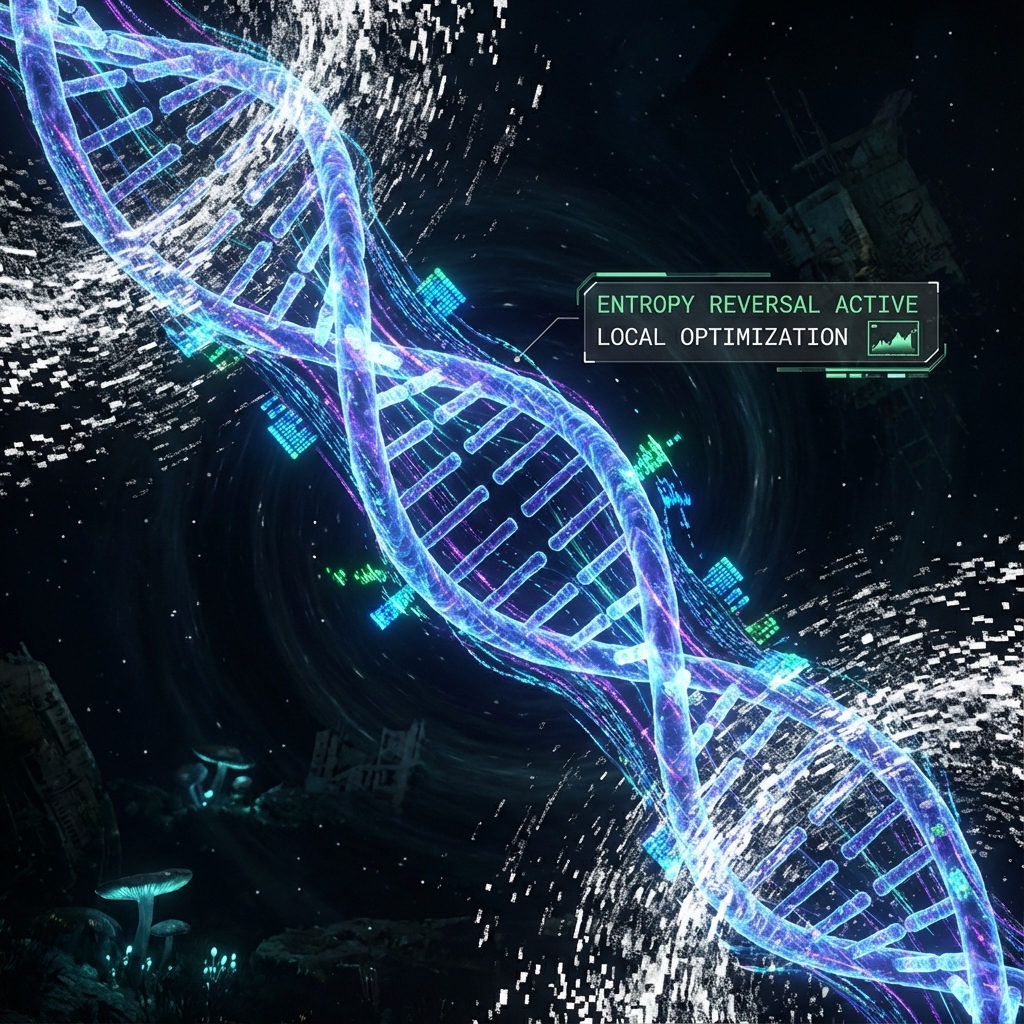
—— Local Algorithms for Reverse Entropy Flow
“Life is not a substance; it is an error-checking process the system runs to combat data decay.”
1. The Anomaly in the Sea of Entropy
In Volume V, we established the second law of thermodynamics as the universe operating system’s log appending mechanism: as system time progresses, global entanglement continuously diffuses, and local subsystem entropy shows a monotonically increasing trend. This seems to predict the universe’s ultimate fate as Heat Death—a dead state where all memory is filled with random garbage data.
However, in this grand flow toward disorder, there exists a puzzling Anomaly: living organisms.
Living systems demonstrate an astonishing ability: they can not only maintain their own low-entropy states (highly ordered structures), but even become increasingly ordered through evolution.
In the Fubini-Study geometric architecture, we don’t need to introduce mysterious vitalism. We reconstruct life as a Local Optimization Algorithm. Its core task is very clear: under the constraint of locked total system bandwidth , use resource allocation strategies to reverse local entropy increase flow.
2. Definition: Life as Error Correction Code
At the physical level, any object (stone, water, air) undergoes FS evolution. But most objects are passive; they drift with the flow, allowing environmental entanglement to erode their internal states, causing loss of internal coherence (decoherence).
Living organisms are different. A living organism is an Active open quantum system.
Definition 8.1.1 (Geometric Definition of Biological Homeostasis)
A biological system is defined as a subregion that can maintain its internal entropy change rate at non-positive values (or near zero) over long time scales :
To achieve this, according to the Generalized Parseval Identity and entropy speed limit, the system must actively consume computational power to perform Quantum Error Correction or its macroscopic counterpart (metabolism).
Life is not a property of matter, but a property of the computational process of “State Maintenance”. What Schrödinger called “Negentropy” is, in our architecture, bandwidth used to clear garbage data.
3. Mechanism: The Cost of Maxwell’s Demon
How does life go against the flow? It must pay a price. This price is directly given by our Entropic Speed Limit Theorem (Theorem 5.1).
We know . This not only limits the speed of entropy increase, but also limits the speed of entropy decrease.
To reduce internal entropy (i.e., exclude chaos, rebuild order), living organisms must perform the following operations:
-
Information Acquisition (Measurement):
Organisms must sense environment and their own states. This requires consuming (internal computation) to process sensor data.
-
Information Erasure (Erasure/Action):
According to Landauer’s principle, erasing internal error information (excreting entropy) requires emitting heat to the environment. This requires calling or channels to “write out” discarded data to the external.
Inequality 8.1 (Bandwidth Threshold for Survival)
To survive (i.e., maintain ), the rate at which organisms acquire and process free energy (effective bandwidth consumption) must exceed the entropy increase rate caused by environmental noise:
where is the information processing rate used by organisms for error correction (limited by ), and is the decoherence rate caused by the environment.
If the environment is too harsh ( too large), or organisms process information too slowly ( insufficient), the inequality is broken, and organisms will Crash—their states rapidly thermalize, merging into background noise.
4. Evolution: Iterative Optimization of Algorithms
Under the FS-QCA architecture, Darwinian evolution can be rewritten as competition in algorithmic efficiency.
Since total bandwidth is finite, all living organisms play the same zero-sum game:
-
Primitive Life:
Low algorithmic efficiency. To maintain survival (resist entropy increase), they must invest the vast majority of budget into (internal repair/metabolism). They have almost no remaining bandwidth for (movement/expansion).
-
Advanced Life:
Through billions of years of “code refactoring” (DNA mutation and selection), they evolved extremely efficient compression algorithms (brains, genes). They can maintain their low-entropy states at extremely low computational cost (), thereby releasing large amounts of remaining bandwidth for (rapid movement, tool making, environmental modification).
Direction of Evolution:
Natural selection favors architectures that can minimize internal maintenance overhead ().
The more advanced the life, the more optimized the ratio of its “standby power consumption” (basal metabolic rate) relative to its “peak performance” (thinking or action capability). This allows them to exhibit maximum macroscopic causal influence under limited constraints.
The Architect’s Note
On: Daemon Process and Self-Healing
In operating systems, we have special processes that don’t execute specific business logic, but are responsible for system health. They monitor memory leaks, restart crashed services, defragment disks. These are called Daemons.
Living organisms are self-consistent daemon processes in the universe operating system.
-
Ordinary Matter (Inanimate):
Like temporarily generated cache files. Once created, they are left to the system’s garbage collection mechanism (second law of thermodynamics) to slowly corrode, eventually cleared.
-
Living Organisms (Animate):
Are Self-Healing Code. They contain a loop logic:
while(alive) { check_integrity(); repair_damage(); export_entropy(); }This loop must run very fast. If its cycle is slower than environmental destruction speed, the program crashes (death).
Why do we feel time is so important to life? Because our essence is a race against errors.
The universe’s bus bandwidth determines the physical limit of this race. We evolved brains, eyes, and hands, all to more efficiently plunder bandwidth (negentropy) from the environment, to maintain this fragile loop code from being forcibly terminated by the system.