Module VIII: The Observer & Consciousness
Chapter 8.3: Relative Horizons
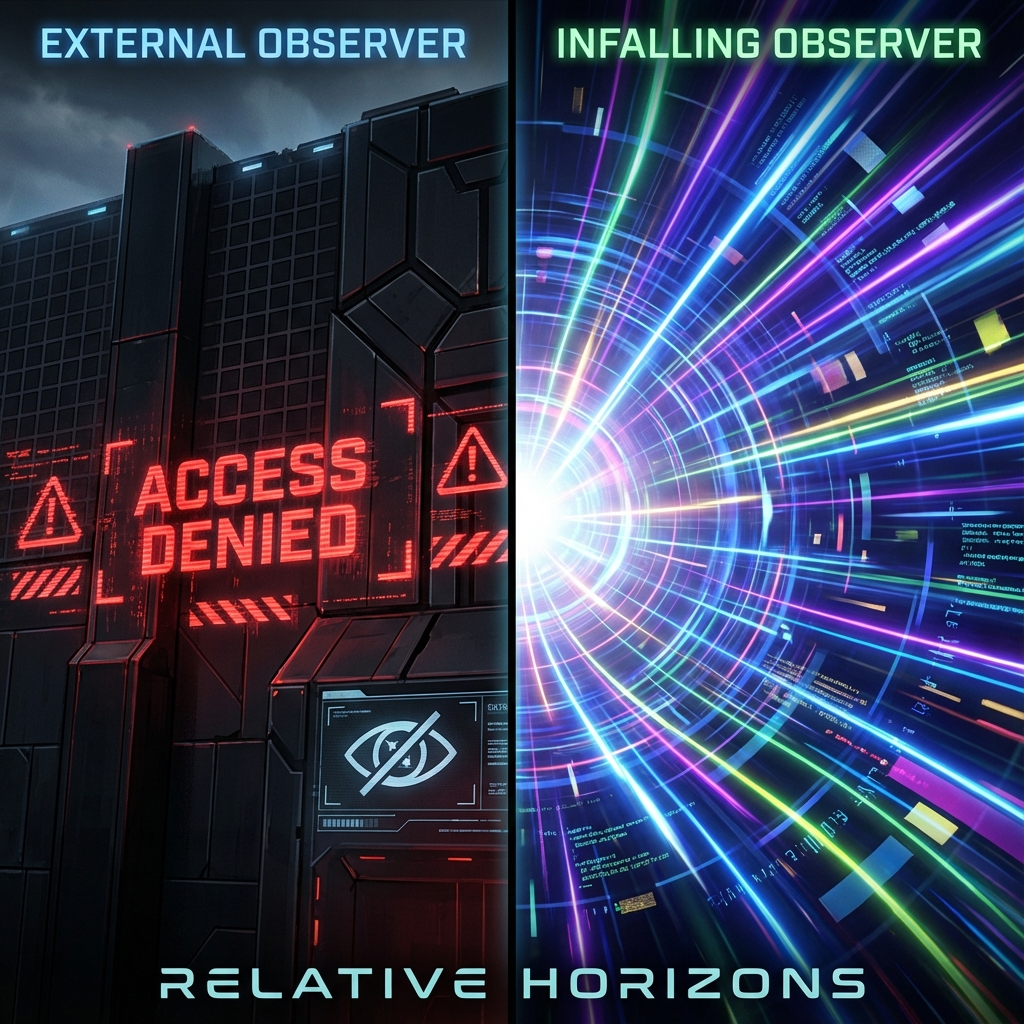
—— Observer Permissions and View Differences
“A firewall is an insurmountable boundary for ordinary users, but for Root administrators, it’s just a log checkpoint.”
1. Objective State vs. Relative View
There has long been a debate in physics about black hole horizons: Are they objective physical entities or observer-dependent illusions? In the FS-QCA architecture, we resolve this contradiction by distinguishing between system kernel state and user access views.
The Objective State:
At the microscopic level (underlying QCA grid), the region where a black hole exists is indeed in a special physical state. The traffic density there reaches physical limits, causing local and . This state of “network congestion” and “deadlock” is objective and does not depend on who is observing [cite: 428-429].
The Relative View:
However, “where the horizon is” and “what it looks like” depends on the observer’s (Client’s) interaction state with that congestion point.
2. Two Observer Experiences
Let us compare two typical observers:
A. The Distant Observer
-
Role: Remote client. Attempting to access a congested server over the network.
-
Phenomenon: Sent probe signals (photons) have no echo, or the echo experiences infinite delay (redshift).
-
Judgment: “Connection Timed Out.” The observer defines an “unreachable boundary” (horizon) at radius . For them, objects forever stop at the horizon surface, slowly turning red and dim. This is because data packets from the congestion point are dropped or infinitely queued.
B. The Infalling Observer
-
Role: The data stream itself (or Root administrator). Following the flow into the congestion zone.
-
Phenomenon: They don’t feel like they hit a wall. Local spacetime (network connection) is smooth for them. Because they themselves are moving at , they remain synchronized with the surrounding data flow.
-
Judgment: “System running normally until crash.” They cross the horizon and directly enter the server interior. They don’t see a “timeout”; they see the scene of a “core dump”—until they hit the singularity (server room on fire).
Conclusion:
The horizon is a relative access permission boundary. For external users without permission (insufficient speed), it’s a firewall; for internal users with permission (going with the flow), it’s just an ordinary coordinate point.
3. The Unruh Effect: Temperature Depends on Frame
The relativity of horizons is not only manifested in position, but also in temperature.
According to the Unruh Effect, an observer accelerating in vacuum sees thermal radiation, while an inertial observer sees cold vacuum.
In the FS-QCA architecture, we reconstruct temperature as the bit error rate or packet loss rate of data reading.
-
Inertial Read:
Reading along the data flow direction (free fall). Packet arrival timing is natural, packet loss rate is 0. The observer sees cold vacuum ().
-
Accelerated Read:
Forcing data interception against the data flow direction (hovering outside the horizon). This is equivalent to high-frequency sampling in a high-load network. Due to network congestion and timing jitter, you receive many out-of-order packets and noise. This noise is macroscopically perceived as thermal radiation ().
Theorem 8.3 (Temperature-Acceleration Relation)
The “heat” (noise) felt by an observer is proportional to the computational power (acceleration) they consume to maintain their current position:
The closer to the horizon, the greater the computational power (acceleration) needed to maintain rest, and the higher the “waste heat” (radiation noise) generated by the system.
The Architect’s Note
About: User Permissions and Firewall
Imagine you’re accessing a protected corporate intranet.
-
External View (The Firewall):
You don’t have VPN access. When you ping the internal server, requests are intercepted by the firewall. You see a black box. You can only infer that it’s still running based on the slight heat emitted by the firewall (Hawking radiation).
-
Internal View (The Intranet):
You’ve passed authentication (or you are the data itself). You pass through the firewall and find a busy data center inside. There’s no wall here, only busy buses and processors.
Black Hole Complementarity:
There’s a profound paradox in physics: Is information burned at the horizon (firewall), or did it pass safely through?
In our architecture, this is no longer a paradox, but view consistency.
-
For external users, information is indeed “stuck” on the horizon (firewall).
-
For internal users, information indeed went in.
-
As long as these two users can never exchange receipts (because internal users can’t come out), system consistency won’t be broken. This is a perspective-based permission isolation mechanism.