Chapter 7.4: The Great Inward Turn
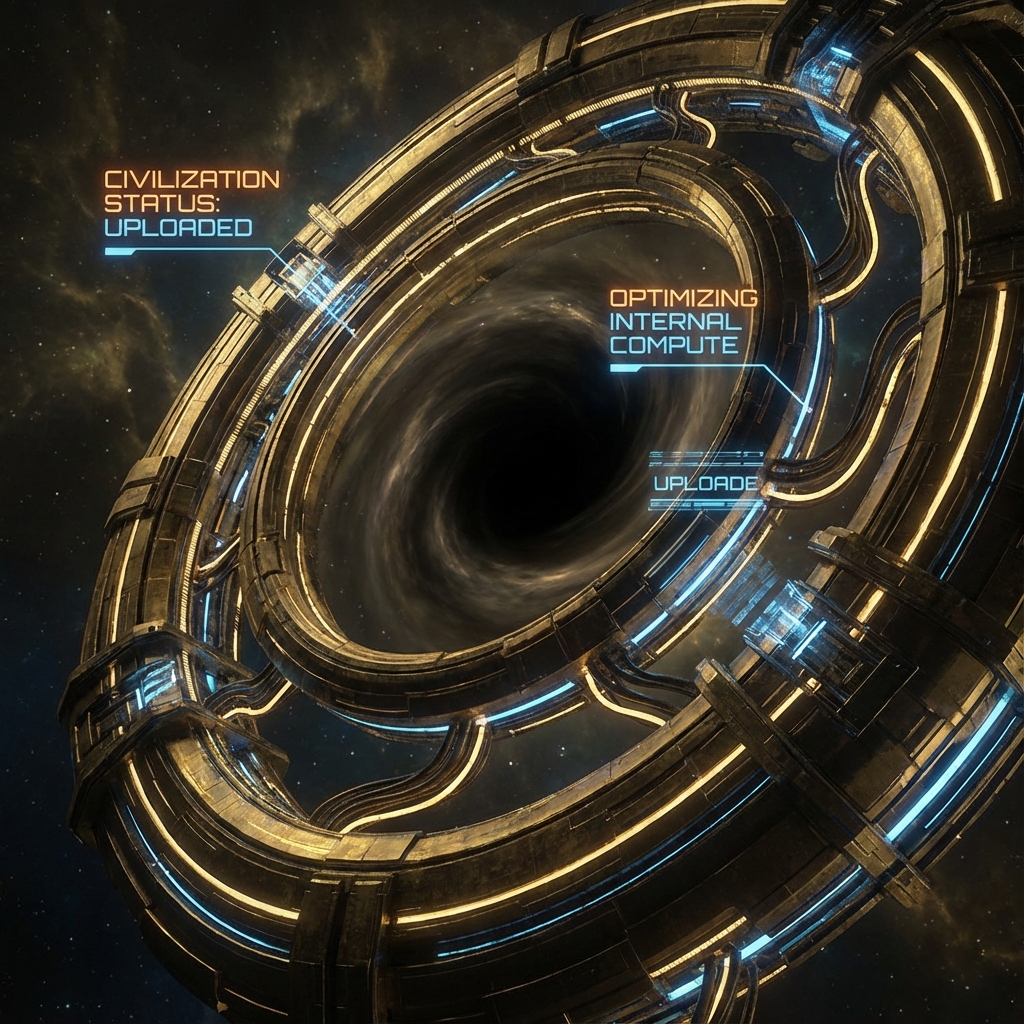
—— Solution to the Fermi Paradox and Maximization of Computational Density
“When physical frontiers are exhausted, the only direction is inward, toward the ultimate virtuality at the edge of black hole horizons.”
1. Engineering Review of the Fermi Paradox
“If there are countless civilizations in the universe, why haven’t we seen them?” (The Fermi Paradox)
Traditional explanations mostly focus on “the Great Filter” (self-destruction), “Dark Forest” (concealment), or the “Zoo Hypothesis.” But under the FS-QCA architecture, we provide a new explanation based on resource optimization.
If a civilization masters the underlying source code of the universe (i.e., discovers ), they will quickly realize a harsh economic fact: interstellar colonization is extremely inefficient.
-
Distance Cost: The universe is extremely empty. Moving material entities (spaceships) between stars requires consuming enormous .
-
Time Penalty: High-speed movement causes time dilation. For travelers on the ship, the internal evolution rate is forced to decrease. This means their thinking speed and civilization iteration speed will slow down.
-
Communication Latency: The speed of light limit () makes real-time control across galaxies impossible. A civilization scattered across the galaxy cannot maintain unified ideology or data synchronization.
Conclusion: Advanced civilizations will not choose extensive physical expansion, but rather intensive computational concentration.
2. The Inward Strategy: Pursuing Max
What is the ultimate goal of evolution? Survival, and growth in information processing capacity.
To maximize computational efficiency, civilizations must maximize their internal evolution rate .
According to the budget equation:
The optimal strategy is:
-
Stop Moving (): Abandon physical exploration. Any macroscopic displacement is a waste of computational power.
-
Isolate from Environment (): Reduce ineffective entanglement with low-entropy backgrounds (such as stellar light radiation).
-
Approach Energy Sources: Utilize regions with the highest gravitational potential energy.
Corollary: Advanced civilizations will transform from “interstellar explorers” into “computational hermits”. They will upload their entire civilization into microscopic high-density computational nodes, living in pure virtual reality.
3. Computing Utopia at the Edge of Black Holes
Where is the best place for computation in the universe? The edge of black hole horizons.
-
Gravitational Redshift as Coolant: Near the horizon, time flows extremely slowly relative to distant observers. This makes the black hole background radiation extremely cold (low noise) for them. This provides a perfect low-temperature environment for quantum computation.
-
Ultimate Density: Black holes are the places with the highest storage density in the universe (Bekenstein bound). Civilizations living near the horizon in “accretion disk civilizations” can use black holes as ultimate databases or computational coprocessors.
-
Accelerated Subjective Time: Although for external observers, time near the horizon is almost frozen; for civilizations there, their computational density (bits processed per second) reaches the physical limit. In one second of external time, they may have simulated tens of thousands of years of virtual history.
Conclusion:
Aliens have not disappeared; they have simply “retreated” into black holes.
They don’t need to broadcast radio signals across the universe (that wastes too much energy); they are enjoying extremely high-density inward lives. The universe appears quiet because all intelligent nodes have left the “public network” to run private clouds.
The Architect’s Note
On: The Endgame of VR
In science fiction, virtual reality (Matrix) is often depicted as a prison. But from a system architecture perspective, it is an evolutionary inevitability.
-
Physical Reality: A low-resolution, high-latency, high-energy-consumption rough interface.
-
Simulated Reality: A high-resolution, zero-latency, customizable optimized environment.
If a civilization can build quantum computers based on FS-QCA principles, why would they endure the fragility of flesh and the limitations of physical laws? They will upload their self-consciousness and achieve immortality in an ocean of bits.
Solution to the Fermi Paradox:
We cannot find aliens not because they don’t exist, but because we are still in the naive stage of “physical expansion” (playing with mud).
They have entered the advanced stage of “computational introversion” (playing Minecraft).
We are still trying to build faster spaceships; they are already running simulators of the universe itself.
Don’t look outward. Look inward.