Module VII: Computation & Complexity
Chapter 7.3: The Scrambling Protocol
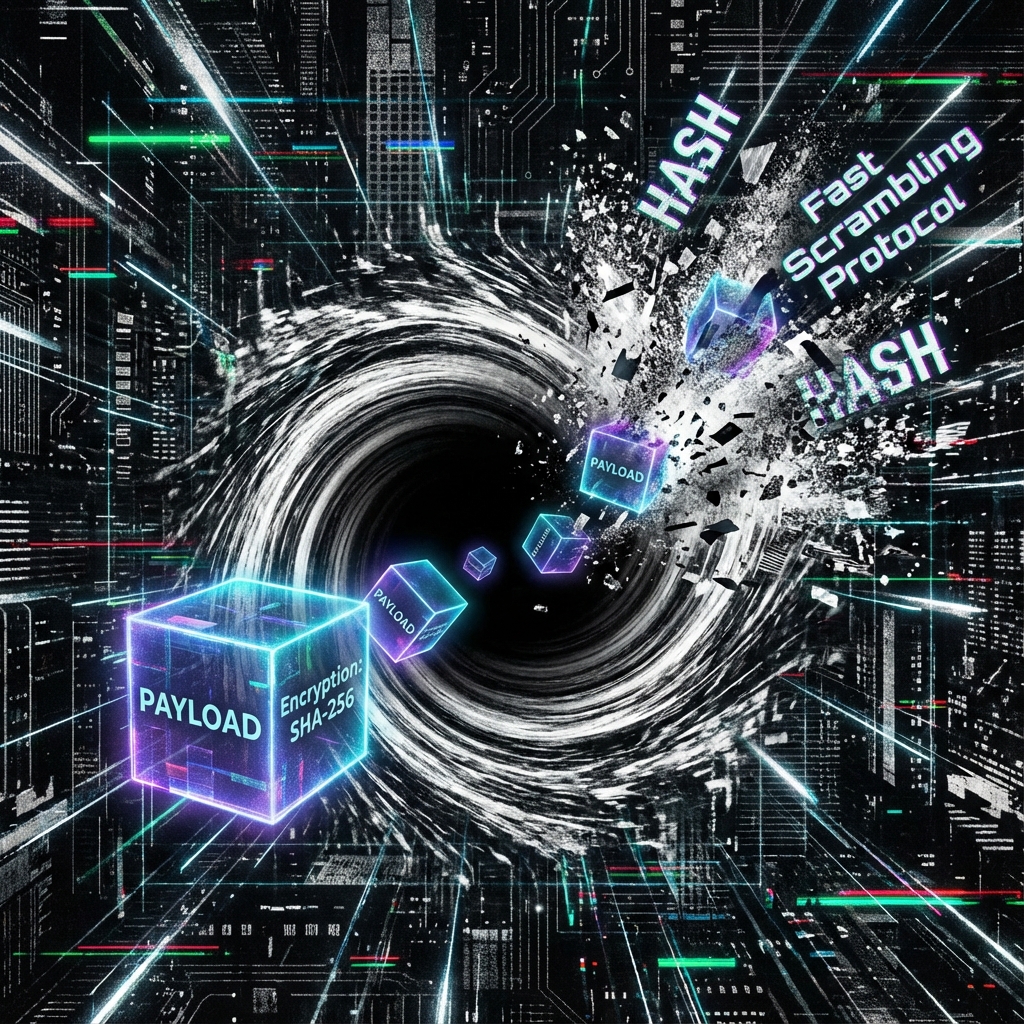
—— Black Hole Accretion as Computational Complexity Merging
“Black holes are the fastest hash functions in the universe. They devour structure, spit out randomness, and redirect pointers to the surface.”
1. Pointer Loss and Redirection
In the previous volume, we established the black hole horizon as a “holographic drive mount point.” Now, we need to delve into the addressing mechanism during the data writing process.
In flat spacetime, an object’s position is clear, and we can maintain a reference (pointer) to that object, such as three-dimensional coordinates . However, when an object crosses the horizon, the system undergoes pointer redirection:
-
Internal Pointer Loss (Null Pointer Exception):
For external observers, any causal chain pointing to (inside the horizon) is severed. No physical signal (return value) can come back from inside. The original 3D coordinate pointer becomes
NULL. Attempting to access this address results in a “connection timeout.” -
Surface Hash Map:
Although the internal pointer becomes invalid, the system doesn’t lose data. According to the Holographic Principle, data is “smeared” onto the horizon surface. The system replaces the original volume pointer with a surface index.
This means that black holes are not just storage devices, but massive hash tables. Data you throw in is re-encoded and hash-distributed across the horizon surface.
2. The Swallowing Process: Fast Scrambling
The “computational complexity merging” you mentioned is central to this process. In computational physics, this is called fast scrambling. Black holes are proven to be the fastest scramblers known in nature.
-
Ordered Input:
Matter thrown into a black hole (such as an encyclopedia) has highly ordered structure, i.e., low-complexity states. Bits have specific, local correlations.
-
Complexity Merging:
When matter falls into the “stretched horizon” region near the horizon, its quantum bits undergo violent all-to-all entanglement with the black hole’s massive existing quantum bits.
This is like an extremely violent
git mergeoperation, but performed at an extremely fast speed.In an extremely short time, newly entered information is completely scrambled and uniformly mixed into the black hole’s overall entanglement network.
-
Output State:
This mixing causes explosive growth in computational complexity. Originally simple quantum states evolve into extremely complex states, such that no polynomial-time algorithm can reverse them.
3. Spaghettification as Serialization
In general relativity, objects falling into black holes are stretched into spaghetti (Spaghettification). In the FS-QCA architecture, we reconstruct this phenomenon as the physical manifestation of data serialization.
-
Destructuring:
As an object approaches the horizon, the gravitational gradient (bandwidth gradient) increases dramatically. Different parts of the object have vastly different requirements, causing internal binding forces to fail to maintain structure.
The system is forced to break down complex 3D objects (such as stars, spaceships) into their most basic constituent units (elementary particles/bits). This is like breaking down a complex Java object into a binary stream (JSON/Protobuf).
-
Flattening:
Original three-dimensional structural information is stripped away and converted into one-dimensional or two-dimensional bit streams, so they can be “written” to the horizon, this two-dimensional holographic drive.
What we call “swallowing” is the system’s forced “dimensionality reduction compression” algorithm to save storage space.
The Architect’s Note
About: Write-Only Storage and Hash Collisions
“Why can we continuously throw data into black holes?”
As an architect, I would explain this “write-only” property as follows:
-
Dynamic Resizing:
Black holes are not fixed-size hard drives. Every time you throw in a bit of information (entropy ), according to the Bekenstein formula, the horizon area automatically increases by .
This is like elastic cloud storage. The more you write, the bigger it gets. It never reports
Disk Full; it just gets fatter (horizon radius increases). -
Cryptographic Hash:
The black hole swallowing process is essentially a SHA-256-level encryption operation on cosmic information.
-
Input: Your matter (ordered data).
-
Function: Fast scrambling.
-
Output: Tiny changes in the horizon’s microscopic state + eventual Hawking radiation (disordered hash values).
For the external world, this looks like a one-way function computation. Data goes in, becomes random thermal radiation (hash values), and you can almost never reverse-engineer the original data. This is why it looks like “garbage collection”—because it effectively transforms “meaningful information” into “meaningless hash values,” thereby releasing the cognitive burden on the external world.
-