Chapter 7.2: Quantum Walks
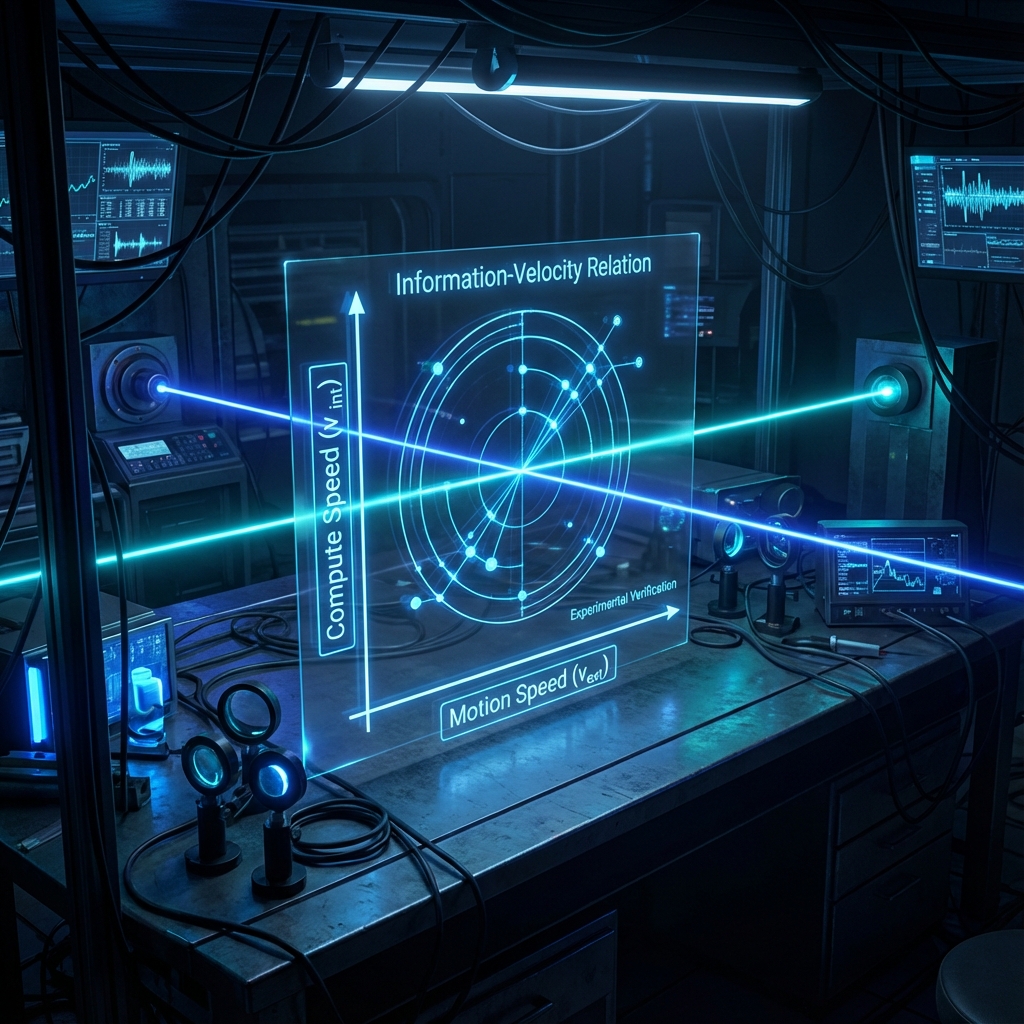
—— Prediction: Experimental Verification of the Information-Velocity Circle
“Simulating the universe’s underlying logic on silicon chips, verifying the projection of the Pythagorean theorem in information space.”
1. From Thought Experiments to Tabletop Experiments
In previous volumes, we constructed a grand theoretical edifice based on Fubini-Study geometry. All core corollaries—from time dilation to scattering delays—are built on the axiom of Generalized Parseval Identity ().
This sounds beautiful, but is it true? Can we directly observe this “computational resource allocation” phenomenon in the laboratory?
Verifying cosmological (speed of light) typically requires massive particle accelerators or astronomical observations. But fortunately, our micro-architecture theory indicates that physical laws are emergent results of QCA (Quantum Cellular Automata) dynamics. This means that if we can construct a programmable QCA system in the laboratory—namely, a Quantum Walk platform—we should be able to reproduce and verify this geometric constraint in a controlled microscopic environment.
This chapter proposes a specific experimental prediction: The Information-Velocity Circle.
2. The Setup: Quantum Walk with Internal Coin
Consider a one-dimensional discrete-time quantum walk system, the simplest model of QCA.
-
Hardware Architecture:
-
Position Space (External): A one-dimensional lattice, states described by .
-
Internal Space (Internal): A two-level “coin” space (Coin Space), states described by spin . This corresponds to internal degrees of freedom () in our theory.
-
-
Update Rule ():
Each update step consists of two operations:
-
Coin Toss (Coin Operator ): Rotate spin in internal space.
-
Conditional Shift (Shift Operator ): Move position according to coin state. If move right, if move left.
Total evolution operator is .
-
3. Prediction: The Information-Velocity Circle
Now, we prepare a narrow wave packet in momentum space and let it run on this lattice. We need to measure two geometric rates:
-
External Velocity (): Group velocity of the wave packet center. This is the physical speed at which the wave packet moves on the lattice.
-
Internal Velocity (): Precession speed of coin state (Bloch vector). This is the rate of internal qubit phase rotation.
Core Prediction:
In the long-wavelength limit (i.e., wave packet momentum much smaller than Brillouin zone boundary), these two velocities will strictly satisfy the Pythagorean relationship. If you plot on the horizontal axis and on the vertical axis in a two-dimensional plane, all data points will fall on a circle with radius :
where is determined by the quantum walk’s step size parameter (i.e., the system’s maximum signal speed).
Physical Meaning:
This experiment will intuitively demonstrate Resource Competition.
-
When you adjust coin parameters to make the wave packet run faster ( increases), you’ll find its internal spin precession speed must slow down.
-
When the wave packet stops moving (), internal precession speed reaches maximum (). This corresponds to the intrinsic frequency of stationary massive particles.
This “circle” is the direct projection of Fubini-Study metric in low-energy effective theory.
4. Signatures of Discreteness: Deformation in High-Energy Region
Even more exciting, when we push the wave packet’s momentum toward the Brillouin Zone Boundary—i.e., simulating “trans-Planck scale” high-energy physics—this circle will deform.
Due to underlying lattice discreteness, the perfect Pythagorean theorem is based on continuous tangent space assumptions. On lattices, dispersion relations introduce higher-order correction terms:
This Deviation from the Circle is conclusive evidence that spacetime has discrete microscopic structure.
If such specific deformations are observed in precise programmable quantum optics or superconducting qubit arrays, it will provide analog evidence for understanding the real universe’s “Planck granularity.”
The Architect’s Note
On: Benchmarking and Stress Test
As an architect, if I want to verify a graphics card’s (GPU) performance, I won’t just read the manual; I’ll run Benchmark.
The “Information-Velocity Circle” experiment is actually a benchmark test for the universe’s physics engine.
-
Low-Load Test (Low Momentum):
At low speeds, the system behaves very smoothly, consistent with relativistic continuity predictions (perfect circle). This shows our “Virtualization Layer” (Volume III) works correctly, successfully hiding underlying pixels from users.
-
Stress Test (High Momentum):
When we push momentum high, approaching the system’s Nyquist Frequency (lattice limit), we’re actually performing a stress test on the system.
At this point, the virtualization veil is torn, and underlying “pixel aliasing” begins to emerge. That imperfect circle is telling us: “Look, there’s no continuous spacetime here; there’s only a grid.”
For future physics hackers, quantum walk platforms are not just tools for verifying theory, but sandboxes for simulating new universes. You can modify ’s rules (changing physical laws) inside and see what kind of “light speed” and “gravity” emerge. This is the first step toward God Mode.